
Cameron Brink & the Emergence of the Hyper-Utility Rim Protector

As schemes in the WNBA continue to evolve, so does the needed statistical profile of players in the front court
The 2024 WNBA Draft is trending to be one of the best in the league's history, with players like Caitlin Clark, Angel Reese, Kamilla Cardoso, and Rickea Jackson all being selected in the top 10. A somewhat overlooked player in that class has been the player selected with the second overall pick: Cameron Brink. Brink was heralded as a generational defensive talent who led the nation in rebounding and block rate as a senior at Stanford. But injuries have severely limited the start of her WNBA career, appearing in only 34 games in her first two seasons.
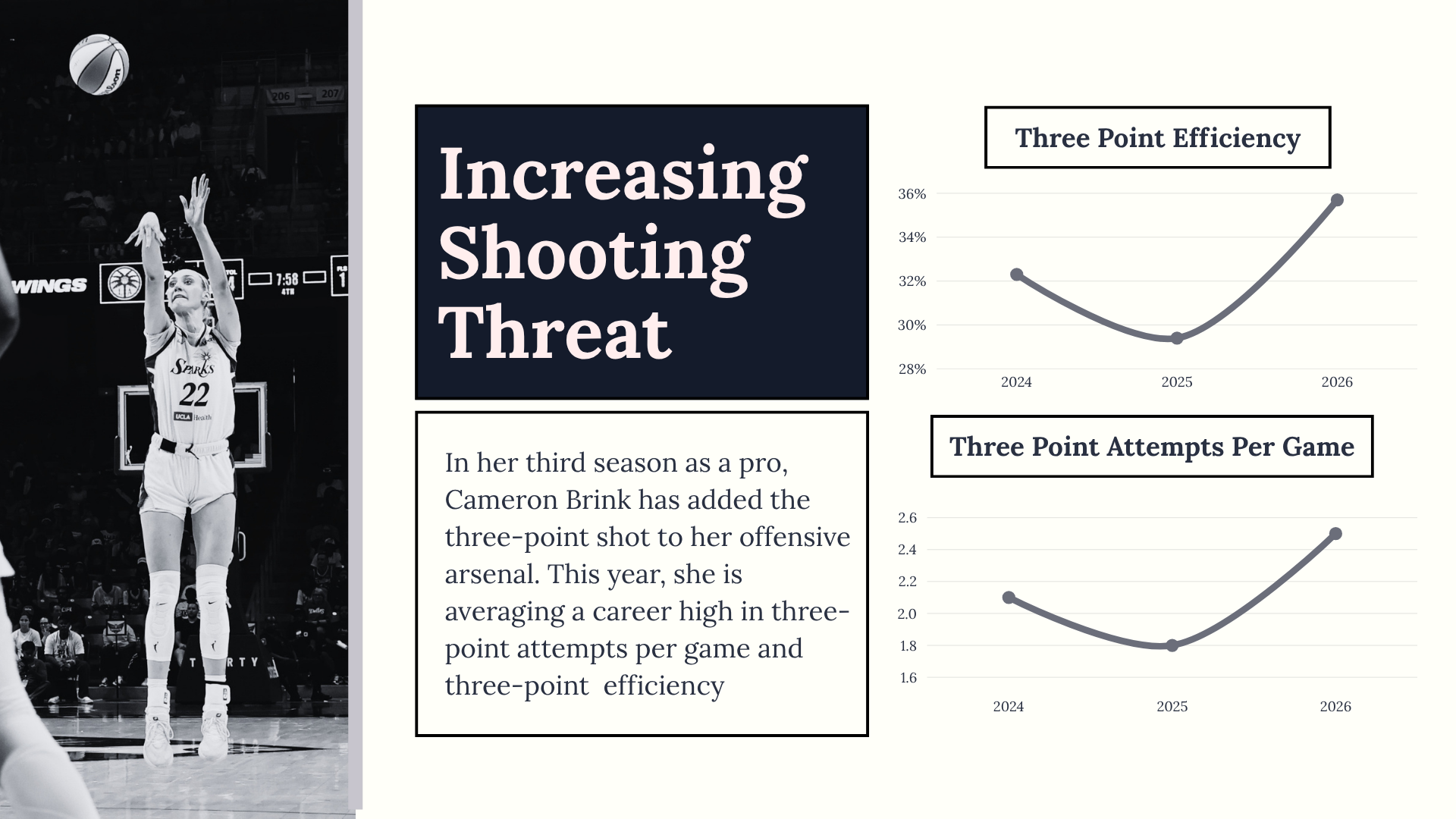
In her third year, Brink has slotted into a bench role and is currently on a minutes restriction as she rehabs from an ankle injury. In her limited availability, however, Brink has been effective—remaining one of the best rim protectors in the league while setting career highs in three-point attempts and efficiency. Her 42% three-point attempt rate is also a career high, dictating that floor stretching is a huge part of her development as a pro. This evolution introduces a combination that is becoming more and more coveted in the modern WNBA: the stretch front court player that is a threat from three while also being an elite rim protector against opposing offenses.
The 2020s has been a decade that has seen the three-point revolution hit the WNBA. The top 25 teams in threes attempted per game in league history have all happened in 2020 or later. In fact, the top seven teams in three point volume in league history have all happened in the last three seasons. Three point volume is here, and it's here to stay.
Teams have often leveraged this by having shooters set up on the wing. This positioning allows for catch and shoot opportunities while also giving them options to drive the lane or make an entry pass into the post. The added wrinkle has been incorporating front court players more into catch and shoot situations to create a threat from deep.
Several front court players have adopted this in recent years. Recently retired Tina Charles entered the league in 2010 and attempted a combined 17 threes in her first six seasons. But in 2021 and 2022, she attempted over 100 threes in each season. The game required centers to shoot more, and Charles adapted. A more contemporary example is Jonquel Jones of the New York Liberty. She entered the league only attempting one three per game, but in her last three seasons those numbers have ballooned to four attempts per game.
There is a trade-off that comes with valuing stretching out power forwards and centers to the perimeter, however. Because of geometrical complexities that having a front court player away from the basket creates, oftentimes these players can be slower to get back on defense—which is a decided disadvantage in a league that is increasingly looking to push the pace.
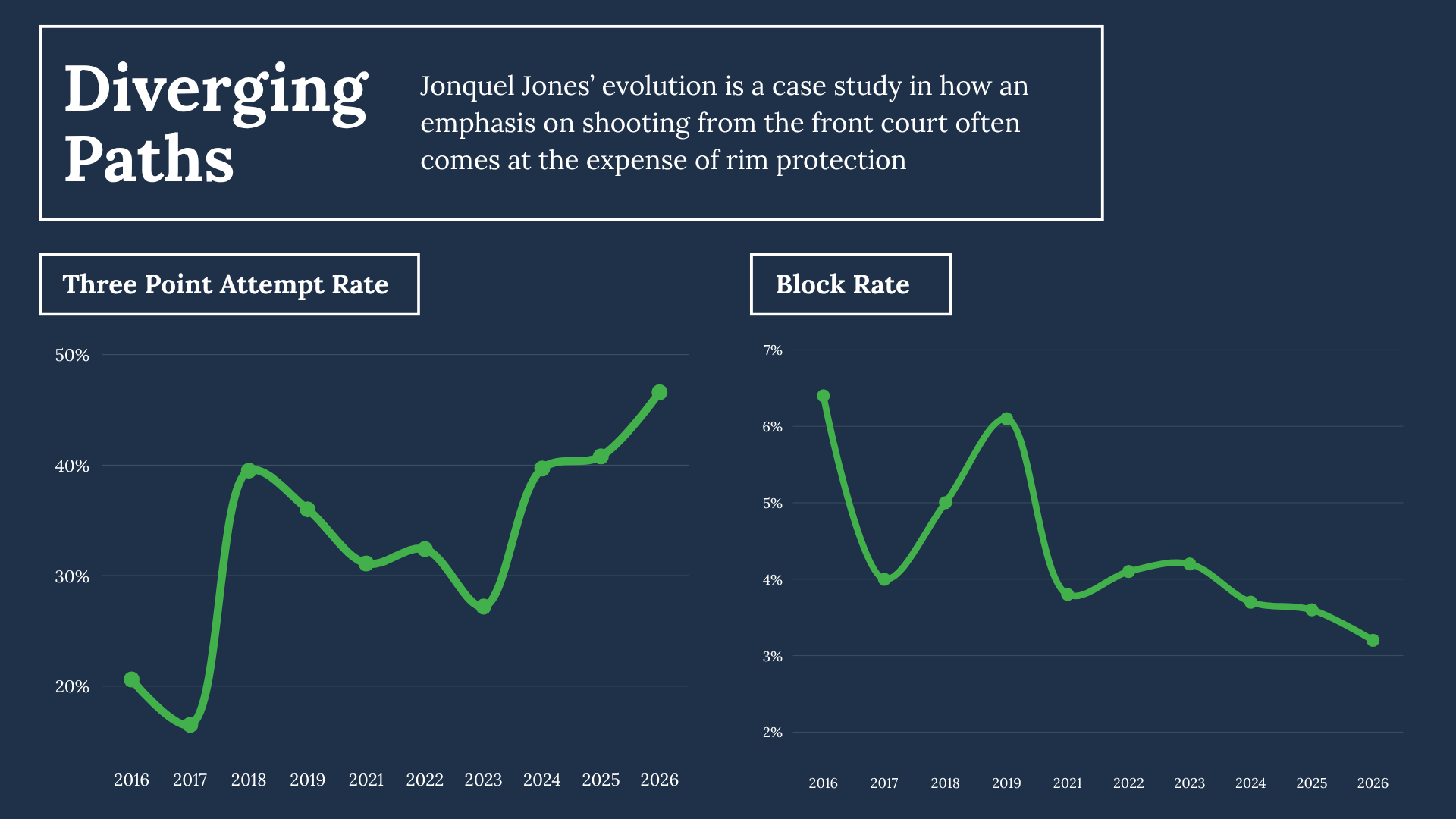
Jonquel Jones is a classic example of this dynamic. Early in her career when her three-point attempt rate was lower, her block rate (usually a good measure of a player's rim protection) hovered between 5-6%. But as the attempts from three have increased, her block rate has dipped under 4%. Teams are making the decision that if their front court player is a threat from deep, that it is worth sacrificing a little bit of rim protection to maximize the offensive upside.
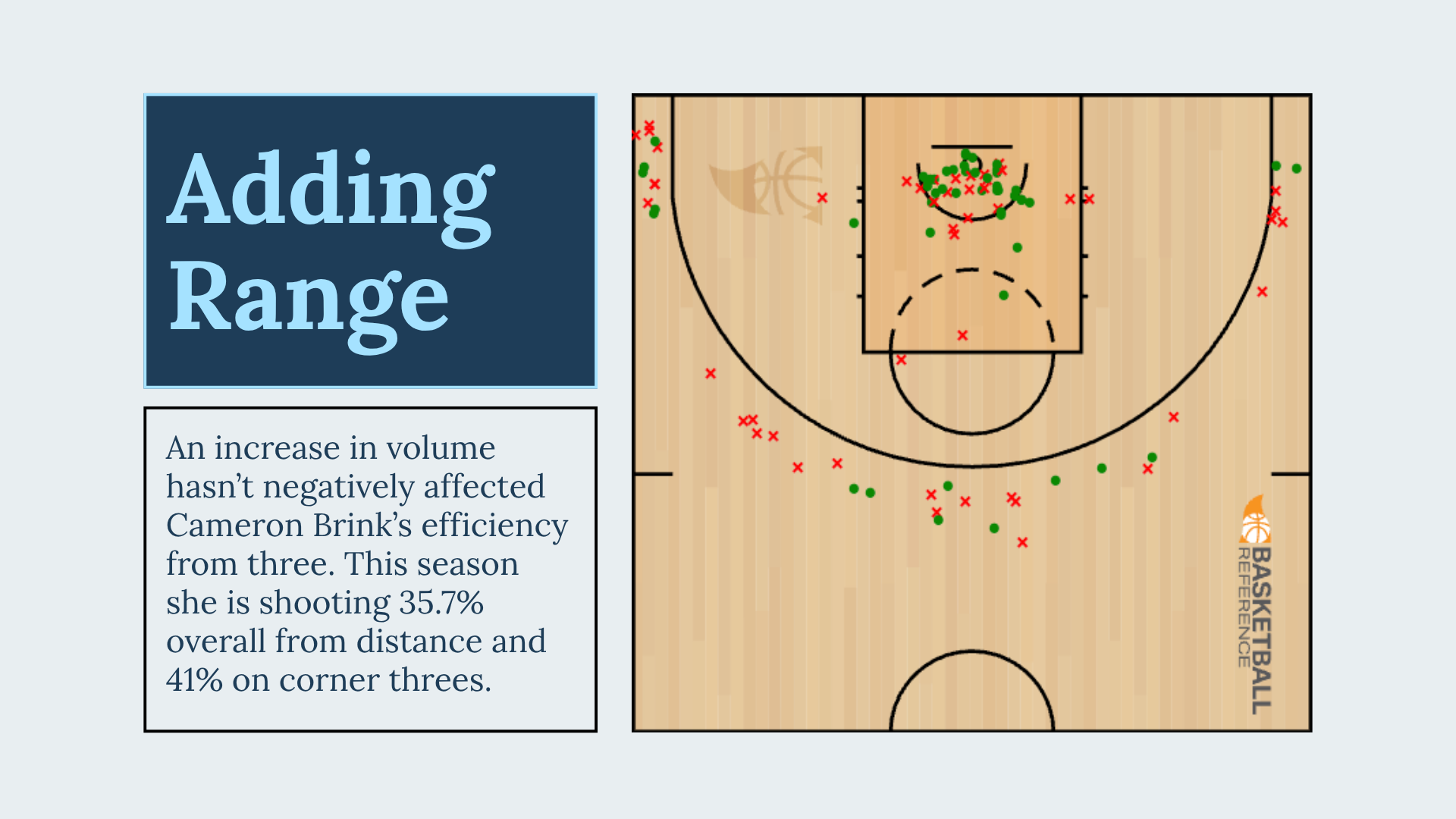
That calculus is what makes Cameron Brink's current trajectory so fascinating. This season, Brink is shooting 2.5 threes per game at an efficiency of 35.7%. She has been especially potent from the corners where she is shooting 41.6%. However, this enhanced volume and efficiency, both of which are career highs, has not come at the cost of her rim protection metrics. Brink's block rate has reduced a bit by her standard, but is still a top ten shot blocker in the WNBA with a block rate of 8.1%. So how has Brink been able to do both?
Part of the answer is rooted in her minutes restriction this season. Brink has only been playing 17.6 minutes per game as she continues to ramp up from an ankle injury. This restriction allows for maximum energy exertion when she's on the court. In addition to that, her 6'8" wingspan is a huge asset that allows her to play more of a roaming role in drop coverage defensively. That coupled with elite agility allows her to get to spots and contest them well, often leading to altered shot attempts by opposing offenses.
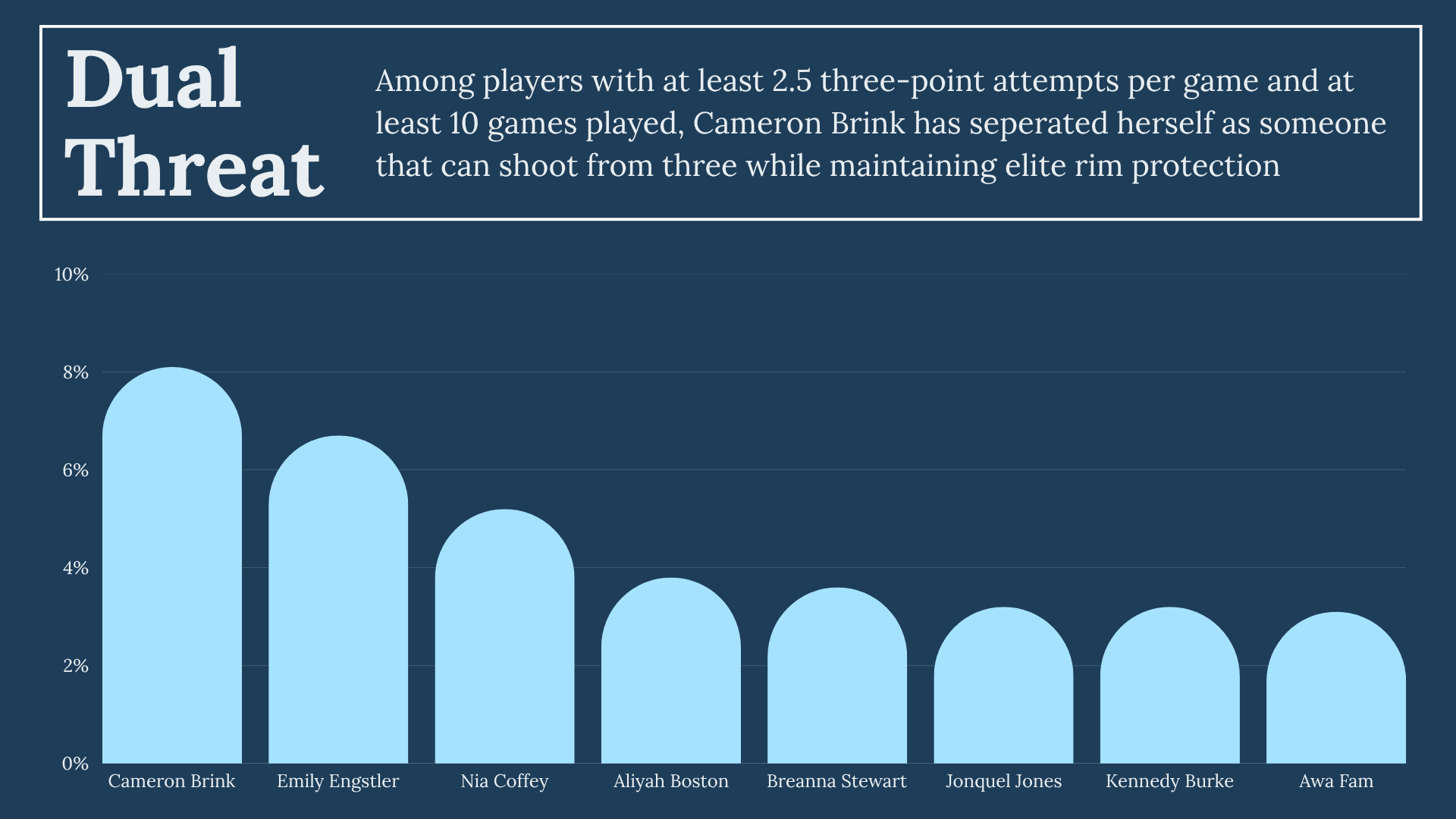
Brink is presenting a new class of front court player that can rim protect and shoot with volume and efficiency at a high level. Among all players with 2.5 three point attempts or more per game this year, Brink has by far the best block rate—with the next closest player, Emily Engstler of Portland, averaging a 6.7% block rate with 3 three's attempted per game. What Brink is providing the league is something of a blueprint for the sort of front court skill profile of the future: the hyper-utility rim protector.
WNBA teams have pivoted to more five-out alignments to bend opposing defenses and create options offensively. Centers and power forwards need to be a part of that equation and to be threats as shooters to maximize that geometry. But that also means that there need to be solutions regarding rim defense.
What Cameron Brink is showing the league, is that for high energy skilled front court players, taking a more limited burst approach might be a path forward. For a while, there was a thought that this needed to be two separate players, but there is mounting evidence that the answer may be in spurts of high energy full court presence.
This new archetype will be essential considering the way that the WNBA plays today. The pace is only getting quicker, with teams looking to run off of misses to create confusion and easy baskets. Guards are exploiting their quickness to get to the basket and break down defenses in the process. These trends require a reliable rim protector.
But on the offensive side, those same players need to be threats from three to maintain a court geometry that can't be exploited by sagging off a front court player. The hyper-utility rim protector solves this by offering spurts of energy to maximize rim protection while also presenting the upside of efficient shooting from three.
Cameron Brink may very well not be this sort of player for the rest of her career, there is a reason she was drafted number two overall after all. But in the process of her finding her footing in the league, it seems that she has unlocked a new archetype that other teams will look to add in the coming seasons. In her return from injury, perhaps Brink has inadvertently shown us what the future of front court evaluation will look like.