
Jessica Shepard & the Importance of Opportunity


The Dallas Wings forward has ascended into stardom after years as a role player, reminding us of the beauty of reinvention and second chances in basketball and in life
When I managed a Cricket Wireless location in Michigan, I pushed for a friend of mine to be hired as a sales associate. It was a risk, but she excelled at the job and was on track to revitalizing a career that started in food service. Sadly, the timing wasn’t right and the company we worked for, sold off their stores and laid off all of their employees. This friend went back, begrudgingly, to the food service industry. As Robin Scherbatsky once said in How I Met Your Mother, “You got chemistry, you need one other thing. Timing. But timing’s a bitch."
Eventually, I moved on to another opportunity—this time training and selling Google Chromebooks in Best Buy. When we had an opening in her area, I vouched for her again, hoping that the timing was right this time around. It was, and she reinvented her career and has progressed in that company to being a regional manager covering a massive territory that spans the central United States and Canada. The second time around, the timing was right and she took advantage.

I can’t help but think of this friend and her journey when I see the season that Dallas Wings forward Jessica Shepard is having. In her sixth WNBA season, Shepard has had a breakout season, making her first All-Star appearance and leading the league in double doubles for a Wings team that seems poised to make a playoff run. Shepard’s ascension after years of filling out a bench role and dealing with injuries is a reminder of the importance of opportunity and how basketball teaches us a lesson of perseverance.
In the 2019 WNBA Draft, five Notre Dame players were selected. Shepard was the fourth one. Drafted in the second round, many projected Shepard to be a role player with the upside to be a running mate for the future with fellow 2019 draftee Napheesa Collier. Collier went on to be one of the best players in the WNBA and face of the franchise for the Lynx.
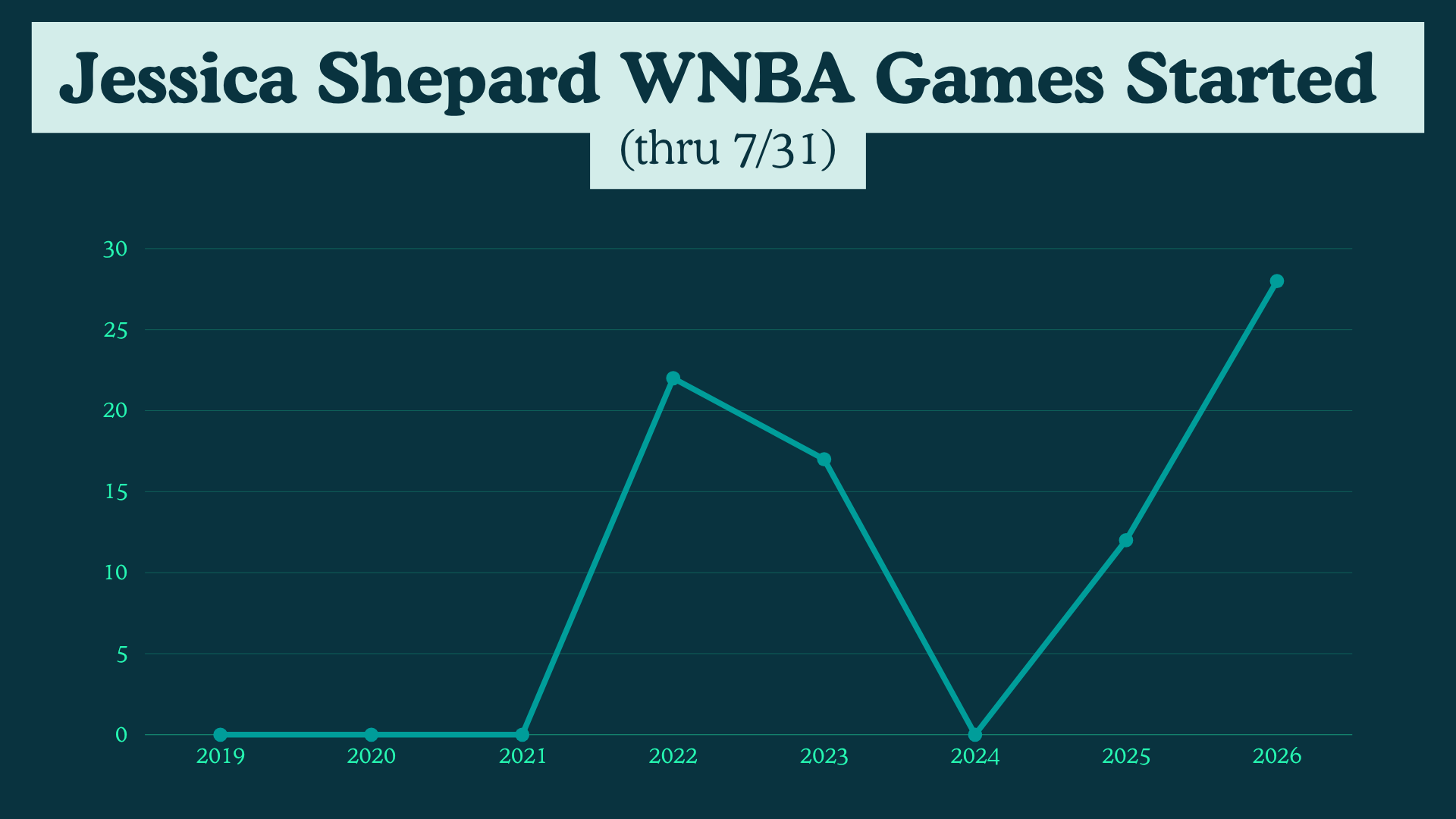
Shepard, meanwhile, tore her ACL six games into her rookie campaign and missed the following season rehabbing the injury. She would go on to carve out a spot as a role player in Minnesota, averaging 8.1 points and 7.3 rebounds in 2022 & 2023. She would then miss the 2024 season, opting to stay in Italy to fulfill her contract obligations with her Italian club, Umana Reyer Venezia.
2025 saw her return to Minnesota, fully healthy and embracing a reserve role where she finished third in Sixth Player of the Year. Like so many people, Jessica Shepard needed a fresh start. She ended up signing with Dallas, pairing her with college teammate Arike Ogunbowale and filling a necessary front-court hole for the Wings when they lost both Luisa Geiselsöder and Haley Jones in the expansion draft to the Portland Fire. Dallas provided a new start for Shepard and a chance to play alongside an exciting young guard in Paige Bueckers.
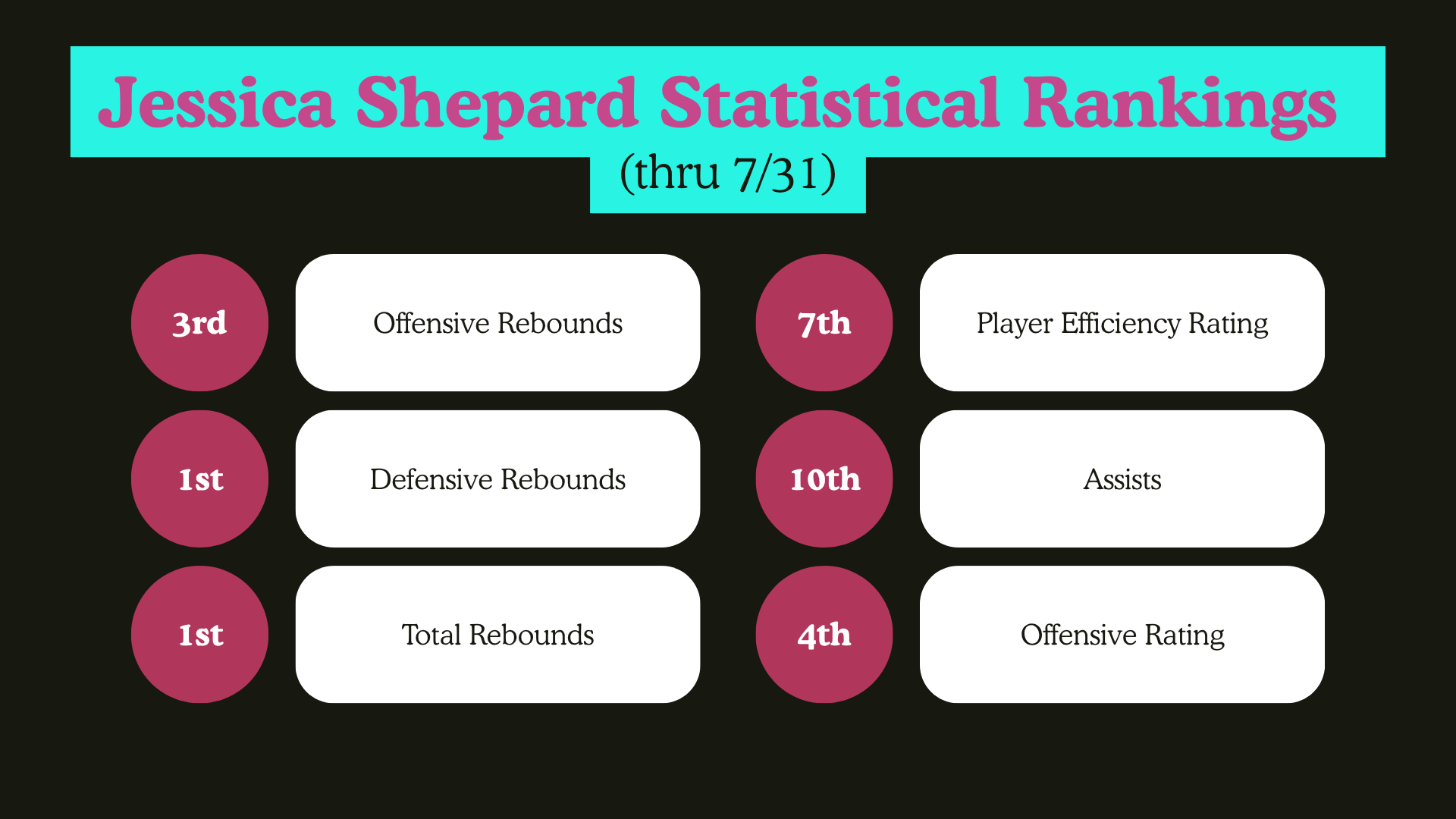
More than midway through the season, Shepard has been a revelation. The WNBA has slowly shifted to more versatile front-court players, and she has fit this mold perfectly in Dallas. Operating as a point forward, the Wings have unlocked a playmaking element in her game that has helped to propel the Wings to the 4th highest offensive rating in the league this year, a complete turnaround from last season that saw them at the bottom of the league in that same statistic.
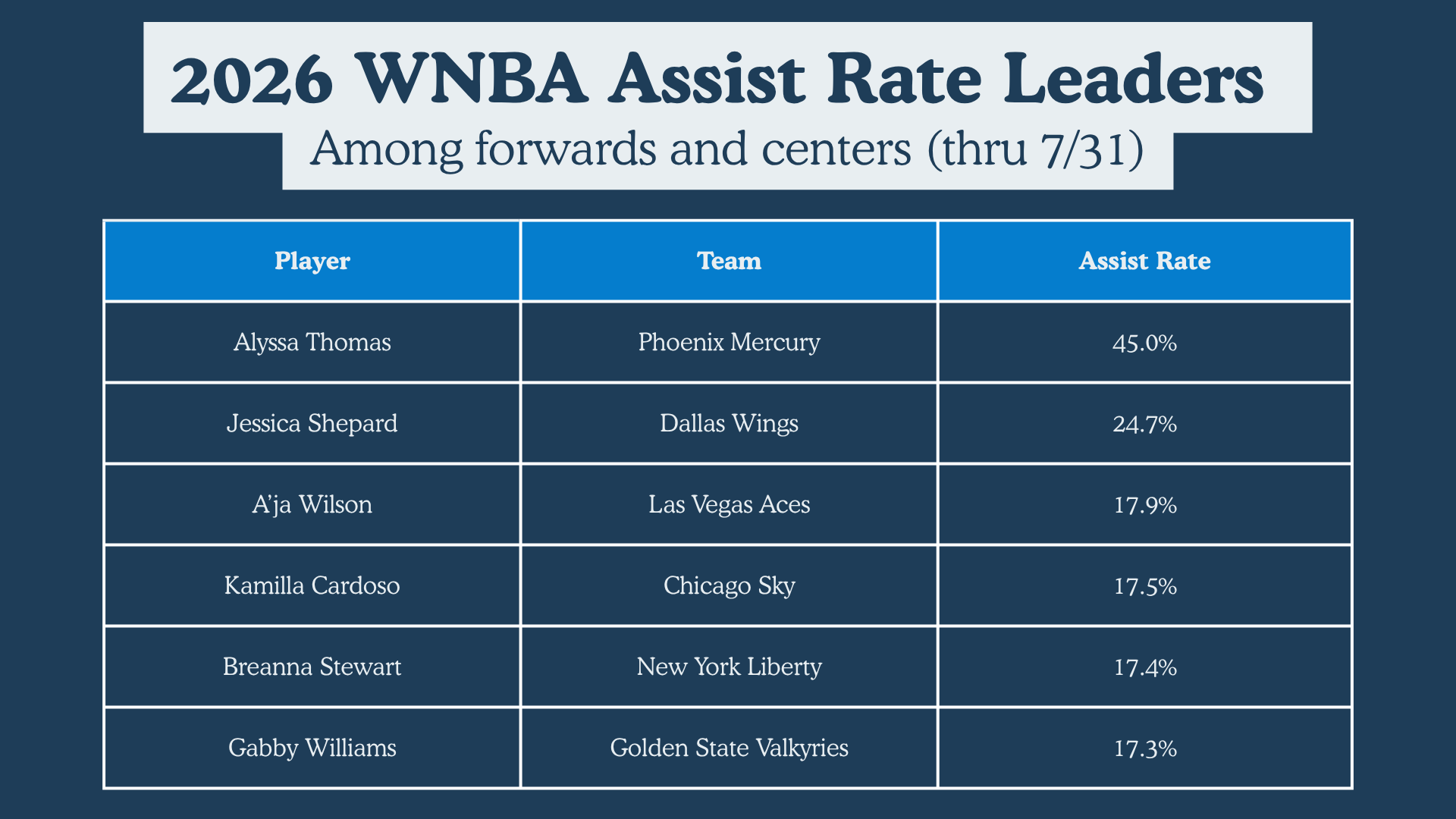
Shepard has seen her usage uptick this season, and as a result her assist rate has increased exponentially. Among forwards and centers that have appeared in 20 games or more, Shepard trails only Alyssa Thomas in assist rate and is a comfortable 6.8% higher than the third-place player, A’ja Wilson. Her offensive package of downhill scoring and facilitating has led her to be seventh in the WNBA in PER (player efficiency rating) and fourth in offensive rating. Shepard has seen an uptick in minutes (already surpassing a career high) and has made the most of it.
As a scorer, the three-point shot has not developed for Shepard (she is 0-for-8 from three this season as of this writing), but she has proved to be an elite scorer at the rim and in the midrange. In the restricted area, Shepard has shot 71.6%, which ranks as the fourth highest among players with over 100 attempts in that zone. And from midrange she is shooting 47.5%, which ranks third among players with at least 40 attempts from that zone. Ironically, the only two players higher than her are her teammates, Azzi Fudd and Paige Bueckers.
Shepard has also established herself as a pre-eminent rebounder this season. She leads the league in both rebounds per game and in defensive rebounding rate. She has been impactful on the offensive glass as well, ranking third in the league in total offensive rebounds and sixth in offensive rebounding rate.
How this has translated for the Wings is allowing Paige Bueckers to roam more off ball, which has led to 76% of her made threes to be assisted off the catch. Bueckers still has a high usage rate but the possessions where Shepard sets up the offense have allowed her to get better looks, resulting in an uptick in field goal percentage (up 7% from last year) and three-point efficiency (up 5.7%). Part of that is certainly due to Bueckers’ progression as a player, but a portion of it must also be credited to the offensive dynamism that Shepard has introduced into the Wings offense this season.
Shepard’s elevation from role player to star player is a key driver of the Wing’s success on the court and she will undoubtedly be a crucial piece come playoff time. But beyond the basketball of it all, Shepard’s breakthrough is a reminder why we watch sports, and the type of stories that resonate with us.
Shepard was a talented recruit coming into college and proved worthy of the hype at both Nebraska and Notre Dame. But when she entered the professional ranks, she faded into life as a role player. A story ending that way is not a slight, and it is the story for many pro basketball players—especially in a league like the WNBA with fewer teams in it when Shepard was drafted.
What is both fascinating and inspiring is that she was able to redefine and reinvent her standing in the league with the right opportunity. Her success story is the outcome that any athlete in the wrong situation will cling to. The idea that when put in the right circumstance, they too can reach their full potential. Shepard’s story is one of right place and right time certainly, but it is also a story of belief and commitment to the work that she has put in.
In Jessica Shepard we see a path of possibility in our own lives. We’ve all been there, stuck in a sort of career rut, unsure what the next step will be, and if you even be able to take that next step. You wonder, there has to be more than this, surely. Shepard shows us that there is a next step, that change doesn’t have to be terrifying, but exhilarating. The ascent from role player to star has been magnificent to watch, because it’s a trajectory we all hope for ourselves. That parallel between life ambitions and athletic reality is why we watch, and why we love basketball.