
The Beautiful Mathematics of the Golden State Valkyries


Golden State is contending for a title by leaning fully into analytics ball...and changing our perception of math in basketball in the process
In an episode of How I Met Your Mother, Ted Mosby (played by Josh Radnor) likens the game of basketball to mathematics by saying:
"Basketball, people don't realize, is all geometry, physics, and engineering. If you think like an architect, you could win a thousand games without ever touching a ball."
The joke is of course that Ted and his ill-fated T-squares basketball team are no good at the game and were demolished despite their deep understanding of geometry and physics. Despite that, the point of the connection between math and basketball is incredibly true. Modern basketball spacing requires an understanding of floor geometry and statistical probabilities help inform what sorts of shots are the best ones to take.

WNBA teams have embraced the role of data science in recent years, with teams like the Minnesota Lynx and Phoenix Mercury investing in data analysts to optimize their on-court efficiency. The principles of analytics basketball have permeated throughout the league. In the last decade we have seen mid-range shot attempts plummet while rim attempts and three pointers have increased leaguewide.
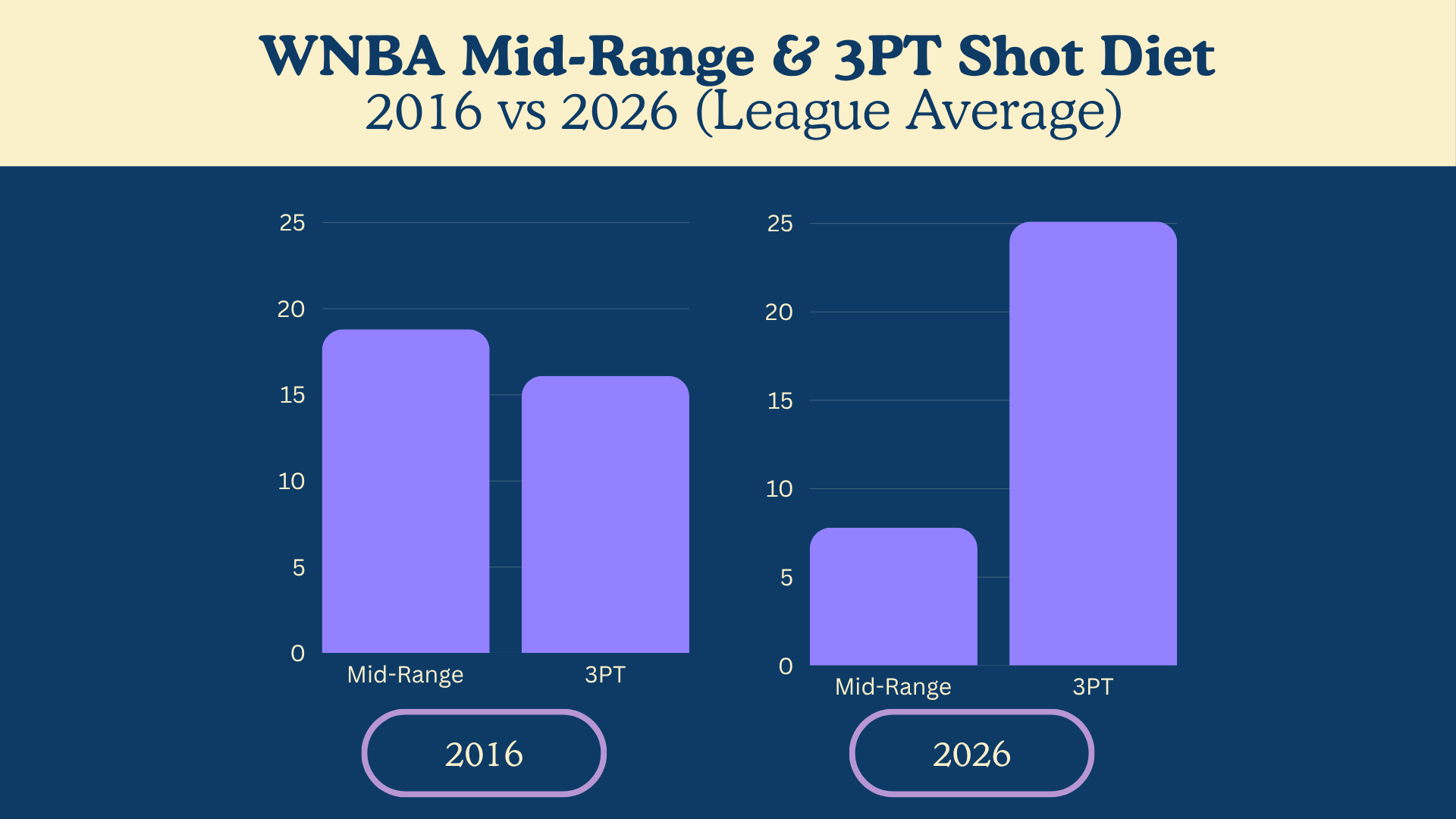
In 2016, teams attempted an average of 18.8 mid-range attempts per game and 16.1 three pointers per game. Ten years later, teams are only attempting 7.8 mid-range attempts per game and 25.1 three pointers per game. Those long twos have been replaced by threes as the game evolves into more of a math problem.
The embrace of data has been widespread, specifically the Las Vegas Aces and New York Liberty who have built their championship teams around spacing and the three-point shot. And while the shift to mathematical philosophy is widespread, there is no team that is employing it more thoroughly than the Golden State Valkyries. The Valkyries, in their second year of existence, are well positioned as a playoff team and have legitimate championship aspirations. The way they have gotten here and the way they are winning games may be the single biggest step forward in analytically focused basketball: the battle for aesthetic preference.
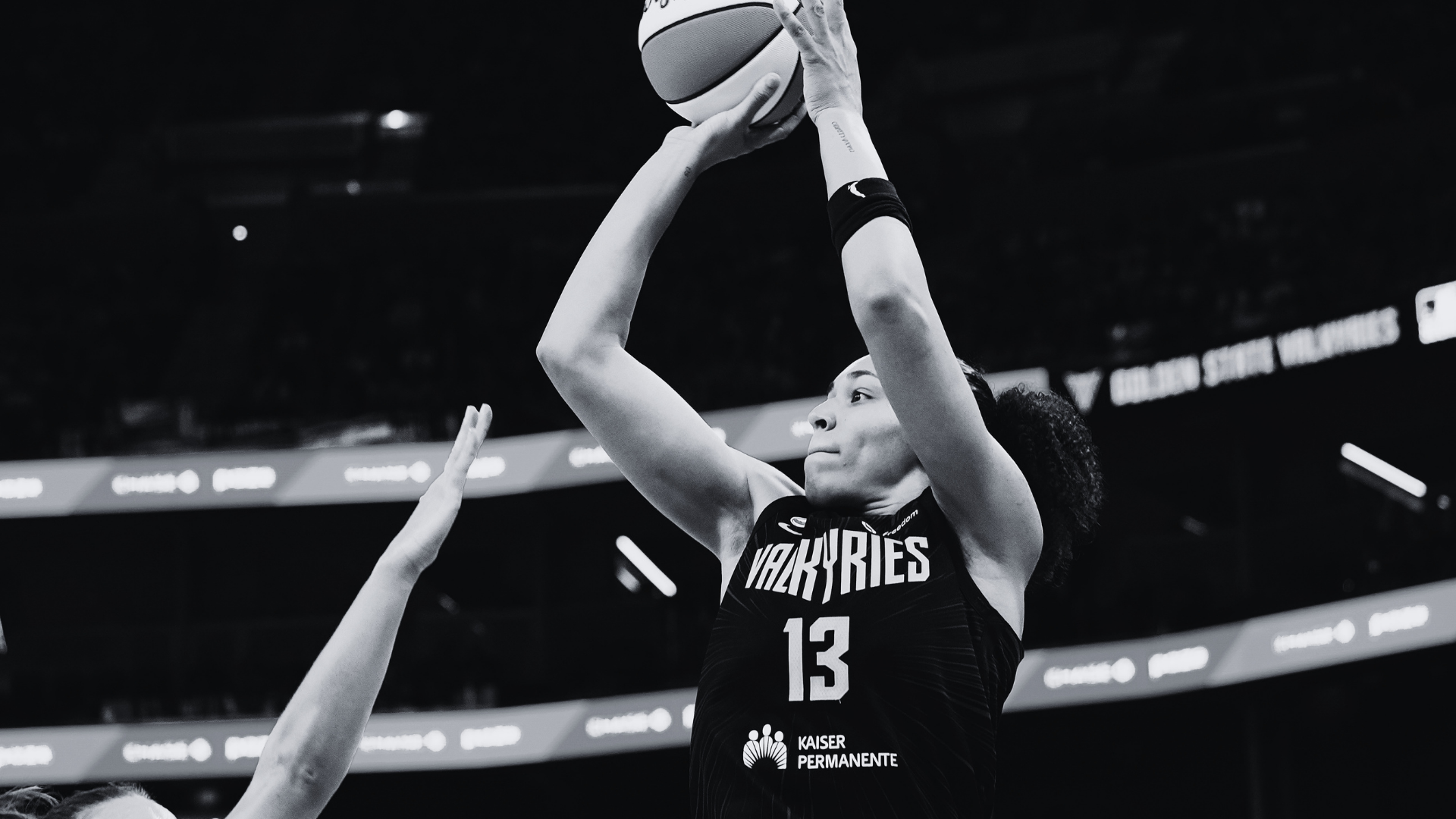
There has been a push and pull in basketball conversation about whether analytics in the sport has gone too far, if it has skewed the way that we view players. It's juxtaposed by the eye test which relies more on subjective sensibilities. The argument of a math-forward approach is that human emotion varies, but numbers are absolute. The entire aim of the data analysis movement is to encourage behaviors that maximize success and reward degree of difficulty.
The three shot types that are coveted in this approach are rim attempts, free throws, and three-point shots. Rim attempts and free throws provide a higher probability of success, with WNBA teams averaging 67% on rim attempts and 78.9% from the free throw line. These attempts are essential because of how successful they can be for an offense. The three point shot, while the least efficient shot from a percentage point of view (teams are shooting 34.1% from three this year), has the added benefit of being worth 50% more in point value. In a game where the object is to score more points than the opposition in a relatively equal number of opportunities to do so, focusing on those shots make sense.
The sport that popularized using more statistical models as a scouting and success strategy was baseball with the Oakland A's and their "moneyball" era. The A's did this out of necessity. In a sport without a salary cap that saw them perpetually lose talent to teams with more financial capital, the A's flipped what they looked for and exploited mathematical deficiencies in the sport. This led to their success as a playoff team and the strategy was eventually emulated by other teams until it became the standard in the sport. The Valkyries, similar to the A's, have found success in using math out of necessity.

As an expansion franchise in 2025, the Valkyries accessed their original pool of players in an expansion draft. The WNBA's expansion draft rules allow existing teams to protect up to five players, with unprotected players eligible to be drafted by the expansion team. It stands to reason that teams would protect cornerstone highly drafted players while more middling role players and unproven young players would be drafted. The Valkyries, like the A's, faced a structural disadvantage of available players and utilizing analytics has helped to make up ground.
This season, the Valkyries lead the league in both three pointers attempted and made per game. Among their regular rotation players, the Valkyries have six players that are shooting 35% or better from distance, and that shooting versatility down the lineup is crucial to their style. Golden State plays a true five-out system that is predicated on ball movement and maximizing open space.
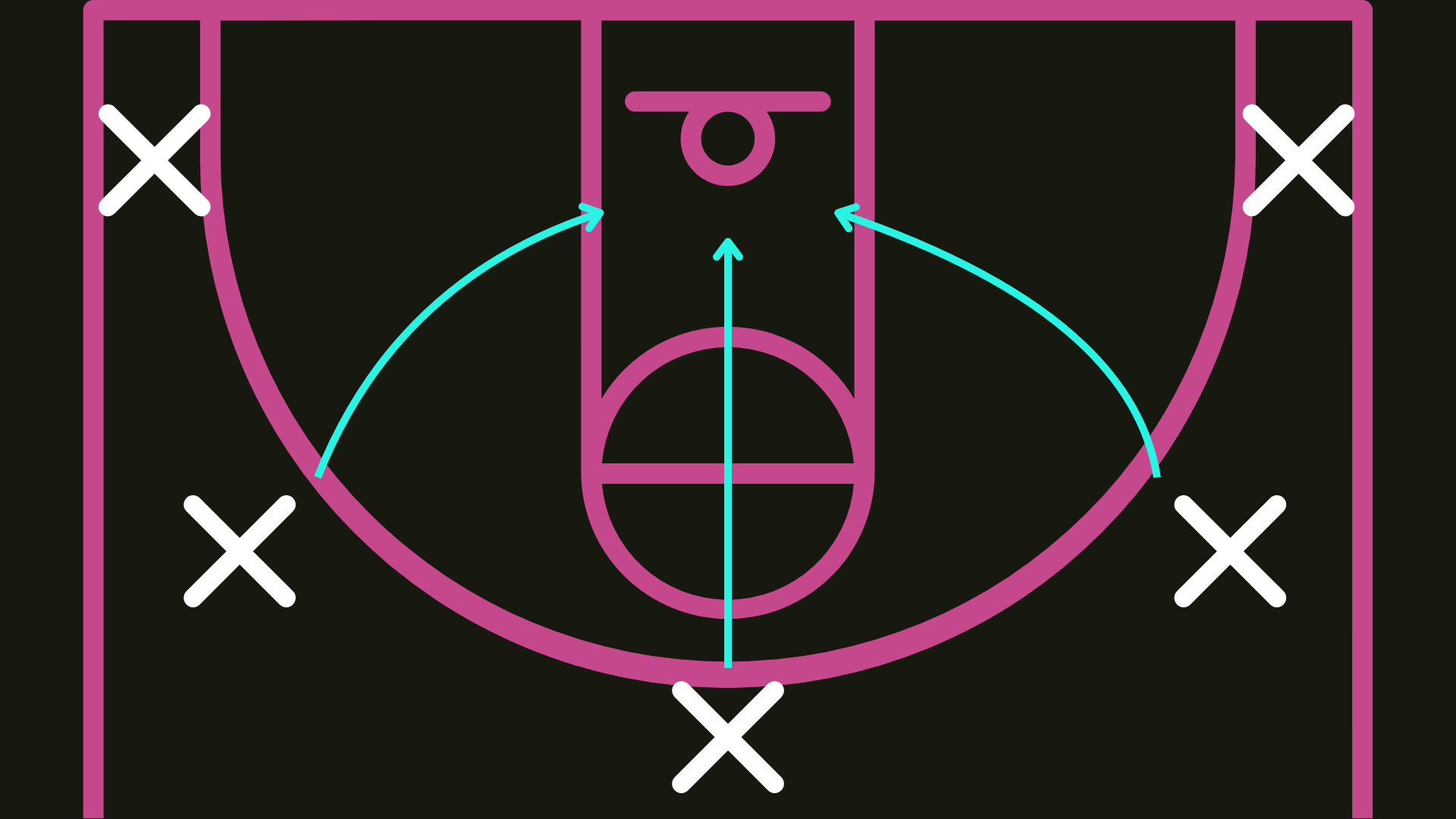
Guards will frequently attack the paint, drawing defenders in, and opening up a lane for three-point attempts (10.8 made and 30.6 attempted per game). To maximize their efficiency in that regard, Golden State also plays at the slowest pace in the league. This might seem contradictory, but in the sense of maximizing possessions and limiting the options available to opponents it has been effective—leading the Valkyries to have the best defensive rating and fourth best opponent turnover rate at 15.9% thanks to their full court press defense.
What is so interesting about the Valkyries is that there is no clear-cut superstar. Gabby Williams is the team's leading scorer with 14.9 points per game, but Williams only ranks 34th in the league in scoring. Since 2010, of teams that made it to the WNBA Finals, none of them have had a leading scorer that ranked less than 23rd. In fact, 27 of 32 teams that have made the Finals have had at least one scorer in the top ten. This statistical anomaly speaks to the culture of togetherness that head coach Natalie Nakase has instilled.
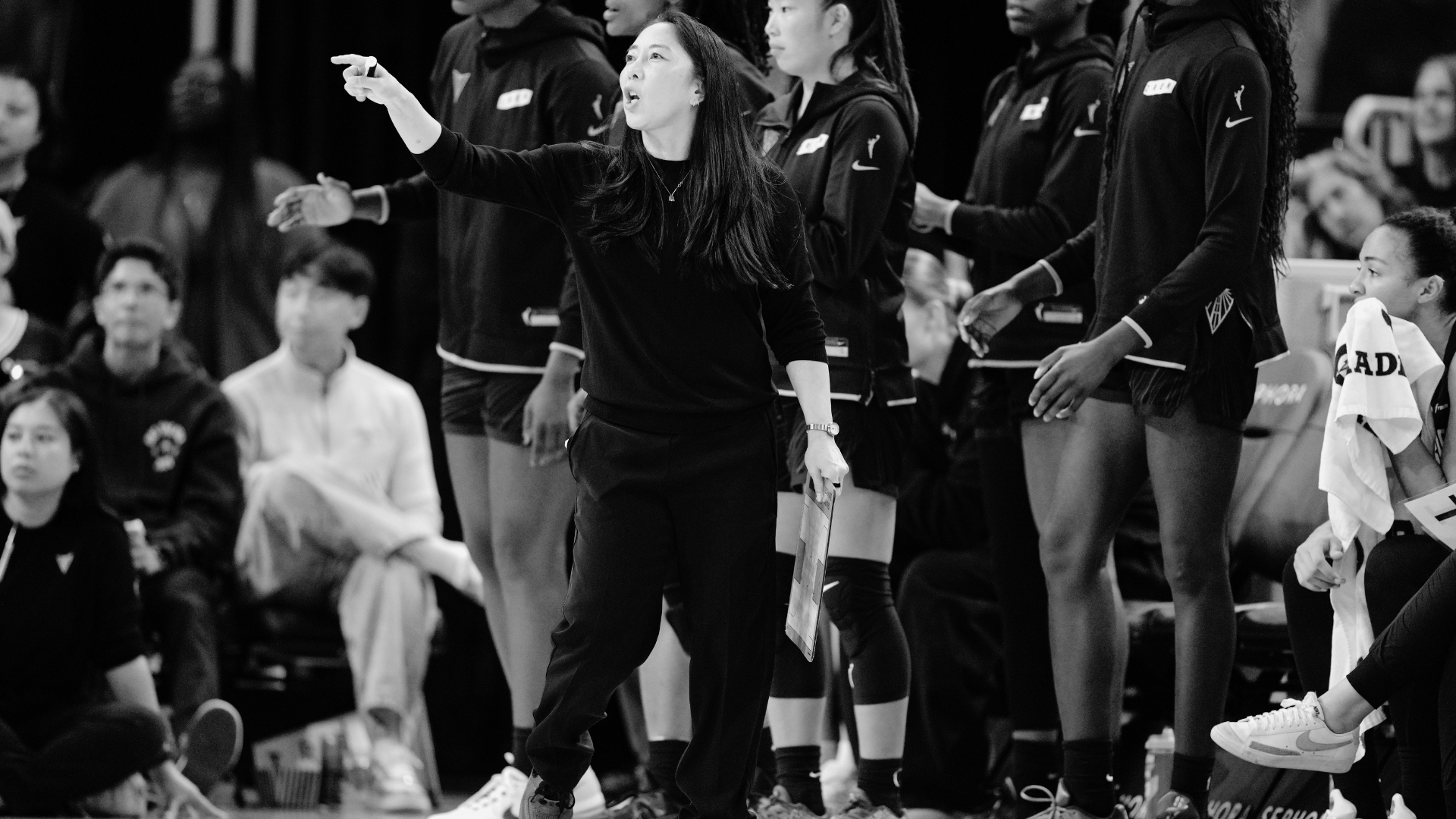
Among the top four teams in the league, Nakase has shown to be the most disciplined with her minute distribution with the intention of keeping her players fresh to operate at maximum efficiency. No Valkyries player averages 30 minutes per game. The other teams in the top four—Las Vegas Aces, Dallas Wings, and Minnesota Lynx—all have three players that average over 30 minutes per game. What this indicates is that while many teams use analytics, the Valkyries have abided by it, making them the utopian vision of what analytical basketball should look like.
If the idea of smarter basketball is maximizing good shot attempts, taking care of the basketball, minimizing player fatigue, and being defensively sound then the Valkyries play incredibly intelligent basketball. Many of their lineup variations feature five shooters that can create off the dribble in their five out drive and kick system. This opens up driving lines to attack the rim all while opening up other shooters for open looks.

The reason it all works is the buy-in from the players. They seem to operate free of ego, which has led to Golden State cultivating the best bench in the league. A bench so good in fact, that they have the highest points per game from a bench unit (35.9) in the history of the WNBA. That buy-in and belief in Nakase's system and philosophy is what makes it so different than the typical permutation of what an analytics-focused operation looks like.
Because of the emphasis on threes and minimal turnovers, these teams typically feature a high usage initiator that demands the ball in isolation situations, forcing offenses to become heliocentric. A coach will typically trust their primary ballhandler implicitly, and that can lead to a lack of offensive movement. This is never the case with Golden State, the ball is fluid, and they operate in a sort of equal opportunity lens that is refreshing.
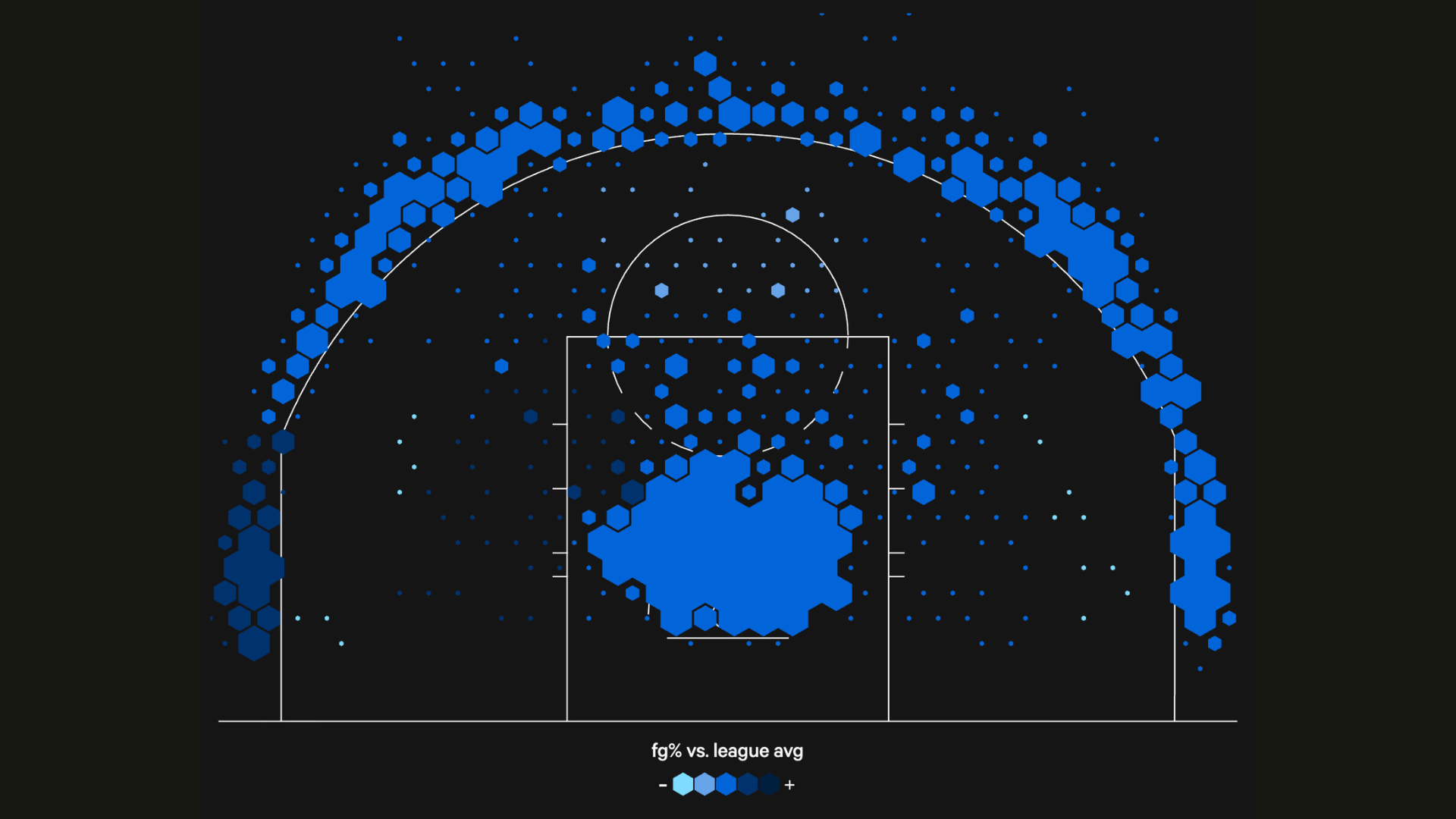
Perhaps what is most fascinating about their style of play is that it flies in the face of what normal criticisms are of a more mathematically inclined style of basketball. Many long-time basketball watchers find that reducing the game to a math problem takes away the artistry and creativity of the game. That it devolves the game into a three-point shooting contest. In many permutations of the idea, this is valid criticism. However, it's not the case with Golden State, which poses the notion that maybe our vitriol wasn't using math in basketball as a general concept, but that the way it was executed was the real problem.
What Nakase and the Valkyries show us is that volume three-point shooting doesn't mean boring basketball. It can mean aggressive cutting, ball movement, and ball pressure on defense and not just four players watching a heliocentric initiator try to manipulate space. These are all elements that basketball purists claim to love. But when it results in volume three-point attempts, they bristle. What the Valkyries brand of basketball shows us is that basketball can still be selfless, team-oriented, AND analytically sound.
With the way they have been playing this season, Golden State has a real chance to make history as an expansion team winning a title in its second season of existence. But beyond that, they are showing us that math and basketball can mix for an aesthetically pleasing product, that the eye test and the analytics aren't always at odds with one another. This mathematical style is something that will be the future of basketball, but importantly, Golden State has shown us that it can still be fun, and there is something incredibly beautiful about that.