The Death of the Live Game Post


Live posting used to be integral to the sports social media experience, but the relentless pursuit of ad revenue has created a fragmented reality
Years ago, I was the host of a podcast about the New York Knicks with two friends from Europe. One of the elements of our promotion strategy was to live post on Twitter (now X) during games. We would take turns based on availability during the season, and it was relatively effective. By posting in real-time, we were able to gain followers and drive interest in the podcast.
Live posting (formerly live tweeting) was the lifeblood of earlier eras of social media. But in today’s landscape of algorithmically curated feeds and “For You” pages, there is a disconnect. When someone makes a post about a moment in a game it might not surface on a person’s timeline until hours later, reducing the relevance (and sometimes accuracy) of the original post. Once a crucial part of the sports social experience, it seems that the live post is dying and social media apps like X and Threads are trying to reinvent the very thing that they killed.
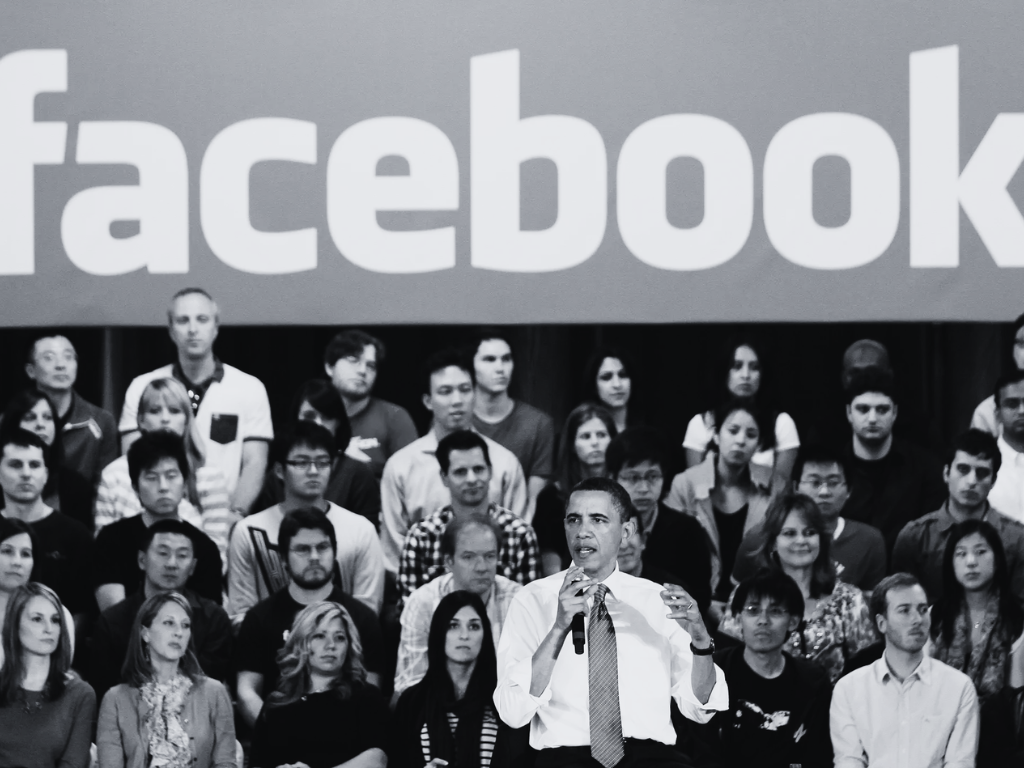
The idea of live posting can be traced back to 2009 after Barack Obama was inaugurated as the President of the United States. There was a sense at the time that this was an evolution in the way news would be reported—dynamic, in real-time, and unfiltered. The Obama inauguration was done on Facebook, cementing his election as the “social media president”—but the trend of live posting would pick up steam on other platforms as well.
Twitter became the perfect medium for the in-the-moment live post. Live tweeting became social media vernacular almost overnight as then Twitter CEO Evan Williams live tweeted the birth of his child. Eventually, it became expected practice to tweet things as they happened. In the sports world, this trend became expected behavior. With the proliferation of the smartphone, firing off a tweet while watching a game became second nature for fans.
The town square that was Twitter eventually became the preferred social media home of sports fans with NBA and NFL Twitter communities becoming abundant on the app. Live tweeting games became ways for fans to interact, connect, and argue with one another over a shared viewing experience. What made this special was that at the time Twitter employed a chronological feed that brought a sense of importance around notable moments.
In the early days of social media, chronological feeds were the norm and dictated the way that we behaved online. An example of this was on Facebook during the early 2010s, where people would post a question about plans for that night, get replies, and then those plans would materialize. The chronological feed enabled a collective reaction over a thunderous LeBron James dunk or a deep Peyton Manning touchdown pass. In other words, the chronological feed enabled in the moment reactions—the utopian ideal of what a digital town square is supposed to be.
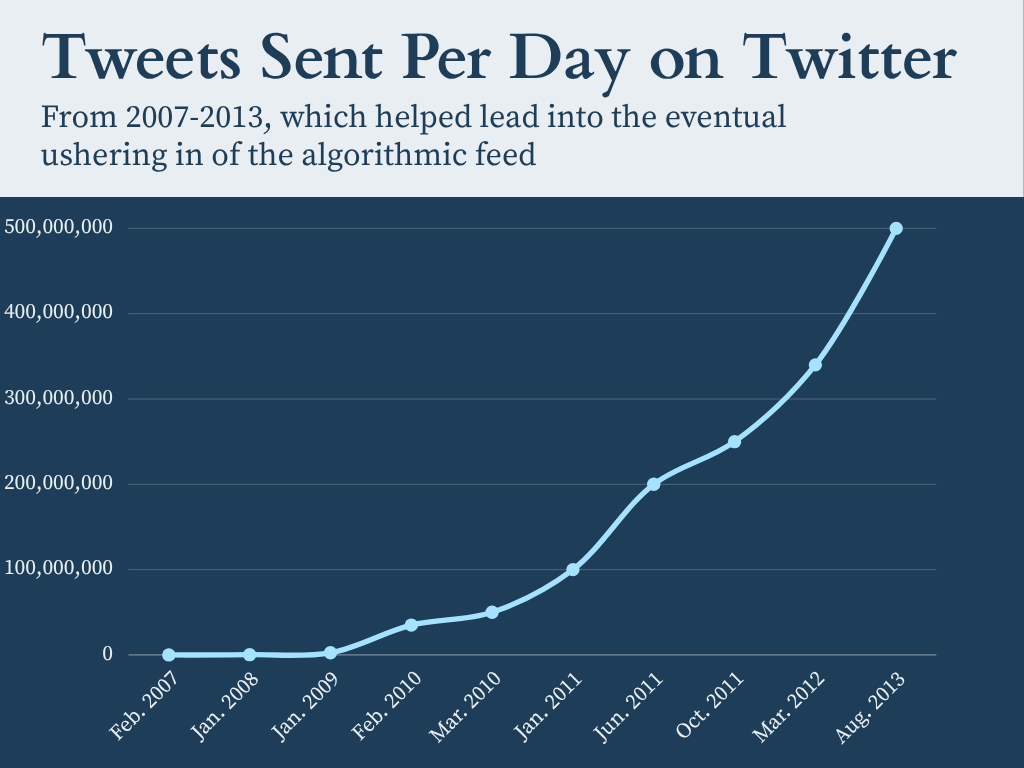
But two things happened to apps like Twitter, Facebook, and Instagram as time went on: posting volume increased and so did their need to generate revenue. On Twitter in 2009, there were roughly 2.5 million tweets sent out per day. By the summer of 2013, that number ballooned to 500 million tweets per day. The chronological feed meant that there would be an overflow of tweets to get through. But perhaps even more crucially, a time-based feed of your favorite accounts had an end point. And that end point limited advertising potential.
Starting in 2010, Twitter started to incorporate ads, something the company called “Promoted Tweets” at the time. By 2015, its ad network expanded into a multi-format ad platform. That meant that within the feed there would be sponsored tweets based on views and impressions. It was in Twitter’s best interest to maximize time on the feed, which a chronological feed would not accomplish.
With that, the algorithmic timeline was born. Every major social media app uses some version of the algorithmic feed today—some call it the “For you” page, others simply call it a feed, but the idea remains the same. Posts are surfaced based on interests and likelihood to engage. It’s a never-ending feed of posts, which is why prolonged social media usage is often called doomscrolling. The result is that time-sensitive posts suffer more than others, while ensuring that more ads are delivered as users scroll through posts.

Currently on X, ads surface around three times per every ten posts seen. Consider how many ads will appear in a typical scrolling session at that rate. If there was an end point in sight, this would limit advertising reach, which would make X or any other social media limited in function from an advertising point of view. While countless users have begged for the return of the chronological feed—to the point of creating petitions—the reality is that they will not be returning as the default social media experience any time soon.
An issue that arises, however, is that many sports fans who have been using social media in the last 15 years have often been encouraged to live react on platforms, to spark discussions in the moment, even if it is at odds with how those same social networks function. The result is that a reaction to a play that happened in the second quarter is surfaced to someone after the game is over and the original post looks foolish in retrospect. This is a common occurrence. So common in fact, that the account Freezing Cold Takes exists as a sort of hall of shame of incorrect sports social media posts.

In their quest for revenue maximization, social media apps have now encountered a problem within their sports niche. People want to post on their platform about what is happening in the moment, but the algorithmic feed is an imperfect solution that satisfies that need and the need for advertising revenue capture. The solution that seems to be winning the day is the live chat.
Live chat rooms are far from a new idea; in fact they were created in 1973 with the Talkomatic which used the e-learning PLATO system at the University of Illinois. Chat rooms grew and proliferated during the internet boom of the 1990s and 2000s, spearheaded by companies like Yahoo and AOL. Those chat rooms allowed people with shared interests to interact with one another in real-time via the internet.
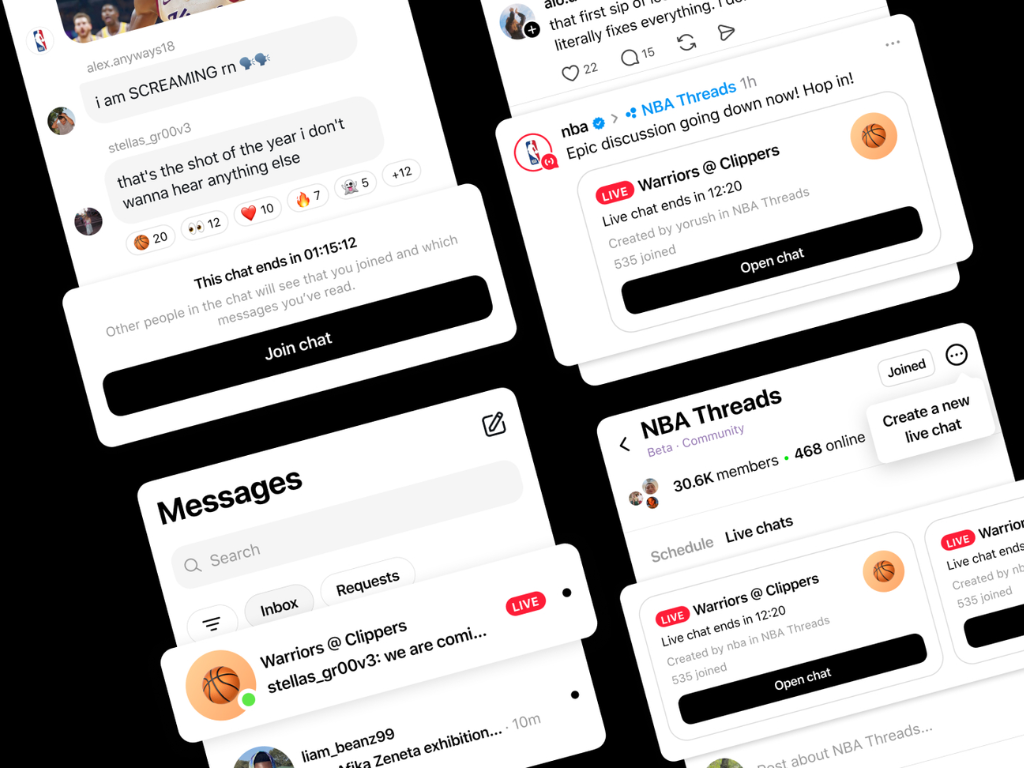
Even today, the essence of the chat room persists with services like Discord and Twitch. It then only makes sense for social media apps to take what was old and make it new again. Threads (owned by Meta) started rolling out live chats for NBA and WNBA games this season and has expanded to include the NFL. Meta positions this feature as a way to connect and build community in real-time. In truth it is simply a large, temporary group chat filled with people watching the same event.
Similarly, X has embraced live chats for the NFL season. As an addendum to its NFL Gametime feature that includes live scores and updates from select reporters, the app has also included a live chat while games are going on. This is in addition to the Spaces feature, which has operated like live radio shows since the company tried to offer an alternative to Clubhouse in 2021. Both of these products allow X to satisfy the demand for live commentary while still preserving the cash cow that is the algorithmic timeline.
Both of these solutions are effective in the sense of recreating a communal feel. But they are awkward replacements for the live post. Threads’ live chat feature often requires administrator approval to join, while X’s live game threads feature a chaotic stream of posts with very little moderation. They are opposite ends of the spectrum. The beauty of live tweeting (or posting) during a game is that there was a mix of people you already follow with the opportunity to connect with others. That connection feels lost in the proposed solutions and gives a feeling of a bolted-on answer to a problem.
The solutions offered by these social media apps are the indication that the validity of the live post is in fact dead. The platforms themselves helped to make them irrelevant, making those that post them deal with more headaches than positives. In its place have come live chats, live audio rooms, and live streams across a variety of social interfaces.
The lesson is that in the pursuit of revenue, an organic community builder had to die. In many ways, this is a corollary of modern economics and the general decline of the third space. In the third season of the popular Netflix series Stranger Things, a central location is the new shopping mall—a place that becomes a third space (after home and school) where teenagers hang out. These places used to be more abundant as gathering places in the pre-internet era. But as time has gone on, these places have either disappeared like the shopping mall or been de-emphasized like libraries.

In an age of hyper digitalization, more and more elements of human connection and community building have been de-emphasized, leading to the erosion of spaces where people connected. Beyond this trend, modern urban and suburban design have prioritized American car culture, which has limited the ability for younger adults to access third spaces. The result of that is the struggling third space—which is why we have seen an uptick in the closure of bookstores, community coffee shops, and other third spaces.
With the chronological feed in the social media space, there was a sense of a live community experience. The algorithm arrived as an exercise of profit seeking, much how infrastructure changed and limited the viability of third spaces. What has resulted is a philosophy change. People interact online now more than ever at the expense of third spaces, and sports fans either join a live chat or post thoughts after a game to prevent the confusion of real-time posts being surfaced later on.
What we are left with is wondering if it was all worth it. There is a utopian idea of what social media should be from the perspective of connection and community building. Typically, that involves good faith discussions and shared experiences. The issue is that capitalism and its pursuits often get in the way of that vision. So, what are we left with? The resurrection of the chat rooms of yesterday with a special brand of toxicity that is inherently modern and a digital experience defined by speaking into the ether only to get a response long after you have moved on.
Social media companies killed the live post and tried to re-engineer it while continuing to implement their profit mechanisms. The direction of social media has become a reflection of modern reality. Community is discarded in favor of revenue generation, and we are reminded of the capitalist hamster wheel even when we try our best to escape it.