
Analytics, the Eye Test, & Optimization in Basketball


Analytics and advanced stats were meant to make understanding the game more intelligent, but increasingly it has fallen into the same efficiency trap that we face culturally
My father is an interior designer—a profession that can be considered both art and science. The vision of how to utilize a space can often feature various creative flourishes—such as lighting decisions and strategic placement. But interior design is also very mathematical in nature. There is a required understanding of the possibilities of space and the geometry of the canvas. The ability to marry the two worlds is what turns a good designer into a great one.
Much like interior design, basketball possesses an abstract and numerical quality. What we see with our eyes will often inform what we think of a player's ability. No stats are truly needed for someone to know how skilled Kyrie Irving is as a ball handler, for example.
But statistics also inform why a player or team is successful. It's understood by many that the Knicks OG Anunoby is an upper echelon corner three-point shooter. His numbers from that specific spot in addition to his efficiency on catch and shoot threes help to inform and validate the premise of Anunoby as a great shooter.

In utopian basketball sensibilities, the marriage of both the eye test and advanced analytics helps us to come to more informed conclusions. To validate or devalue what we see with our eyes using statistics to back it up, or conversely how a good statistic alone doesn't define a player's greatness.
The issue that has arisen in modern day basketball discussions is that the marriage of the two entities is increasingly rare. People are either fully beholden to analytics or completely dismissive of them and solely reliant on the eye test. Nowhere has this been more evident than in the conversation about Jaylen Brown and his impact as a winning basketball player.

Days before his trade from Boston to Philadelphia, there was a lot of discussion about the true value of a player like Brown in the context of advancing a team's title ambitions. From an analytics point of view, Brown is often viewed as a negative player—often ranking low in advanced metrics like DARKO and EPM. So much so, that an anonymous executive told ESPN’s Bobby Marks that they would view Brown as the sixth or seventh best player on a team because of his weaker analytic profile.
Consider the return that Boston got for Brown (an aging Paul George and two first-round picks) versus what the Jazz got for more trading more analytically friendly Walker Kessler (two unprotected first round picks and two first round pick swaps) despite Brown being the far more accomplished player. Kessler often tests well in block rate and true shooting percentage as a prototypical rim protecting big, leading him to be viewed incredibly favorably in a league enamored with numbers. Compare that to Brown, who tests poorly in analytics-based metrics despite having MVP-like production on the court.
Much of the on/off discrepancies levied against Brown are the byproduct of a style of play in Boston that maximizes shot variance and three point volume, which leads to some lopsided statistics in the regular season. But from an eye test and result on the court point of view, Brown is a player that has won at the highest level and was the reason that the Celtics overachieved in the 2025-26 season where he placed sixth in MVP voting.
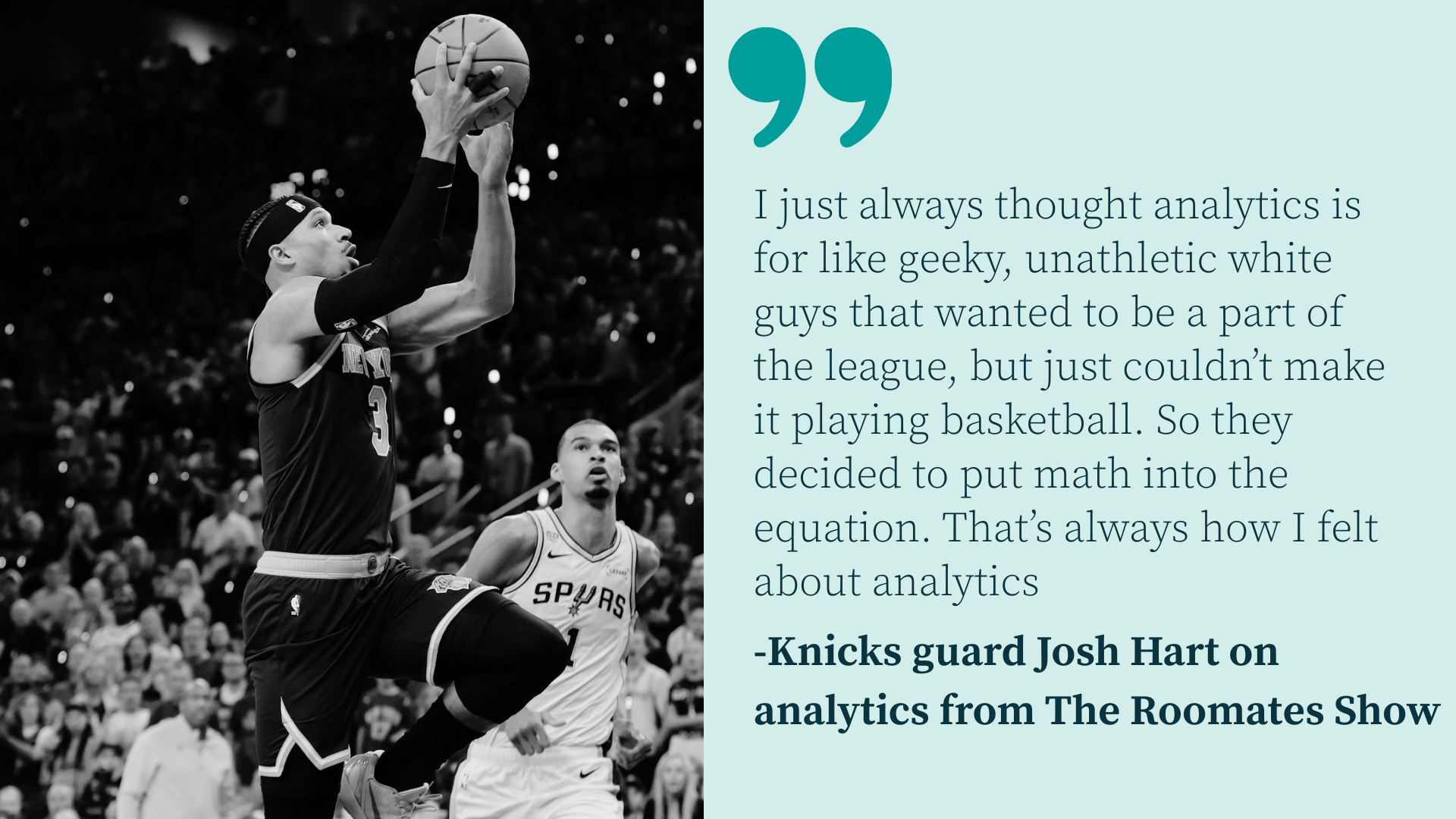
In response to this divide, Brown has called analytics a flawed way of viewing players. New York Knicks guard Josh Hart took it a step further, suggesting that analytics was for unathletic people that couldn't play the game. Many critics of the NBA agree with this assessment, placing the current spacing and three-point volume revolution in basketball at the feet of analytics—blaming it as the root cause of the loss of the artistry and creativity of basketball. Beyond the craving of a preference, however, the disdain for analytics and statistic-informed basketball thought presents a bigger conversation over our loss of the tangible and the cost of a society that has coveted optimization.
Modern basketball analytics as we know it today started in the beginning of the 2000s with Dean Oliver's "four factors" that broke down four statistics that contributed to winning: shooting efficiency, turnovers, rebounding, and free throws. That evolved into the introduction of Player Efficiency Rating (PER) to consolidate a player's performance in a single number, introduced by ESPN's John Hollinger.

But the true breakthrough of modern analytics in basketball was introduced with Daryl Morey and the Houston Rockets. Morey constructed the Rocket teams that featured James Harden in his prime years and used the guiding philosophy of three is greater than two to evaluate and sign players.
Morey and the Rockets distilled the game of basketball to a math problem. The philosophy prioritized high efficiency shots (layups and free throws) and higher value shots (three-point shots) as the backbone of an offense. The result was that his teams would focus on getting to the free throw line and would primarily shoot threes and attack the basket.

In the 2006-07 season when Morey was hired by the Rockets, NBA teams shot 52.7% of their shots at the rim or behind the three-point line. Long twos from 16 feet to the three-point line accounted for 22.9% of their shot diet. This past season, rim attempts and threes accounted for 74.6% of total attempts. This has come at the expense of the long two, which only accounted for 4.9% of shot attempts.
This shift has led to a rise in specialists over the years and the birth of the "Three and D" archetype—or more plainly, a player that has defensive upside and could make three pointers at a high rate. This approach has been widely used by several NBA teams and has resulted in defensively efficient wings being coveted by all NBA teams.
What this has diminished is the midrange technician and post dominant big archetypes. Because a post up shot or mid-range jumper are considered inefficient shots by the rules of analytics, they have been increasingly removed from the game. Players that scored like Carmelo Anthony or Hakeem Olajuwon, as a result, are rare.
The bothersome aspect of this is that by limiting accepted play style, and similarly the criticisms of Jaylen Brown's specific style of play, has created a formulaic style of basketball that fans often voice displeasure at. This era of spacing and rim pressure has caused more individualistic and creative styles of play to become endangered. But the effect of that is that teams have become more efficient in the shots they take; and the numbers show that analytics have optimized basketball—much in the way the rest of society has experienced a push towards full optimization.

Decades from now, we may remember the first quarter century of this millenium as one that has been defined by the quest for efficiency. The ubiquity of the smartphone proliferated and with it, many redundancies were consolidated. Devices like MP3 players, digital cameras, calculators, and step trackers were deemed to be unnecessary when the computer in our pocket could accomplish all those tasks adaquetely.
Having DVD's and music CDs became unnecessary when we could simply rent access to vast libraries for a monthly fee. It was an optimization of convenience and portability that we all willingly signed up for. Sure, a movie or album you liked might disappear, but it would be replaced by something else to consume.
Everything that has come to market in the smartphone age has often carried the focused message that it will make you more efficient and productive to focus on what really matters. As we have shifted into the age of AI, that optimization has struck more of a controversial tone.
AI has taken the idea of the creative and research process and concluded that it was too long—offering solutions via large language models. The result is a rising literacy crisis and an increased dependency on AI tools, shifting the way artists work. But during this time of ruthless optimization, there has been a pivot—a return to the tangible items of the past.

Led primarily by Gen Z that have only known the optimization era, several tools long thought to be extinct have started to make a comeback. MP3 players and digital cameras have both had a resurgence in an aim for the tactility and realism that has eroded in the smartphone age. Digital cameras are a step away from the HDR sharpened smartphone photos trained for social media algorithms, while MP3 players provide an escape from increasingly AI-optimized and bloated streaming music player experience.
There is an increasing appetite for physical experiences in the products we use. Analog watches have resurfaced instead of the constant notifications of the smart watch; vinyl records have made a fierce comeback as have DVDs. Even journals have seen a resurgence to escape the vortex of various doomscrolling apps. These trends are a rebuttal of the digital optimization of modern life, seeking a time defined by simplicity and enjoyment of a medium as opposed to mechanisms designed for constant scrolling.
The disdain for analytics in basketball is rooted in a similar rejection of optimization. Basketball, more than other team sports, offers a flair of personality that is evident in play style. Consider Magic Johnson as an example of this. Johnson is regarded by most as the greatest point guard in NBA history. His up-tempo style with flashy passes often mirrored the personality of the player off the court who was engaging and magnetic.
Or perhaps someone like Allen Iverson, who’s entire mythology is rooted in the small scoring guard that was relentless and did what he had to to win games. Iverson is far from efficient analytically, never averaging higher than 50% eFG% in his prime, numbers that would be considered problematic in today’s game. But his relentlessness is the point, and numbers alone don’t illustrate that.
In other sports like football or baseball, more emphasis is placed on mechanics and repetition, leaving less room for personality in the course of play—which is why celebrations are so important to player identity in those sports. It is that personality, the meshing of both the individual with on-court expression, that creates a fascination with basketball stars. Taking that away in the name of optimization creates a chasm.

Therefore, it's easy to understand why players like Jaylen Brown and Josh Hart would be opposed to analytics dictating the way they are viewed. Those two players have specifically caught the ire of analytically driven analysts. Brown's propensity to shoot long twos (31.7% of his shot volume in 2025-26) has labeled him a negative player in some respects.
Josh Hart, who possesses a unique skill as a rebounder and break initiator as a guard, is often diminished because of his inconsistent three point shot as a guard. Despite not being analytics sweethearts, both players were pivotal pieces on championship winning rosters—Brown as the 2024 Finals MVP and Hart as the emotional hustle engine of the 2026 Knicks. No one considers analytics negatives when Brown hits a clutch 20 footer or Hart tips a ball that leads to an offensive rebound in the moment for instance.
The eye test of the viewer shows us that both Brown and Hart are impactful players. Any diminishment of their abilities is a willingness to be obtuse about basketball. Similarly, a player that scores a lot but is inefficient in doing so cannot be deemed a true winning player.
As ever, there needs to be a level of nuance applied. In a world of smartphones, AI, and mobile applications, a return to a purely analog existence is impossible. So many aspects of day to day living—using public transportation, viewing a menu at a restaurant, using navigation tools—requires a connection to the internet and a smartphone app. Minimizing social media use, prioritizing offline experiences, and having purpose-built devices offers value in today's digital native landscape.

Similarly, in basketball relying on eye test or analytics alone is a fool's exercise. Analytics don't account for the flow of a game and the emotion of a moment on the court. Similarly, the eye test might show you a player that scored tough shots, but analytics provide necessary context about the effectiveness of that play style long term.
More than anything, the fervent adoption of analytics and data models in basketball is a symptom of a society obsessed with optimization and less focused on craft. That idea is unappetizing to many of us, which is why it bothers us on the basketball court. Sports are often meant to be an escape from reality, so when they start to mirror those realities, we don't like it.
As such, those that base all their basketball viewpoints on data feel like a representation of a world that many are trying to escape. This dichotomy is a reminder that a world viewed in absolutes is a flawed world. Deep down humans crave a sense of uniqueness and individuality; it's why any depiction of society as a monolith is often viewed as dystopian (as countless action movies set in the future have shown us).
If nothing else, the analytics versus eye test discourse is an oversimplification. Basketball players, like all human beings, are complex. There is no one size fits all metric to determining who is effective and who isn't. Being beholden to only advanced metrics in the way we see basketball is a symptom of the optimization era. We have mythologized efficiency to a point that it has clouded our better judgement and made us beholden to data as opposed to using it to strengthen what we see with our eyes.