
Dominique Malonga, Star Ascendent


Seattle’s second year center has continued to refine her game and could be a blueprint for what the position might look like moving forward in the WNBA
How would you define pressure as a professional basketball player? Would it be the expectations of being a high draft pick, maybe living up to the hype of your pre-draft scouting report? Or maybe it's being drafted to an organization that is used to winning and is one of the two WNBA franchises that have won four titles? If you're Dominique Malonga, it's all of those things.
In her second season in Seattle, the young French center is starting to elevate, unlocking the sort of potential that scouts saw in her time in LFB in France. But as she continues to refine her game amidst a developmental season in Seattle, we are left to wonder if we are seeing the beginnings of an emergence of another landscape-shifting superstar in Seattle.

The Storm have had their fair share of excellent players. It started with Lauren Jackson in the early days of the franchise's existence who won three MVP awards and All-WNBA eight times. It then transitioned to Sue Bird and Breanna Stewart, who amassed numerous all-league nods and All-Star Selections. From 2004-2022, the Storm won four championships and only missed the playoffs twice. This is an organization that is used to having star players and to winning.
That is the history that Malonga entered while also being the third youngest player in WNBA history to make their debut. As a rookie, she didn't start a game—appearing in 42 games and playing 14.3 minutes a night while Ezi Magbegor and Nneka Ogwumike dominated the front court minutes. This year, Ogwumike has departed to Los Angeles and Magbegor has only played in two games after sustaining an injury during international play.
That opportunity has enabled Malonga to get more minutes, up to 25.4 so far this season, and increased usage, up to 32.1% (a 6.7% increase over last year). The result for a team as young as the Storm (five of their top six minutes per game players are under 25) has been predictable—there have been flashes but a lot of losing. In that losing, however, we are starting to see the outlines of a superstar emerging in Malonga.
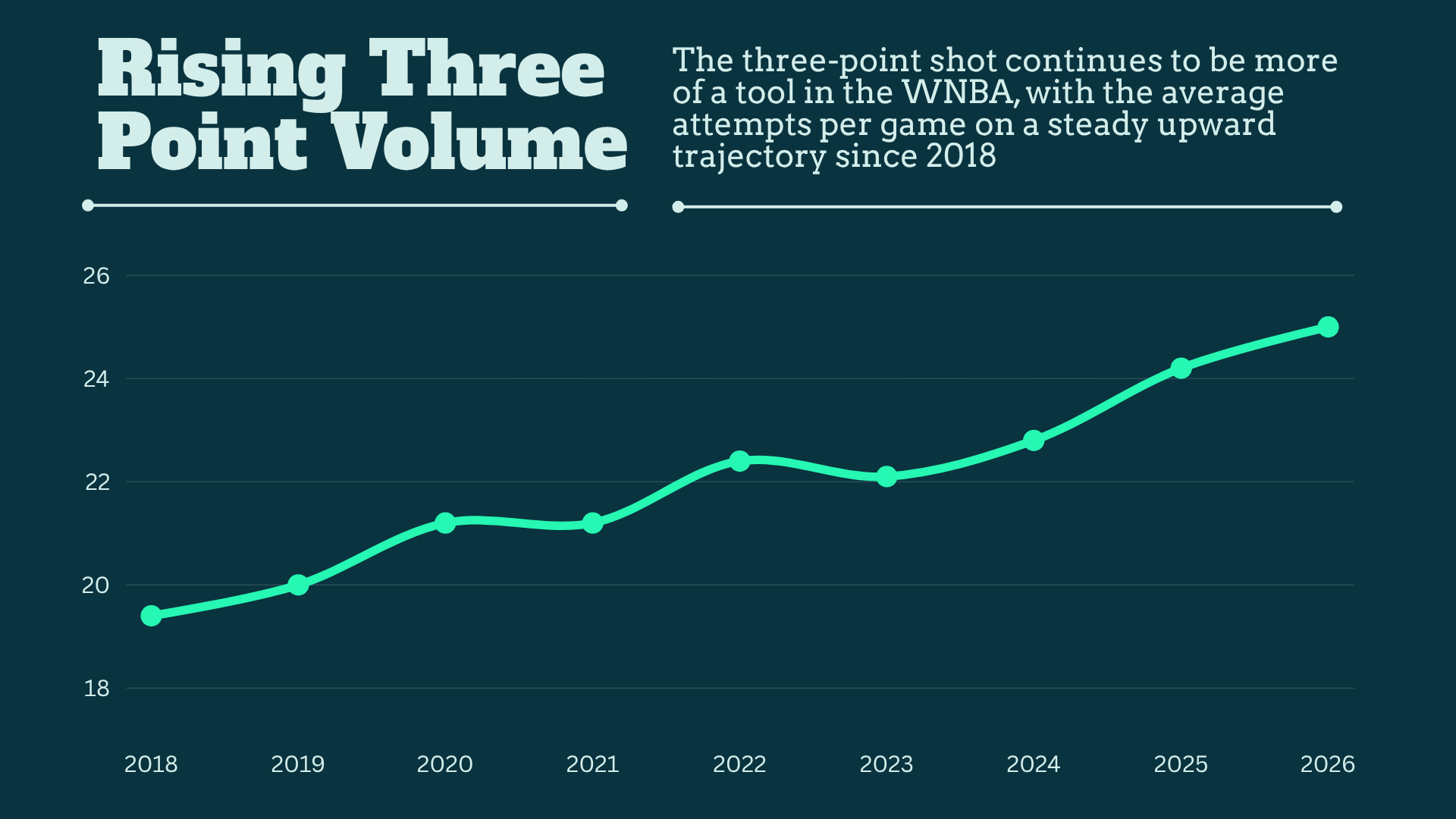
The WNBA is a league that is rapidly changing into one that is prioritizing the three-point shot. This season, teams are shooting 25 threes per game, accounting for 36.6% of the shot diet across the league. Compare this to 2018, when teams averaged 19.4 three per game, accounting for 28.3% of shots taken. Increasingly, WNBA teams need to have players that can be threats from deep and space the floor. Dominique Malonga, as a center, fits that new archetype.
In her rookie season, Malonga only averaged 1.1 three-point attempts per 36 minutes. This season, that number has increased to 2.7 attempts. Her raw shot attempts per game have quadrupled, but she has maintained excellent efficiency. She has shot 40.7% from three, with a heavy emphasis on above the break threes. This efficiency as related to volume is in line with other centers like A’ja Wilson and Jonquel Jones. But Malonga is proving herself to be more than a simple pick-and-pop center.
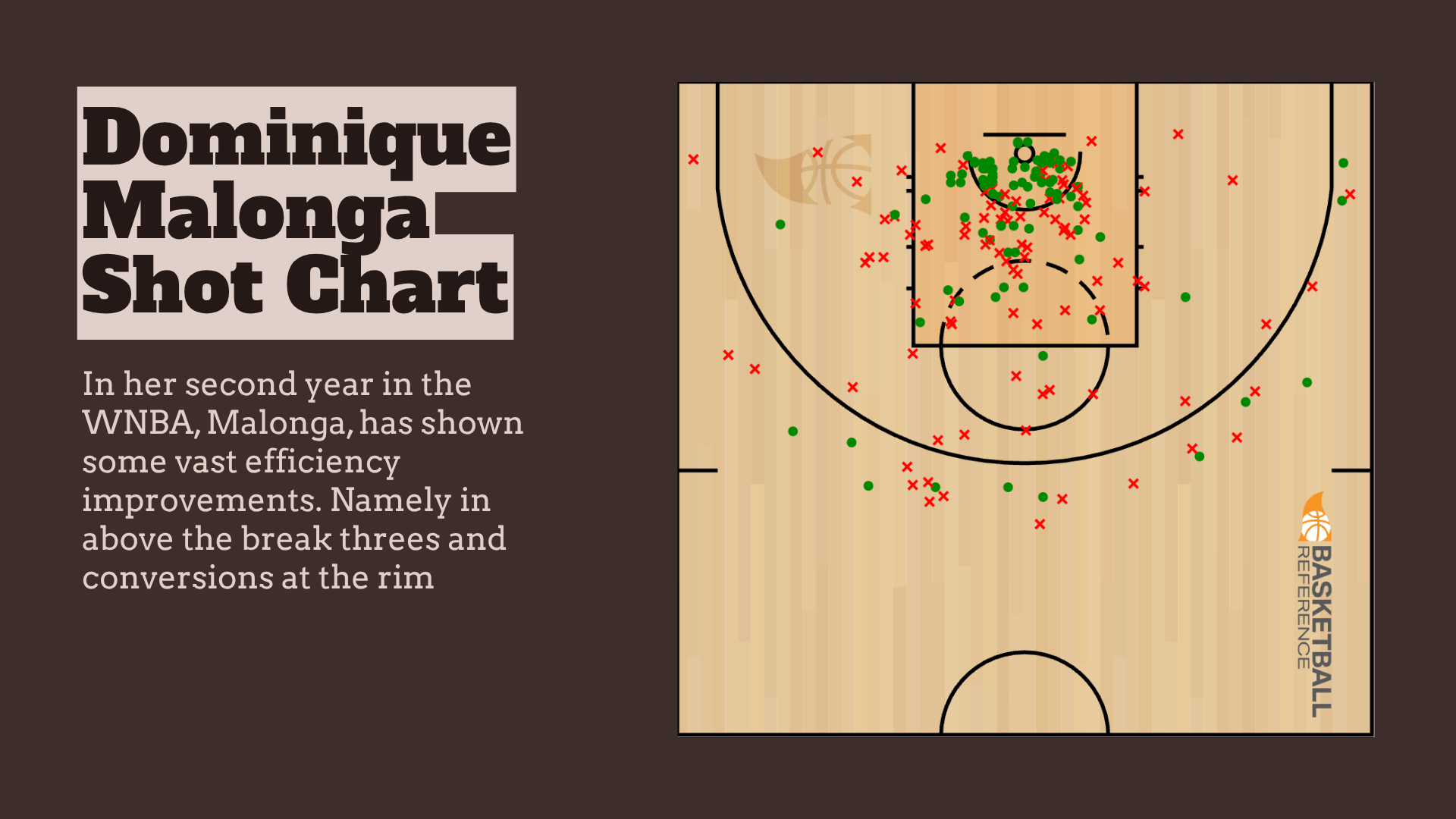
Malonga has often feasted inside the paint this season and is proving to be an adept finisher at the rim. At 87.2% rim attempt efficiency, she has been nearly automatic when getting to the basket. She has also started to incorporate a short mid-range game, adding a step-back mid-post fadeaway to her arsenal.
At 6’6”, she is able to get to a higher release point on these jump shots, giving her a natural advantage when defense collapse expecting an attempt at the rim. While the efficiency is not there quite yet (8-for-25 from the general vicinity of the free throw line as of this writing), the threat of her making that shot has to be respected—which poses potential problems for defenses as she works on the shot.
But even with all that tremendous offensive upside, perhaps the most intriguing aspect of Malonga’s development is on defense. She currently has a 4.5% block rate, which ranks 10th among centers in the WNBA with at least ten games played. Amongst those centers she is also sixth in steal rate with 1.6%. This combination shows the blueprint of a modern switchable center that can wreak havoc on opposing offenses. The outline is clear as a shot alterer that can use her length to also play passing lanes.
Malonga’s youth is also crucial to consider in any analysis of her game in its current form. Among WNBA players this season with at least ten games played, she is the second youngest. This is at times evident throughout games this season. While the physical tools have helped her refine on both ends of the floor, there are still lapses in judgement and poor footwork that put her in compromising situations defensively.
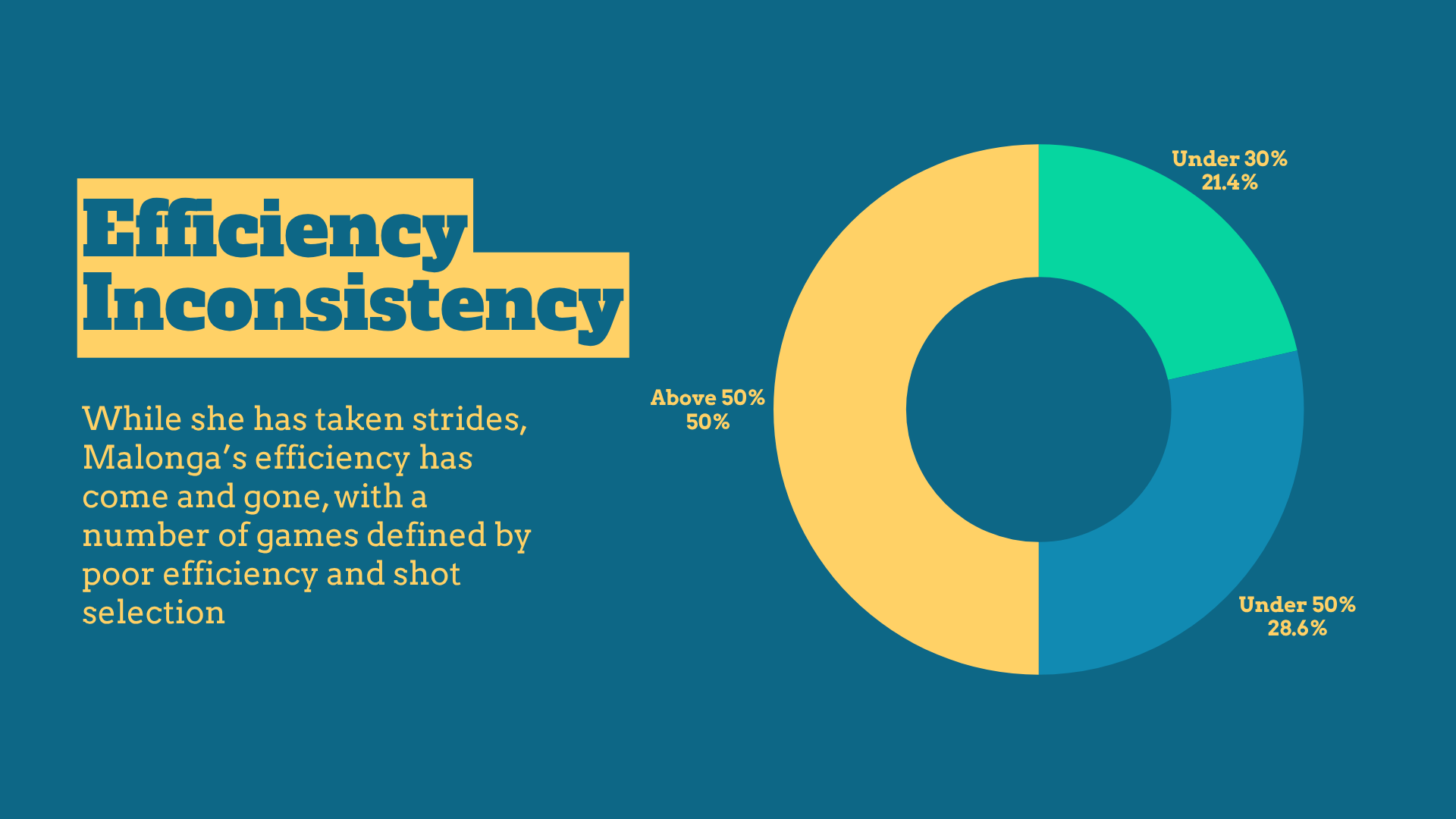
There are fluctuations in her offensive performance as well with 35% of her appearances featuring a field goal percentage of less than 40%. But she has also shown herself capable of dominance, as was exhibited in her June 22nd performance against Dallas where she scored 37 points.
With Malonga we are seeing the ups and downs of development. And it’s crucial to remember that most WNBA rookies are two years older than Malonga is right now in her second season. This is due to the league’s draft eligibility requirements that state that the player will turn 22 years old during the calendar year of the draft and has either no remaining college eligibility or formally renounces it in writing at least 10 days before the draft.
Looking ahead two years from now when Malonga is 22, it’s easy to envision a player that is averaging 24 points and 10 rebounds per game. That talent is there. She also seems primed to be a showcase for what the skillset that will be the blueprint of the modern WNBA center. She will have time to grow, especially with rookie guard Flau’jae Johnson who has shown flashes in her first season in Seattle.
The signs of greatness are there for Malonga, and she appears to be the sort of player that WNBA teams will covet in the future. A center that can slide into a positionless style, while providing switchability on defense and three-level scoring on offense. She feels like a superstar ascendent, a player with the potential to be dominant in this league. It feels like Seattle has once again positioned itself with a great cornerstone, and the way she unlocks her skills will be fascinating to watch unfold over the next few seasons.