
Russell Westbrook and the Art of Effort


A successful 18-year career reminds us of the importance, and rarity, of uncompromising effort in basketball and in society
Historically, America has always loved the story of the underdog that works hard and conquers the world. The notion of “rugged individualism” is built on the foundation of hard work leading to success. The divorce of the American experiment from the aristocracies of Europe helped mold these American stories, and for generations they became pillars of the American dream.
Russell Westbrook is a glowing representation of how far hard work can take you in basketball. An unheralded prospect in high school, Westbrook served as a bench player in his freshman year at UCLA before leaping off the screen as a sophomore as a hyper athletic guard that vaulted up draft boards with the same ferocity that he attacked the rim.
18 years later, he has retired from basketball and left the game with a legacy of tireless work ethic and the memory of a type of player that fans love to root for. Westbrook was the definition of hard work pays off, but as he exits, his archetype is an endangered species in basketball, and perhaps in American life.
On November 6, 2025, following a win against the Golden State Warriors that saw Westbrook record his 204th career triple double, he weighed in on his all-time standing as a rebounder, saying the following:
“Humbly speaking, I'm the best rebounding guard ever. So if the ball come across the rim, I'm going to get it."
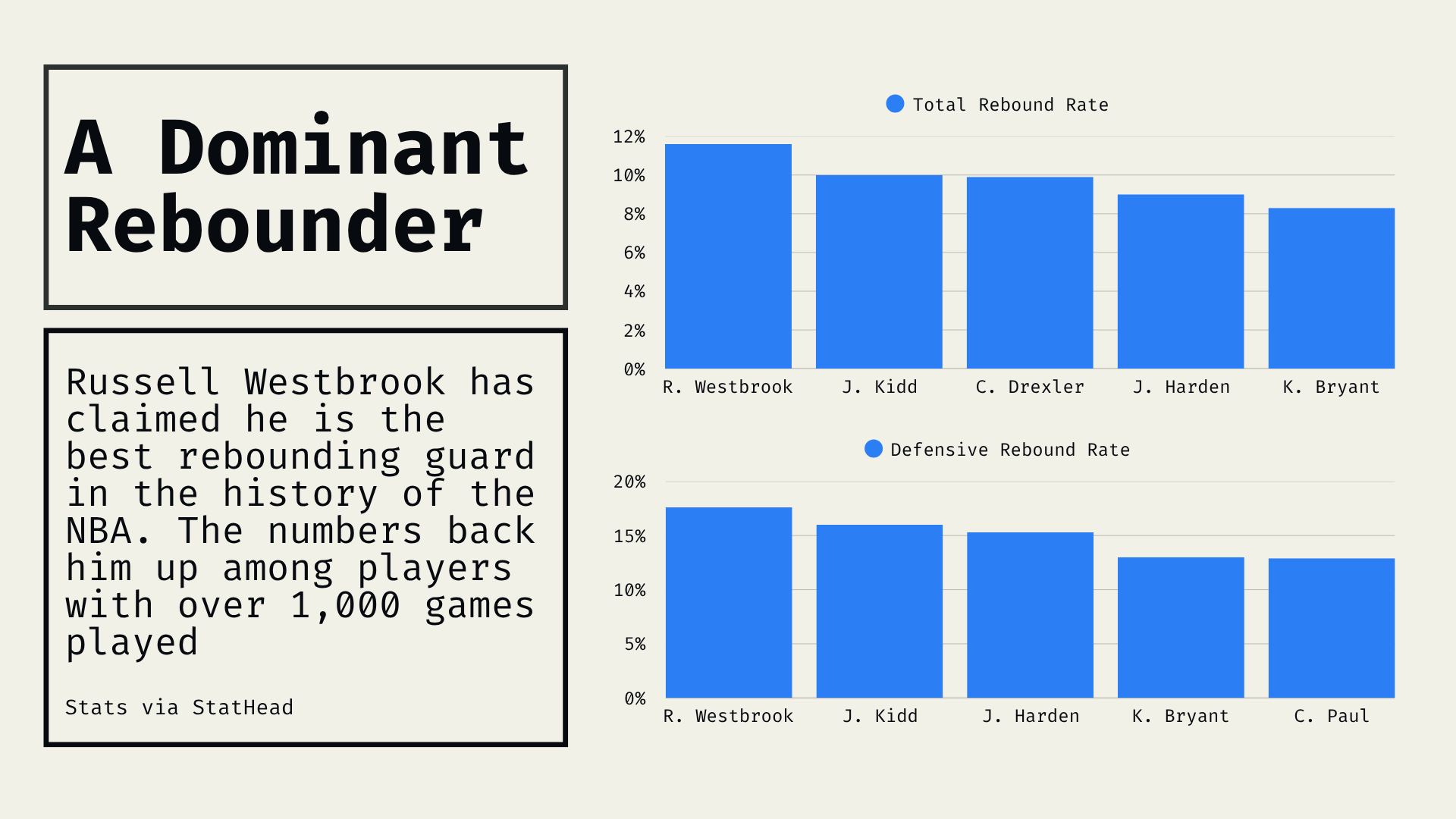
The numbers back up Westbrook’s claim. Among guards that have played in more than 1,000 games, Westbrook is the all-time leader in defensive rebounding rate and total rebounding rate, while ranking second in offensive rebounding rate (behind only Clyde Drexler).
Rebounding, more than any other statistic in basketball, is a skill predicated on effort and desire. It takes a lot, especially for a guard, to willingly navigate the lane to get a rebound. There’s a reason that Westbrook and Jason Kidd are the only two guards in NBA history with over 8,000 rebounds.
If each basketball trait had a parallel to a real-world job, rebounding would be a blue-collar skilled trades profession. Skilled trade positions like construction workers, plumbers, and electricians are facing an underdiscussed labor shortage. The reason for this is threefold: those in positions currently are inching ever closer to retirement, industry demand is outpacing talent availability, and younger generations are simply uninterested in the skilled trades.

Much of the issue for these industries is one of perception. Over the years, skilled trades jobs have been viewed as being too physically demanding and of carrying lower cultural status and offering limited advancement. In a world where social media influencing and tech have risen to the forefront; these career paths have become decreasingly appealing.
Beyond that perception, the prevailing theory is that to attain true success in America, you need a college degree. The merits of this thought are hotly debated, but it’s undeniable that many still view a college degree as a crucial marker on the path to success.
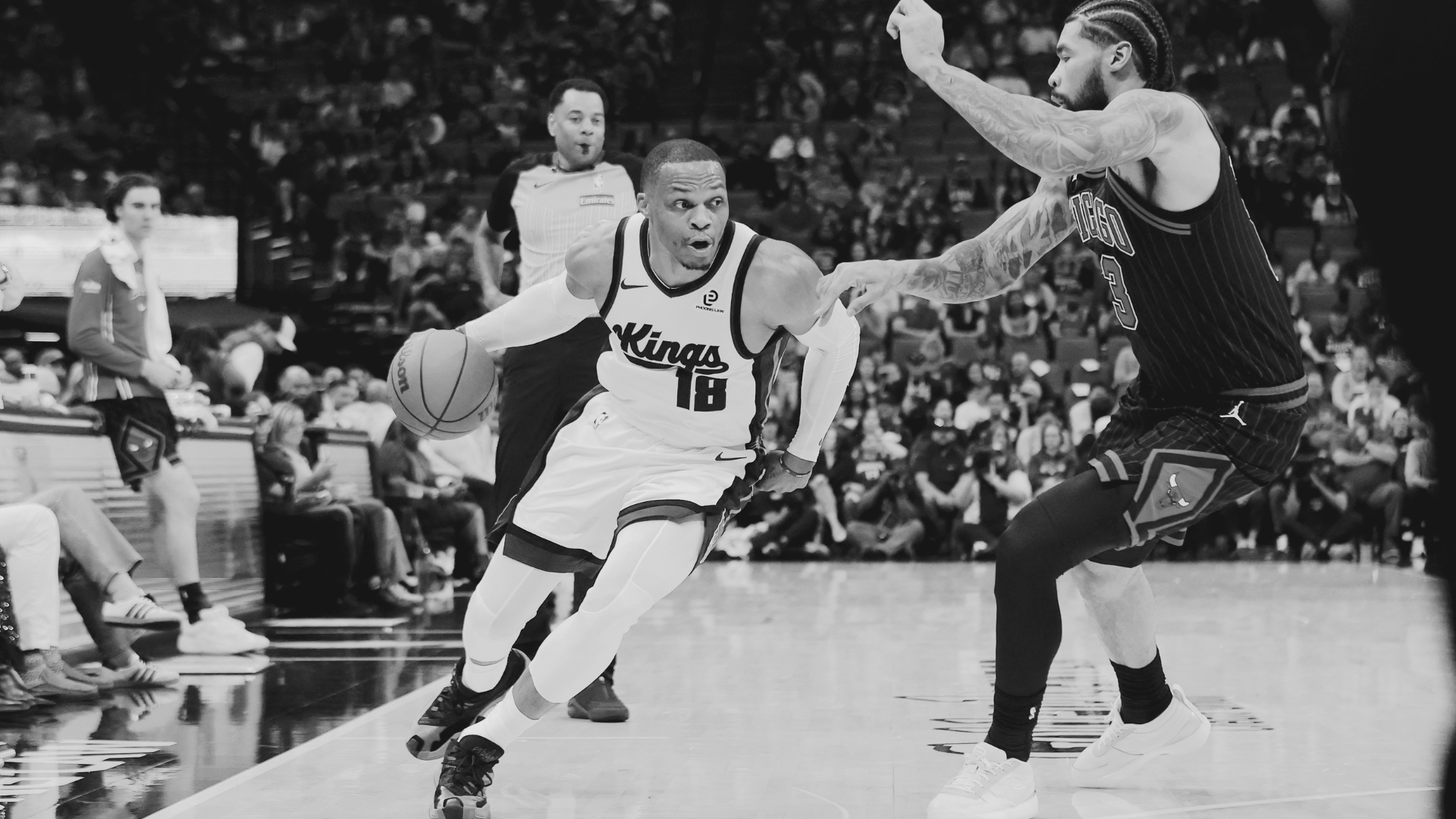
When Russell Westbrook entered the NBA, the workman-like approach that he took to the game was celebrated. By the time he left, it was looked at as more of a detriment. Much like the job landscape, basketball has changed. In Westbrook’s early years, scoring an inefficient 30 points was simply what had to be done. It’s the sort of perseverance that Allen Iverson immortalized.
But in recent years, the way we look at basketball has changed. True shooting and shot selection are crucial indicators of a successful player as opposed to simply racking up counting stats.
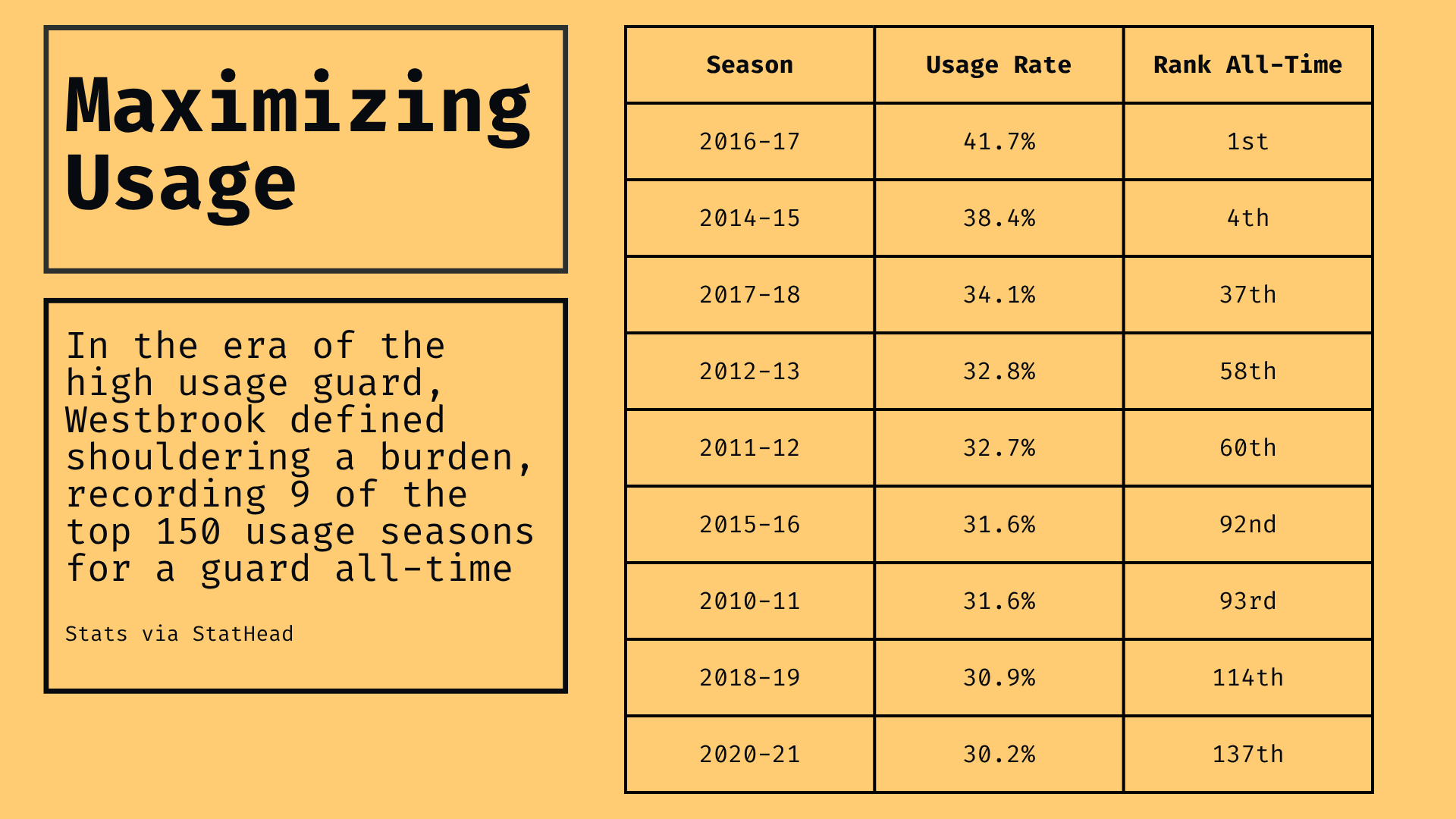
In Westbrook’s MVP season in 2016-17, he set the record for usage rate at 41.7%. That season was also third all-time in assist rate—an indication of how much of a burden Westbrook shouldered in the wake of Kevin Durant leaving for Golden State in free agency. His approach to such a massive roster loss was to simply play harder, the sort of idealized “pull yourself up by your bootstraps” mentality that politicians have been glamorizing for years.
For Westbrook, that was always the answer. If something isn’t working, simply attack it with more ferocity until it does work. After all, that’s how he rose to prominence at UCLA, vaulted up draft boards, and became an All-NBA player and MVP candidate. There is something incredibly analog about his approach, something that feels absent from the way we live life today.
In basketball and in life we have become obsessed with efficiency. The rise of cryptocurrency, sports betting apps, and prediction markets is proof of this. These mechanisms have been presented as ways to profit from real life, to make the news you consume, and the sports that you watch work for you—to make interests hyper efficient. They are often positioned as “get rich quick” schemes, to free yourself from a broken economy. An entire class of influencers has been born with sponsorships from these services to spread this gospel.

Creators that talk about gambling, prediction markets, and crypto investments often position their generation of wealth as easy and simple. That if they can do it, anyone can. They present an alternative to the adage of hard work eventually paying off—a tortoise and hare proposition if you will. With those promises of wealth comes an allure that is hard to resist.
That strategy has worked tremendously. A quarter of all men aged 18-24 have engaged in prediction markets, well outpacing the 14% national average. In fact, 26% of Gen Z men currently view sports betting as part of their long-term financial strategy. More often than not, a game is not just a game anymore, but a chance to hit it big with a parlay.
Prediction markets also enable users to wager on political events, business occurrences, and more under the guise of “investing”. It lends credence to the notion that everything is gambling and that there is an express lane to wealth and prosperity that previous generations never had, even if it is ultimately a mirage.
In basketball, the way we view excellence has also shifted. We covet specialists more than all-around players for the most part. Shot blockers, three-point shooters, and perimeter defenders are all crucial parts of team building. But players with maximum effort are often relegated as more disposable in today’s game.
Westbrook witnessed this happening, where his three-point shooting ability, or lack thereof, made him a journeyman jumping from team to tanking team in the twilight of his career. Consider the way Josh Hart is often perceived as evidence of this. Hart was a key piece to the Knicks winning the title this year, but his impact was often reduced to him being a streaky shooter from the outside. It seems that players that play with energy and relentless effort are somehow overlooked in an NBA obsessed with efficiency.
Westbrook’s services, like skilled tradespeople, have become somewhat underappreciated. His pure force when attacking the basket opened opportunities for three different options: a rim attempt, a kick out, or a pull-up mid-range jumper that he shot with decent efficiency in crucial moments. The raw efficiency numbers don’t tell the full story of his impact, as Westbrook was beloved as a teammate and a community member wherever he played. That should matter.
In a world that is continuously being monopolized by lifeless visions of the future by tech oligarchs, there is a thirst for personality, for effort, for caring. We have come to crave the flaws in art, return to less efficient devices to escape our endless trap of algorithmic social feeds, and use photographic filters that bring back imperfections. In an AI-dominated world, there is something to be said for having something or someone that makes us feel the tangible.
Russell Westbrook played in a way that was filled with emotion. Was his game flawed? Absolutely. But his effort could never be questioned, and when he was at the peak of his powers, there were few players as captivating or polarizing. Westbrook, inefficiencies and all, made the NBA a fun place. In a game where player prototypes have been transformed into amorphous blobs that shoot 38% from three, he was an outlier. A reminder of a former era filled with expression and callouses.
Westbrook made it to the Finals once, in 2012 when the Thunder lost to the Heat in five games. The last two games of that series provided the majesty (20/29 for 43 points in Game 4) and tragedy (4/15 for 19 points in Game 5) that encompassed Westbrook as a basketball player. History will lament the fact that Westbrook never got back to the pinnacle and that he ends his career alongside greats like Patrick Ewing and Charles Barkley who never won titles as players.
But in a way, his ethos and his memory don’t require that. We will always remember him averaging a triple double and winning MVP. We will remember him as a player that defined the Oklahoma City Thunder. And we will remember him as a ruthless competitor who never cheated the game. Like the hardworking American ideal, Westbrook has the satisfaction that comes from a job well done and a career well served. As he leaves us for whatever comes next in his life, we are left to think about his career, what it meant, and pining for the days when that sort of determination and commitment wasn’t so rare.