Donald Trump & a Decades Long Obsession with the NFL
Before he was the President of the United States, Trump had dreams of owning an NFL team. The league’s rejection of him has turned into a fixation that can never be satisfied.
Donald Trump has been in the limelight in some form or another for the last four and a half decades. It’s a run of relevance that rivals just about anyone in modern pop culture. He has done it through a variety of mediums: real estate, casinos, reality TV, various business ventures (or grifts depending on your perspective), social media tirades, and most recently the presidency of the United States.
He has successfully inserted himself forcefully in all these spaces, anointing himself the biggest figure and the center of the universe—but there is an exception. Trump has long desired entering the ranks of NFL team ownership. But the chance has eluded him, which has created a longstanding obsession with the league.
That’s why his recent comments on holding up the Washington Commanders new stadium deal if they didn’t revert to their old team name is no surprise. Trump craves power and being considered a societal elite, but the most exclusive rich guy club that we have in the United States has repeatedly said no. It has created an obsession with the NFL that further shows Trump’s insatiable desire to be a topic of conversation.
No Seat at the Table
In terms of investment, few things are a surer thing than buying an NFL team. The country is obsessed with the sport, which has led to skyrocketing media deals. The current deal in place is valued at $111B and will likely increase exponentially when it’s renewed as streaming networks like Netflix and Apple TV continue to express interest in broadcasting live sports.
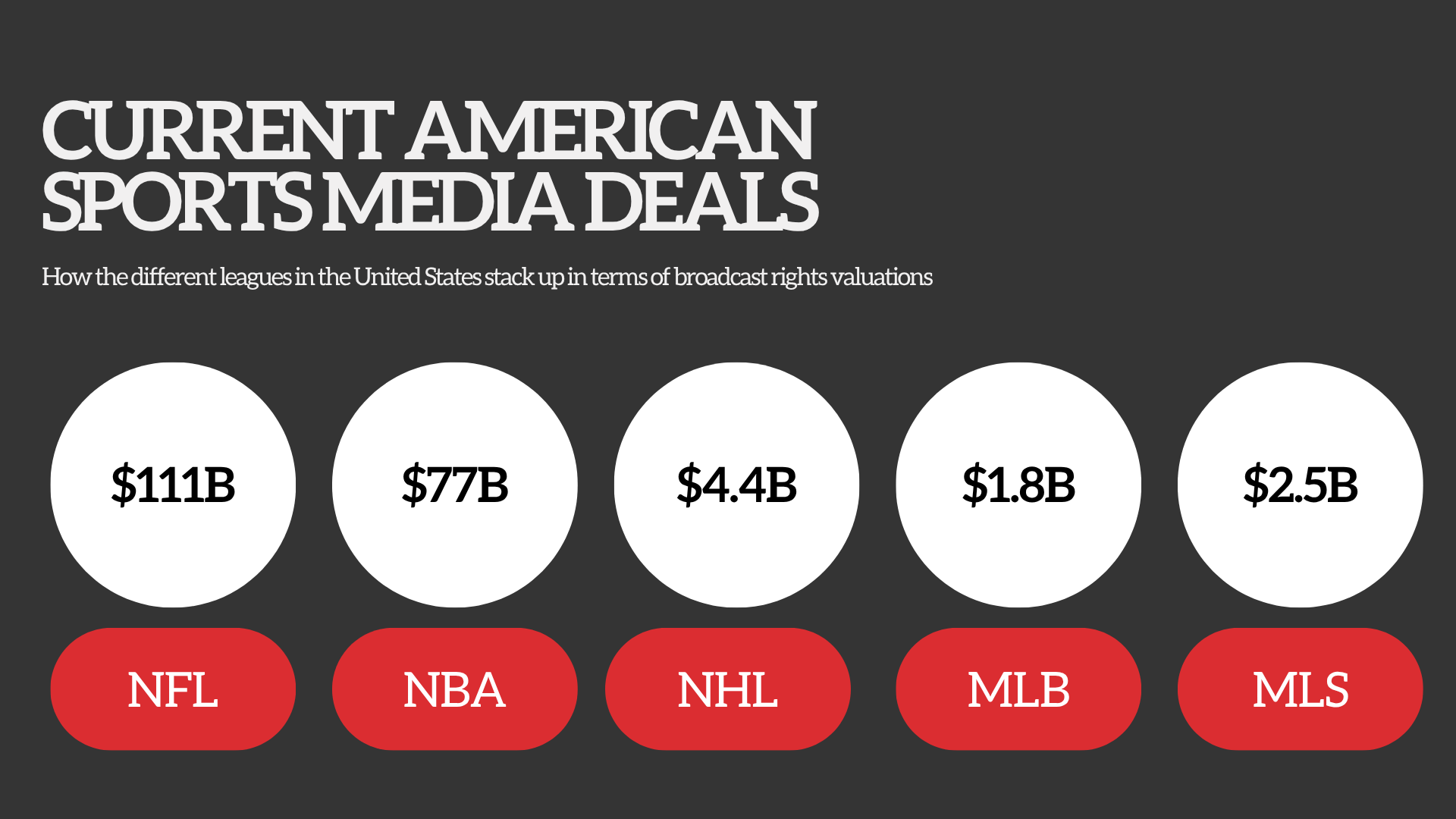
NFL owners, it can be said, are members of one of the most exclusive clubs around. It’s easy to see why someone like Trump, who is addicted to the idea of exclusivity and power, would want to be a part of that group. It is comprised of other powerful people who are often cheered when stadium cameras pan to them in the press box while they accumulate money and sign checks. That’s rocket fuel for someone like Trump.
But desire does not equal reality. He attempted to buy the Baltimore Colts (who later were relocated to Indianapolis) twice—once in 1981 and again in 1983. Both times Trump was rejected by Colts owner Robert Irsay. Trump denied having interest in the Colts, likely to save face, but that has been disputed as a false denial by multiple sources.
Trump tried again in 1984 with the Dallas Cowboys. He was reportedly interested in buying the team for $50M but ultimately passed because he viewed the Cowboys as a “no-win situation” and that there was little room for innovation with such an established entity as an NFL team. The Cowboys franchise today is the most valuable sports team in the world with a $10.1B valuation. It is likely Trump’s biggest business blunder, which is saying something as he has had six businesses file for bankruptcy throughout his career.
Never one to quit trying or attempt to take a hint, Trump tried once again to buy a team in 1988. This time it was for the New England Patriots for an estimated $80M—ironically, his investment group included current Patriots owner Robert Kraft. Trump ultimately decided to pull out of the negotiations, stating that purchasing the team would mean taking on $104M In stadium debt. Then NFL commissioner Pete Rozelle reportedly preferred Trump not to buy the team because of his involvement with the United States Football League (more on that later) and Trump’s ownership of casinos (this was long before the NFL embraced legal gambling). Trump was yet again foiled, and he stayed away from NFL ownership for a while.
That was until 2014. The Buffalo Bills were for sale and Trump once again emerged and expressed interest in buying the team. He was bidding against a group that was led by musician Jon Bon Jovi, who many feared would move the Bills to Toronto. To combat this, Trump deployed Michael Caputo, a political operative of the Republican Party to run a smear campaign against Bon Jovi—turning him into public enemy number one in Buffalo.
The team was eventually purchased by Terry Pegula, who also owns the Buffalo Sabres NHL franchise. Trump’s offer was $1B while Pegula offered $1.4B and secured ownership of the franchise. There was skepticism that Trump even had the money to make a formal bid, since he missed the deadline to do so. Trump claimed he did make an offer but then backtracked and said that his only goal was to keep the Bills in Buffalo and that he succeeded in his mission.
It was later reported in 2019 that Trump had attempted to inflate his net worth to secure a loan to buy the Bills. Michael Cohen, who served as the Trump family attorney, stated that Trump would often manipulate numbers to make him appear wealthier than he was. He did this in the past to appear on the Forbes wealthiest people list, for instance. When he tried and failed to buy the Bills, his foray into politics was born.
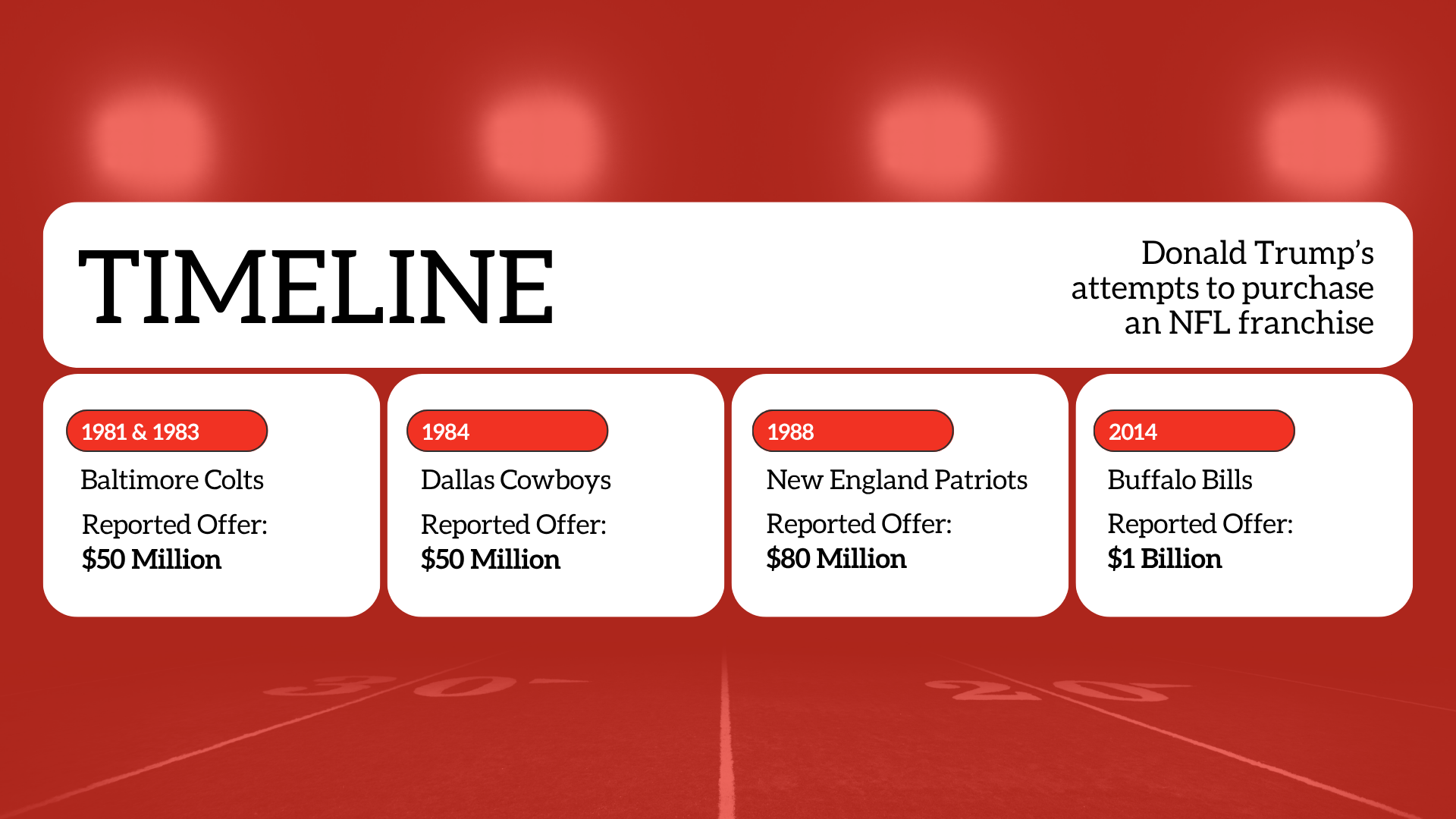
Five attempts, five failures. The NFL clearly stated that it wanted nothing to do with Donald Trump as an owner. Instead of leaving the venture alone and admitting defeat, Trump does what he has always done: do his best to discredit and mock his fabricated enemies.
Going to War with the NFL
Trump’s most direct course of action in retaliation to the NFL rejecting him was purchasing the New Jersey Generals, a football team in the rival United States Football League (USFL). The idea of the USFL was a simple one: people love football, so why wouldn’t they want something to watch year-round. That has been the motivating factor for the establishment of every spring-time football league for decades.
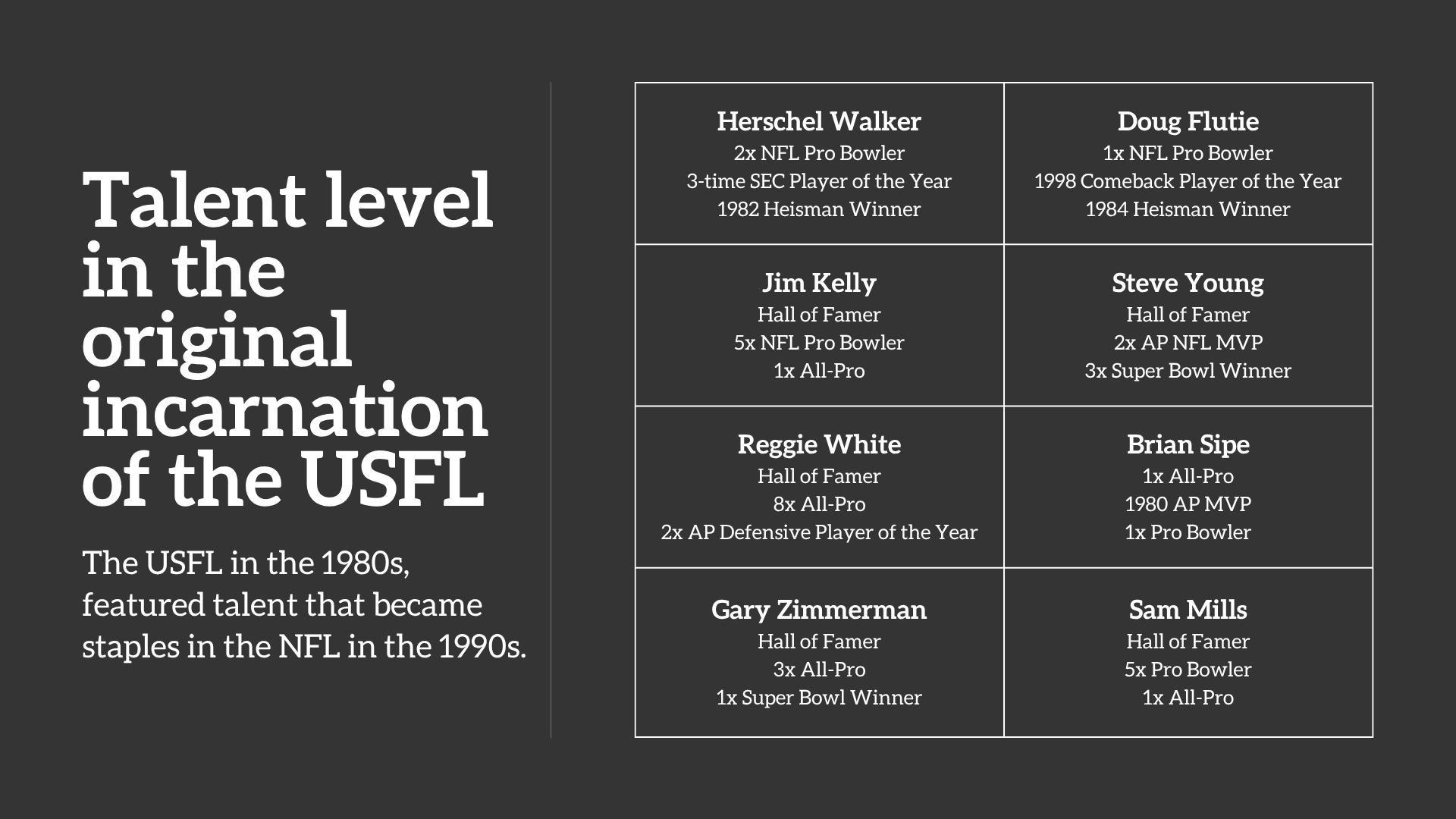
The difference between the original incarnation of the USFL and the rest of the spring football leagues is that they were getting real talent through the door. Jim Kelly, Reggie White, Steve Young, Herschel Walker, and Doug Flutie all spent time in the USFL before dominating in the NFL. The league was taking advantage of a time of stagnation in the NFL and building momentum with an exciting new product.
After the league's first season, Trump joined the ownership ranks. The league was positive about his addition to the fray because of his celebrity and how it could assist in the marketing of the young league (it cannot go understated how big of a deal Trump was in the 1980s). Trump got to work immediately, making waves by bringing in Herschel Walker and eventually Doug Flutie. The team improved immediately and finished 14-4, making the playoffs.
It seemed for a moment, that Trump had what he always wanted. He was the owner of a professional football team that played in the New York City market and the team was doing well. From a public relations perspective, it was a dream for him.
But it wasn’t the NFL, and Trump didn’t forget how he was denied a seat at that table. He wanted to make the NFL pay for rejecting him. The way he would do this was to move the league from its established spring schedule, where it didn’t directly compete with the NFL, to the fall.
Even when he carved an alternate route, the NFL was still Trump’s obsession. His vision was to move to the fall, show that the USFL was a viable product, and then ultimately merge the two leagues. And because Trump was the owner of one of the more viable teams in the league, he could then become an NFL team owner by default. There was a precedent for this idea working to be fair. The NBA and ABA merged in 1976, and the NFL and AFL merged in 1970. Both instances resulted in teams making the move to the more established league.
The plan failed spectacularly. While they were planning a move to the fall, the league was also suing the NFL for monopolistic practices at the urging of Trump. The case that the USFL was making was that the NFL, who had relationship with the three main broadcast networks, urged USFL games not to be broadcast, thus ruining the financial viability of the league. Once again, Trump’s hope was to force a merger with the NFL, making him a de facto NFL team owner.
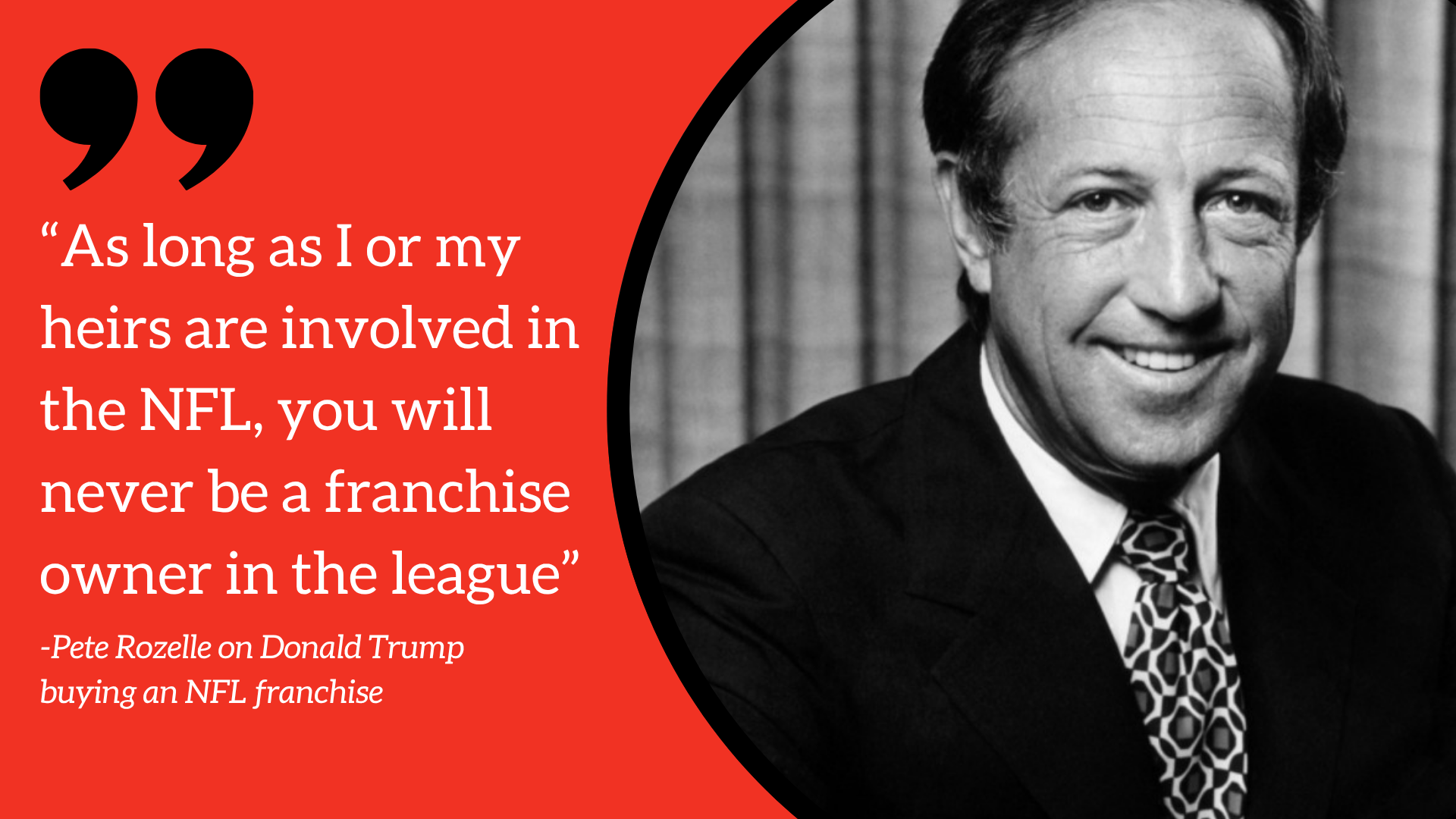
During the trial Trump met with Rozelle to try and negotiate moving the Generals to the NFL. Rozelle denied his request vehemently, stating “As long as I or my heirs are involved in the NFL, you will never be a franchise owner in the league”. The USFL would ultimately win their suit, but the payout was only $3 because while the NFL operated in a monopolistic manner, they were not the sole cause of the USFL’s financial troubles. The USFL appealed against the case, which resulted in the postponement of the 1986 season.
The league folded just six days later. It is widely believed that Donald Trump, in his quest for belonging with the NFL, helped accelerate the death of a promising spring football league. His push to move fast and compete more directly with the NFL before the league was ready was detrimental, as was the investment of resources into the lawsuit. Trump, forever oblivious, doesn’t see it this way—insisting that his involvement helped extend the runway of the league and helped to further boost his image.
Once again, it could be considered that maybe the writing was on the wall and Trump should move on. But as we have learned, he is incapable of accepting fault. After the USFL disaster he tried to buy his way into the NFL two more times (detailed above). When it became clear the NFL would never allow him as an owner, he took another tact: creating political theater to fracture the league.
Rallying the Base
Shortly after failing to purchase the Buffalo Bills, Trump transitioned into his next conquest: the presidency of the United States. Trump later expressed gratitude on not winning the team, as it allowed him to take his candidacy for the nation’s highest office more seriously. While he was making this pivot, his pettiness towards the NFL still reigned supreme—and he made sure that his presence was felt by league from his substantial digital megaphone.
In 2016, San Francisco 49ers quarterback Colin Kaepernick began his kneeling protest to speak out against police brutality suffered by Black people in America. What started as a small, isolated non-violent protest became a talking point thanks to Trump. Ever the chaos agent, Trump used the protest to fan culture wars against Black players and criticized the NFL for allowing players to disrespect the flag of the United States.
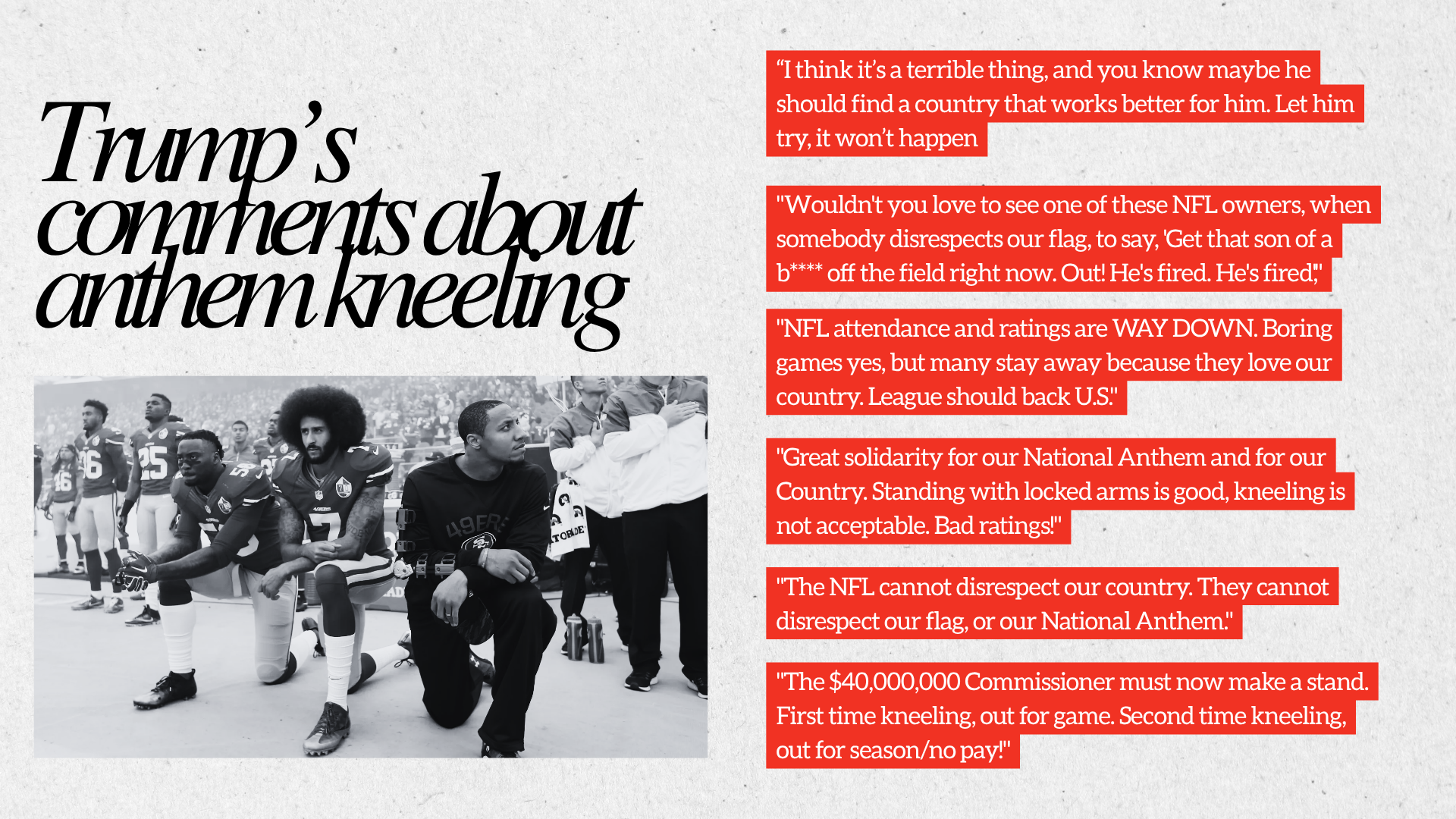
Trump would go on to say that players should be released (he used the term “fired”) for disrespecting the flag and urged his growing base of supporters to boycott the NFL. While it was absolutely a case of a political candidate using a pop culture moment to endear himself to potential voters, it was a full display of the pettiness that Trump is capable of. He hadn’t forgiven the NFL for denying him the opportunity to sit at the owner’s table and he wanted to punish them for it.
Trump pushed the envelope on the anthem issue which resonated with many Republican voters who supremely value patriotism in a leader. The pressure from Trump and his supporters worked, as NFL ratings fell in 2016 and ultimately the league pivoted from allowing players to kneel with a show of hands vote in 2018. This was a clear win for Trump on an issue that he made his base care about.
Trump’s opinions on the NFL hold weight because it is a sport whose fan base skews a bit more conservative than liberal, so the thoughts of a conservative president ultimately matter to the league on some level. Trump has often mused about rule changes such as the new kickoff rule and even uninvited the Philadelphia Eagles from the White House in 2018 after it was made clear that many Eagles players would not be present for the ceremonial Super Bowl champion White House visit.
More than most presidents in our lifetime, Trump has been a president that has cared about and been deeply invested in sports. He has hinted at an upcoming UFC event at the White House, has strong (and damaging) opinions about transgender athletes, and was a fixture with the WWE for many years. But with the NFL it often feels personal and is used as a device to make a radicalized base somehow more radical.
Trump as a political entity has thrived on stoking division. His second term is proof of this, as he has offered a platform to white supremacists and dismantled DEI initiatives that can only be considered racist. He has also put pressure on corporations to do the same, which has led to a deeper lack of diversity in corporate America.
Him urging the Commanders to revert to a name that many have deemed racist is no surprise, but it is a statement with two layers. The first is that the advocacy for the old name has been a talking point of many conservatives, who decry the changing of team names as “woke culture” and “cancel culture”. So, in that sense he is simply pandering to his MAGA acolytes. But the second layer is that he will never forgive the NFL for denying him a team so many times over the years.
Trump’s antics when it comes to the NFL are an obsession and passed the point of general interest many years ago. Whenever there is any issue with the league, he feels compelled to speak about it because of his insatiable desire for political theater and bitterness of being denied membership to a club he desperately wants to be a part of.
Trump craves being the center of attention, and there is no spectacle in modern America that offers that more than the President at a football game. It’s why he has frequently made appearances at college football games in the Deep South and why he became the first sitting President to attend the Super Bowl.
Trump is obsessed with the NFL. It’s a world that has eluded him for over four decades now. For someone that considers himself so profound it must eat away at him that the league never embraced him in that way. And as long as that is the case, he will continue to have strong (and wrong) opinions about the sport and the league at large.
Thanks for reading Deep Cover! This post is public so feel free to share it.