Football, Politics, & the NFL’s Audience Calculus
What the recent Charlie Kirk tributes say about a long-running strategy of political positioning
September 10, 2025 was a dark day for America. There was yet another school shooting—the 161st of 2025—this time at Evergreen High School in Colorado, at 12:24 PM. Fourteen minutes before that happened, conservative political personality and co-founder of Turning Point USA, Charlie Kirk, was shot in the neck during a leg of his “The American Comeback Tour” at Utah Valley University. Later that afternoon Kirk, tragically, was pronounced dead, another high-profile instance of rampant gun violence in the United States. All this happening the day before the 24th anniversary of the September 11th attacks created a moment of massive grief and emotion across the country.
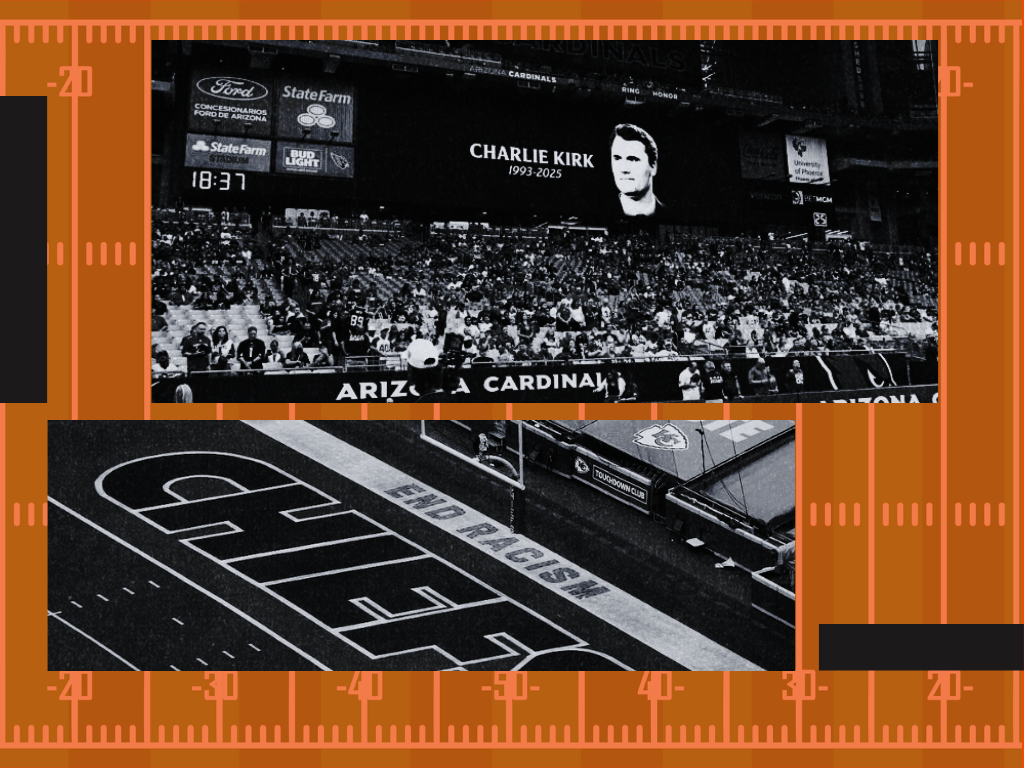
The following day, the NFL played a game in Green Bay, Wisconsin. The Packers held a moment of silence for Charlie Kirk (while notably not mentioning the school shooting in Colorado), with the PA announcer saying that “the NFL condemns all violence in our communities. It will take all of us to stop hate”. Over the weekend, seven other teams held moments of silence for Kirk, while the Steelers flew American flags at half-staff and the Vikings and Texans held moments of silence for all victims of gun violence.
The NFL chose to honor a political pundit that wasn’t directly connected to the league, but has made comments about the league in the past. Kirk notably used racist rhetoric to describe Cowboys fans, suggested defunding the league, and criticized the NFL’s inclusivity efforts. The league and several teams choosing to honor someone whose views appear to be at odds with the image the league has emphasized since 2020 certainly seems curious on the surface. This decision appears consistent with the NFL’s pattern of pragmatic positioning around political moments.
Debunking the Separation of Sports & Politics
For many years, commenters in conservative circles have advocated for a division between political causes and sports—often citing that sports is an escape from the political realities of the modern world and should stay that way. It’s a novel idea, except that the two entities have always been intertwined.
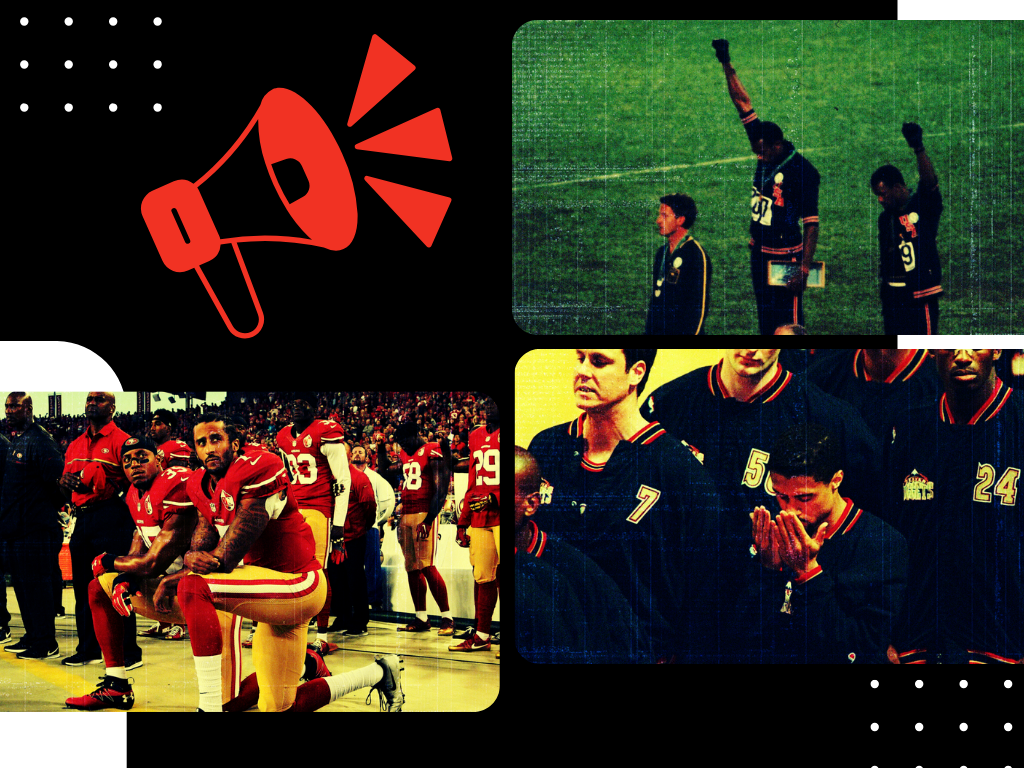
Sports has long been at the forefront of causes like the Civil Rights movement with the efforts of Black athletes like Jackie Robinson, Bill Russell, and Jim Brown. In 1936, American track star Jesse Owens defied Adolf Hitler’s view of Aryan supremacy by dominating and winning medals at the Olympics in Germany. In 1968, Tommie Smith and John Carlos raised their fists in a Black Power salute at the podium as a way of protesting the treatment of Black people in America. And Muhammad Ali refused to serve in the Vietnam War as an act of protest to a war he didn’t support and didn’t align with his Muslim beliefs.
In modern times, NFL quarterback Colin Kaepernick and NBA player Mahmoud Abdul-Rauf staged national anthem protests to speak out against police brutality and systematic oppression, respectively. During the NBA Bubble in 2020, players refused to play in playoff games in response to the murder of George Floyd and the growing tensions between the Black community and police officers. The history of politics and sports intersecting is long and consistent, which is what made Laura Ingraham’s “shut up and dribble” comments towards LeBron James so misguided.
The NFL has often aligned itself with political stances that have some level of mass appeal. It’s messaging around Kirk’s moment of silence has been a broad strokes condemnation of violence without acknowledging the nuance of Kirk’s past comments when it comes to his views on gun violence. In the wake of the George Floyd murder, they shied away from putting “Black Lives Matter” on the field of play the way that the NBA did. Instead they chose a more universally palatable message of “End Racism” and “Stop Hate”. Going back to 2001, the league’s stance has always been to not ruffle too many feathers and follow the trend that the nation seems to be heading politically.
The NFL’s Political Flexibility
The NFL’s history of making statements that move outside the boundaries of a football field can be traced to September 11, 2001. In the wake of the attacks that upended the notion of American life when the World Trade Center was attacked in New York City, the league suspended play for a week and made the decision to resume the season on September 23rd. That moment triggered a moment of patriotism across the sports world and the nation, but specifically in the NFL and MLB.
President George W. Bush threw out the first pitch in Game 3 of the World Series between the Arizona Diamondbacks and New York Yankees while wearing a bulletproof vest under an FDNY jacket—a powerful symbol of national unity and solidarity with the city after the attack. When the NFL returned it was to messages of unity with American flags all over the stadium. The league crossed the threshold of just being a sports league and became a symbol of American resilience.
That moment ushered a period of national pride and patriotism in the NFL, with the national anthem gaining more prominence, flags becoming staples of pregame festivities, and gestures honoring the military (plane flyovers, Salute to Service merchandise). These actions were all fitting of a league that aligned itself with the ideals of a nation that soon found itself engaged in multiple wars in the Middle East.
In 2016, the Black Lives Matter movement began gaining momentum as police brutality against Black people reached endemic levels. Beyoncé performed at the Super Bowl that year and during her performance of the song “Formation”, her backup dancers were dressed as members of the Black Panther Party. The show was a clear commentary on the plight of being Black in America at that moment, and it led to many conservative voices to criticize the singer for being anti-police and anti-White.
Later that year, San Francisco 49ers quarterback Colin Kaepernick began his national anthem protests to draw attention to ongoing issues of police brutality. When it started picking up steam in the press that he was kneeling during the anthem, the NFL was initially standing behind its player. The league said that “players are encouraged but not required to stand during the national anthem”. The 49ers also expressed support, highlighting Kaepernick’s right to decide to participate in celebrating the anthem.
This initial response shows a league that read the room and found it to be a fitting strategy to embrace freedom of expression when it came to the national anthem and statements about the state of America for Black Americans. They simply saw the way the cultural winds were blowing and didn’t go against the grain. As the political landscape then shifted to the Donald Trump era, the tune of the league started to change.
In September 2016, commissioner Roger Goodell said that while he didn’t agree with Kaepernick’s protest, he was free to protest, while reaffirming his own sense of patriotism. Trump began to gain momentum and weighed in on the issue suggesting that Kaepernick disrespected the nation and should leave the country. As soon as the Trump presidency took hold, Kaepernick appeared to be blackballed by the league, an indication that the teams in the league were aligning with the right-wing trajectory of the nation.
Trump’s comments about anthem protests intensified, saying that players should be cut for protesting. He then doubled down on his stance, suggesting that fans start to boycott NFL games as long as protesting was allowed. The league, noticing that Trump will not back down on his stance on anthem boycotts, instituted a rule in 2018 that players cannot kneel on the field during the national anthem. Once again, the NFL appeared to adjust to shifting political winds. The move aligned once again with protecting brand and revenue.
In 2021, after the end of Trump’s first term and the murder of George Floyd, the league introduced its pro-diversity messages on helmets and in the end zone. Again noticing that there was a moment where togetherness was needed, they flowed with the winds of culture. At this time, leagues were honoring their Black players as Democratic lawmakers wore Kente Stoles and took a knee as they announced police reform legislation. What followed for the league was a 10-year, $250 million commitment to combat systemic racism.
But as a second Trump presidential term became a reality, it was time for another shift. With the announcement that Trump would be attending Super Bowl LIX, the league removed the “End Racism” messaging from the end zone—since it would have clashed with his messaging and talking points of the MAGA movement. The messages returned this season, further indication of the league following political trends in hope of not ruffling the feathers of the man that occupies the White House.
With all this history in mind, it is no surprise that the NFL and its teams chose to hold a moment of silence for Charlie Kirk and not the countless other atrocities that exist in the country today. The league has once again taken the political temperature in the room and decided that it was best to fall in line. In the wake of the Charlie Kirk assassination, the Carolina Panthers have fired an employee for his comments on Kirk’s death, which is one of many firings across the nation related to criticisms of Kirk after his death. This pivot by the league shows the widespread rightward shift in sports and sports media—and for the NFL it’s all about demographics.
Appealing to the Core Demographic

The NFL product has historically skewed more to the white male segment of the population. 77% of NFL fans are Caucasian, while 72% of engaged fans are male. The overlap of those two statistics tells us that Caucasian males dominate interest in the sport. That same demographic shifted significantly to the conservative side of the aisle in this past election cycle.
In the 2024 election, men between the ages of 18-44 represented the biggest swing from voting for Joe Biden in 2020 to voting for Donald Trump in 2024. That same demographic overwhelmingly disapproved of Joe Biden’s job as president while also having the highest approval of how Trump fared in his first term as president (see full data here). A big reason for this is the rise of “manosphere” podcasts and right-wing personalities becoming mainstream social media figures.
Charlie Kirk, Laura Loomer, Ben Shapiro, and others resonated with this demographic of voters and helped to deliver Trump his second presidency. Those audiences also watch the NFL, and the critiques of the league from these creators are scathing. On her X feed, Laura Loomer called the Super Bowl “woke” for playing the Black National Anthem, criticized the leagues commitment to DEI, and accused the league of planting Taylor Swift at games to boost ratings.
Charlie Kirk often posted about the NFL to his six million followers as well. He criticized teams that employed male cheerleaders, celebrated 11 teams not “participating in Pride month” suggesting that those that celebrated Pride were child predators, and was openly critical of the NFL’s partnership with Pfizer to further his anti-vaccination stance. These personalities have been very vocal opponents of the NFL over the last half decade, accusing them of being infiltrated by the left.
Yet despite all of this, the NFL held a moment of silence for Kirk following his murder over moments of violence for school shootings or other atrocities across the country. The reason is straightforward: the people that follow Charlie Kirk, that have turned his legacy into martyrdom in the days since his passing, are NFL fans. The league appears to be acknowledging a perceived shift in parts of its fan base by signaling that their grief is heard.
The move further highlights the rightward shift of sports media in the last year. Personalities perceived as more aligned with conservative audiences, like Pat McAfee and Dave Portnoy, have received lucrative partnership deals with media companies, more athletes are endorsing Donald Trump’s policies, and athletes are talking less and less about political issues than they did in 2021. Simply put, people that voted for Trump watch a lot of sports and the leagues and media outlets have matched that trend with the way that they handle and position themselves, and the NFL is not an exception to this rule.
For years the political right in America has decried that sports leagues want to make “everything political”. And yet when certain teams didn’t honor Kirk with a moment of silence before their games, many conservatives voiced their displeasure online—citing a lack of respect for a man that was just murdered. Could it not be argued that those teams were choosing to keep politics out of sports just as those fans had asked for numerous times? Or is the reality simply that people want politics out of sports only when the talking points don’t align with what they believe in?
The NFL’s decision to honor him is on its face a political decision. Charlie Kirk was a very influential political figure, evidenced in the way that President Trump and Vice President Vance (who guest hosted Kirk’s podcast this week) have discussed him and the consequences for people not mourning his death. The league and select team owners made the decision to hold a moment of silence for him and not innocent victims of a school shooting because they sense which way the wind is blowing politically.
The NFL and its teams are a collection of billionaires that are incentivized to protect revenue and brand risk. So if the majority of fans liked Charlie Kirk, they will honor him for business reasons. It doesn’t matter that Kirk hated most of what the NFL did over the last decade. It doesn’t matter that Kirk made multiple racist comments about Black people and that the NFL is a league dominated by Black players. What matters is that many sports fans shifted to the right and the NFL is doing what it has always done: follow suit.
Thanks for reading Deep Cover! This post is public so feel free to share it.