How the San Francisco 49ers Are Becoming the Team of Arab Americans
Through social media, grassroots outreach, and genuine representation, one NFL team is finally making Arab Americans feel seen
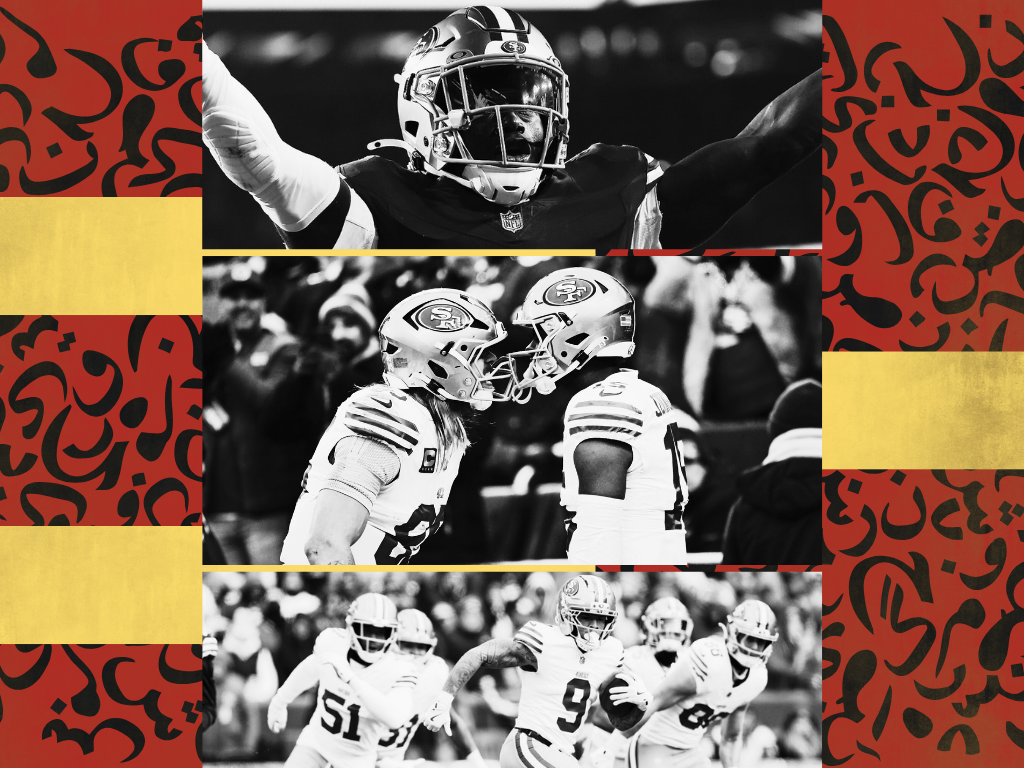
As an Arab American who watches sports, there haven’t been a lot of athletes and coaches that I can look to and feel cultural representation. When I think about Arab representation I am reminded when Mohamed Salah, an Egyptian soccer star, started excelling at Liverpool. Liverpool eventually became the topic of conversation among my soccer-loving Arab relatives, and that was all due to watching a great player that looks like us.
I was reminded of Salah-mania recently when I came across a collaboration between Arab American comedian Nasser Al-Rayess and the San Francisco 49ers. In a series of short videos, Al-Rayess was on the sidelines during the team’s Week 7 matchup against Atlanta. When I came across it on my feed, I had a moment of pride and since then I have found myself with a soft rooting interest in the 49ers. It was a moment that was a reminder of the importance of representation in sports and just how underserved Arabs have been in this space for decades.
A Lack of Representation
For many years, people of Arab descent were considered white on the US Census. This was due to naturalization laws in the United States that forced immigrants in the 1800s to view whiteness as a path towards citizenship. As a result, many early immigrants disassociated from their ancestral lands in hopes of integrating into white American society.
The trend led to the Census not having an option for Middle Eastern, Arab, or North African until 2020—since many Arabs were indoctrinated to register themselves as white. Growing up in New York City in the 1990s, I felt some effects of this. My father made sure that we were aware of our Palestinian heritage, but my sister and I were very much white passing. This all changed after 9/11, when it became dangerous to be an Arab in America.
At the same time that the pivot to racism and prejudice against Arabs commenced, the NFL (and virtually every other sports league) pivoted into outward displays of patriotism. I would argue that in this moment, football spiritually vaulted over every other sport as the game of the masses. In the years since then, it has replaced baseball as America’s game. The NFL dominates ratings and has monopolized a day of the week, making it a crucial part of the zeitgeist and the truest representation of Americana that we have.
For many years, the presence of Arab football fans was minimized. For Arab Americans that saw the consequences of American military operations in Iraq, Afghanistan, and Syria, the NFL’s ongoing military co-messaging created a bit of a divide. This was reflected as recently as 2024 based on the type of advertising that was allowed during the Super Bowl—an indication to Arabs that the NFL doesn’t view us as a primary demographic for their game.
Even NFL players that had Arab ancestry were often ignored and downplayed. Well known players like John Elway, Doug Flutie, Jeff George, and Ryan Kalil all have Arab roots that few people are aware of. In truth, the most outwardly acknowledged Arab personality in the NFL has been former New York Jets head coach and current 49ers defensive coordinator Robert Saleh. His Lebanese origin was on full display when he wore the country’s flag on his shirt during his last season as a head coach, and his ties to Dearborn, Michigan (a well-known Arab American hub city) are well-documented.
From an Arab American perspective, there is something refreshing about seeing someone like Saleh, who is viewed as one of the best coordinators in football, be so forward with his heritage. His presence on a team that is taking engaging with the Arab community seriously makes the appeal of the team to us Arab Americans that much more pronounced.
Creating Momentum
In 2022, the NFL launched its Global Markets Program. This initiative awards marketing rights to the league’s teams for select markets to help expand the leagues reach internationally. The league currently has marketing efforts in 21 different countries. Some markets, like the United Kingdom, feature multiple teams (eight), while others like France only have one team with rights (New Orleans Saints).
The only Arab country in the program is the United Arab Emirates and the three teams that have rights in that country are: the Los Angeles Rams, Washington Commanders, and the San Francisco 49ers. But of the three teams, it seems that the 49ers are the ones leading the push and establishing roots in the country, and the Arab world by extension.
The 49ers have initiated multiple grassroots campaigns through youth programs and flag football tournaments in the UAE and have trained local physical education teachers the rules of football in hopes of fostering a love for the game in the region. The NFL has not scheduled a game in the UAE as of yet, but it stands to reason that if it did that the 49ers would be a featured team.
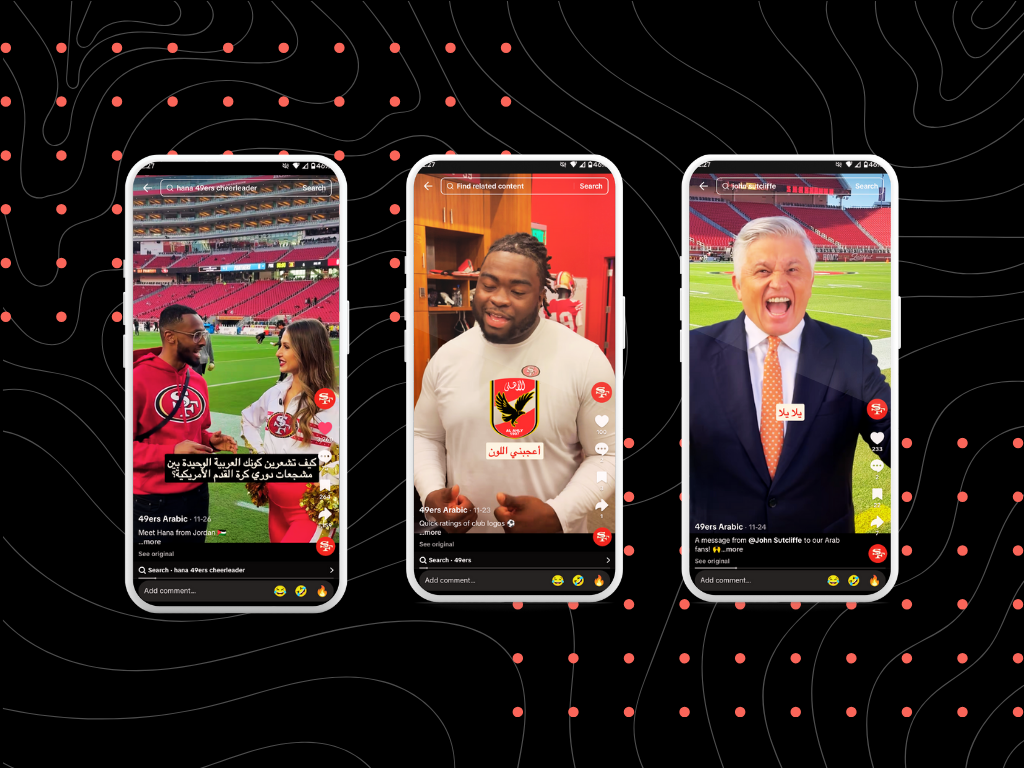
Where the team has taken a step beyond is in its social presence. The collaboration with Al-Rayess is part of it, but the 49ers Arabic social media page continues to create content—injecting Arabic music and cultural anecdotes while also getting buy-in from the 49er’s players for various videos. The team even did an interview with one of their cheerleaders, Hana, who is Jordanian and the only Arab cheerleader in the NFL.
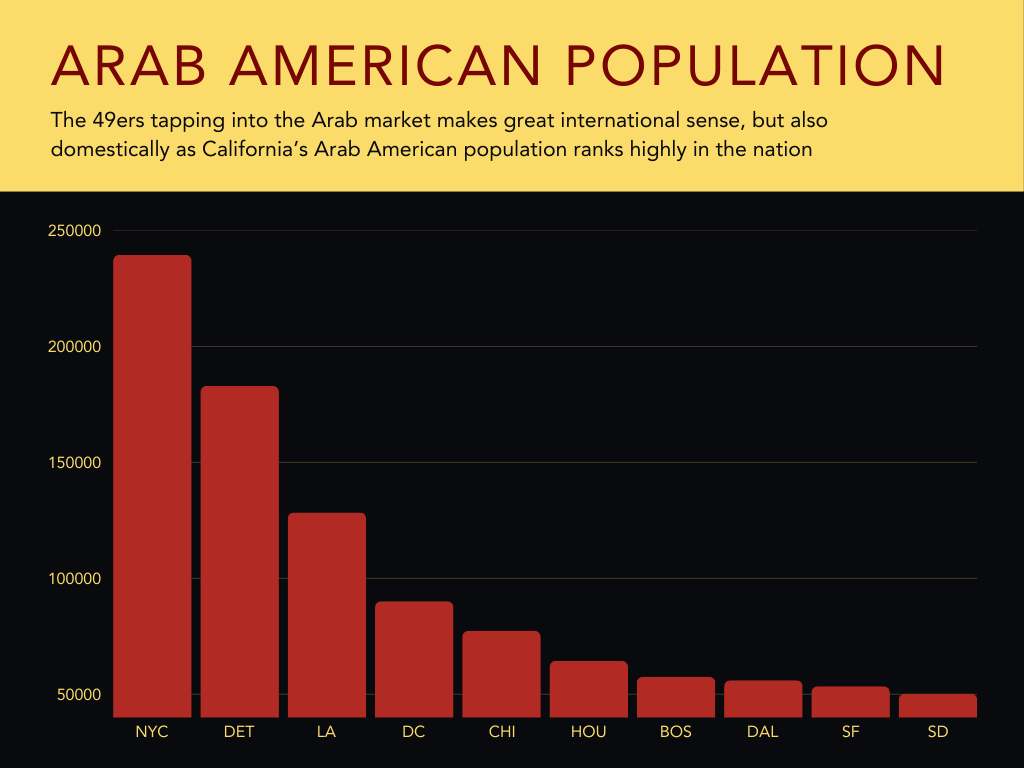
While it’s fair to acknowledge that all of this effort by the 49ers has financial motivations, it is also meaningful to a group of people that has long been discarded as relevant by American culture. From a core demographic perspective, the 49ers engaging with Arab fans is also beneficial. The San Francisco metro area ranks ninth in the US in Arab American population. Los Angeles ranks third and San Diego ranks tenth, meaning that Arabs in California could be attracted to a (somewhat) local team that caters to their identity.
Creating a Space for Arab American Fans
From an outside perspective, this all may seem relatively inconsequential—a marketing effort by a $8.6 billion team to expand its global reach. The team does participate in marketing efforts in the United Kingdom and Mexico as well after all. But consider this, Arabs in America have long been cast aside, asked to assimilate and disregard their culture.
When I lived in Detroit, I had the city of Dearborn close to me, but I rarely visited. Why? Because there was a fear instilled in me culturally that going to where all the Arabs would be the fulfillment of a stereotype. I heard the term “boaters” used often in the 2010s, describing Arabs that acted too foreign—as if they just “got off the boat”. It was often used in a derogatory manner, and sent the message to be an Arab, but don’t be too much of an Arab.
There is a tremendous misunderstanding of Arab culture in Western society that permeates the thought process of Americans. In the past I was casually asked about my involvement in terrorism and if I used to live in a cave when I lived in Jordan. Much of this is the way that we are portrayed in pop culture. In movies and shows, it’s very rare for an Arab character to be the hero, instead they are oppressive villains, often seen chain smoking cigarettes and plotting destruction.
The average American has been shown an image of our culture that is primitive and callous. So, when an entity with clout, like an NFL team, makes an effort to humanize us as a people, it means a lot. The NFL as a whole did this during the NFL Draft in Detroit in 2024 as well, catering to the Arab and Muslim population of the city with Yemeni coffee shops, prayer areas, and partnering with various Arab businesses.
The 49ers Arabic page has over 37,000 followers on Instagram and continues to grow, lending credence that the team is quickly becoming the team of Arab Americans. It’s a moment of representation that would have been unfathomable a mere 15 years ago. Their efforts indicate that the team and the NFL see us as a valuable market to be tapped into. And that is something that has never been true until now, and that matters.
Thanks for reading Deep Cover! This post is public so feel free to share it.