
Jalen Duren is Made for Detroit
The Pistons big man has continued to add to his offensive game, while becoming the sort of athletic vessel that represents the spirit of Detroit

Before the season started, the Detroit Pistons were projected to win 46 games. Almost halfway through this season, they have shattered that expectation. At 31-10 as of this writing, they are on pace to finish 62-20. They’ve done it through the magnificent play of point guard Cade Cunningham and a defense that ranks second in the league in defensive rating (behind only the defending champion Oklahoma City Thunder).
An ongoing concern for the Pistons has been centered on who their second offensive option outside of Cunningham will be. The concern is widespread enough that many have already conjured trades that will send Michael Porter Jr. to Detroit among others. Lost in all of this rhetoric, however, is the emergence of center Jalen Duren. Duren once considered a high-end rim protector and lob threat has become so much more this season—turning into a true running mate and the embodiment of Detroit basketball culture.
Perfect Fit for a City
If you were to cast someone for the lead role in an action movie, chances are that they might look a lot like Jalen Duren. At 6’11” and 250 lbs., Duren is a mass of muscle that is imposing to say the least. When he was drafted with the 13th overall pick in the 2022 NBA Draft, Duren was looked at as a prototypical big man in the modern game.
With a 7’5” wingspan and excellent lateral quickness and agility, he was projected as the sort of defensive center prospect that modern NBA teams love. But many felt that he had a limit to his development, comparing him (ironically) to former Piston’s center Andre Drummond.
Since the 1970s, the Pistons have had an affinity for a certain type of big man. Bob Lanier, Ben Wallace, Rick Mahorn, Rasheed Wallace, and Bill Laimbeer all fit this mold. They were tough, physical, and in many cases overlooked (Lanier is the exception to that last trait). They were embraced for those qualities in the city of Detroit because it’s a mentality that resonates with the culture of that city.
Dating back to the 19th century, Detroit has always been a hub of commerce and industry. From the sprawling avenues and traffic circles devised by Augustus B. Woodward in the early 1800s to the revolution of the automobile led by Henry Ford in the 1900s, Detroit has long been a place where hard work is respected, cherished, and expected.
That spirit transcends generations and is still an ethos of Detroit today. It’s why the heavy use of the term “grit“ by Detroit Lions head coach Dan Campbell has resonated so much—there is a very real culture of grinding and persevering in Detroit. The city expects that sort of desire and toughness from its athletes, especially big men in basketball where being physical is a baseline expectation.
While other markets love their big men to score, there is a special appreciation in Detroit for those that could do the “dirty work”. Those players become cult heroes in the Motor City—look no further than Ben Wallace as proof of that.
The Pistons last won a title in 2004, with a roster that featured excellent players like Chauncey Billups, Rasheed Wallace, and Richard Hamilton. But it was their 6’9” center, Ben Wallace, who never averaged more than 10 points per game in his career that is the hero of that era to most Detroiters. Wallace got it done as a rebounder and shot blocker—leading the NBA in rebounds per game twice and in blocks per game once as a Piston.
There was “Fear the Fro“ merchandise and in that era of Pistons basketball, it was Wallace’s jersey that littered the stands of the Palace of Auburn Hills (where the Pistons played at the time). That sort of reverence shows you what plays in this city, and that is something that Jalen Duren has fully embraced.
Duren and fellow Pistons big man Isaiah Stewart painted the phrase “Dawg Pound” above their lockers, an indication of the mentality that they approach the game with. When asked about the moniker recently, Duren simply said “you gotta do dawg s***”. It sounds like something that Laimbeer or Mahorn would have said in the Bad Boys era after getting into an altercation with Larry Bird or Michael Jordan. And it’s a mentality that feels so quintessentially Detroit.
We saw it on full display last year in the playoffs against the Knicks, where the Pistons ratcheted up the physicality, and Duren was a huge part of that. He is intimidated by no one and plays with a ferocity that the city absolutely adores. That mentality has shifted up a level this year, and we are now seeing skill versatility being added to his repertoire.
The Evolution of Jalen Duren
Through his first three seasons, Duren fit the profile that scouts assigned to him, generally speaking. His usage was relatively low, and he functioned primarily as a lob and dunk threat in the paint. His main utility for the Pistons was in the rim protection and rebounding realm.
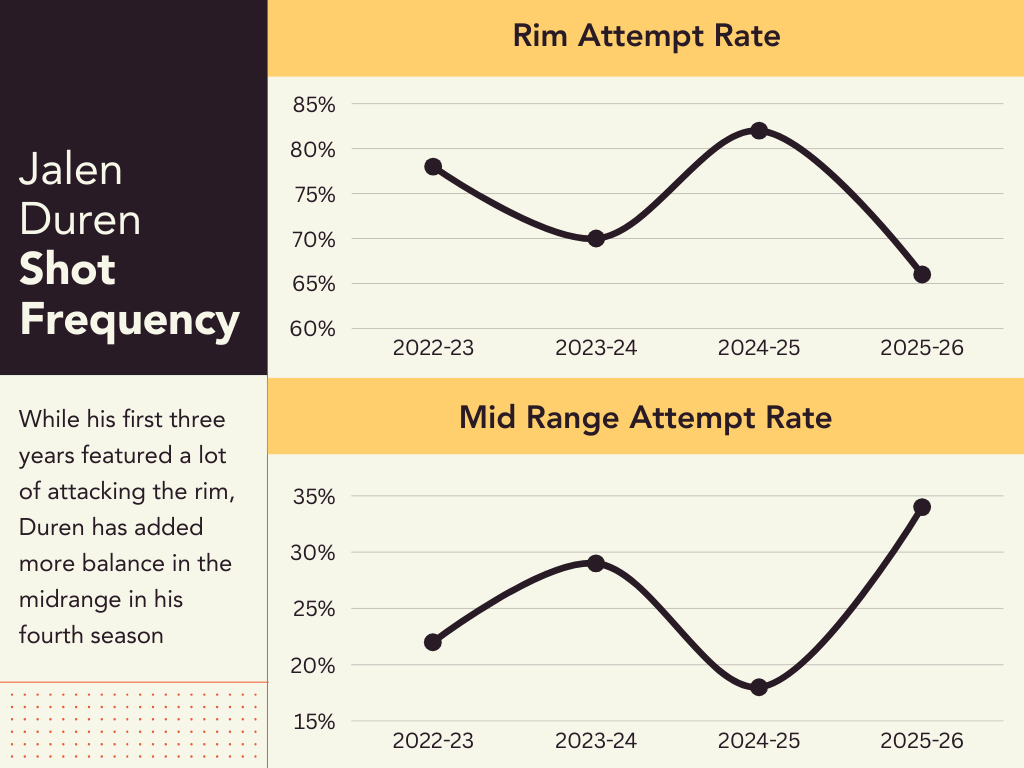
In those first three seasons, 76% of Duren’s attempts were taken at the rim. Last year, 44% of Duren’s field goal attempts and 58% of his made field goals were dunks. He was the recipient of 94 alley-oop attempts, accounting for 17.2% of his total shot attempts. That means that 61% of the time, not only was Duren attacking the rim, but it was likely with a dunk attempt. It plays to his drafted strength, as he was always considered an excellent paint occupier and lob threat coming out of Memphis.
This year has presented a pivotal moment in his development, however. Was he simply going to be an elite lob threat, or could he evolve into more? In other words, was he going to trend towards Clint Capela or Bam Adebayo in terms of trajectory. From what we have seen of him so far this year, it’s clear that the trend points to the latter.
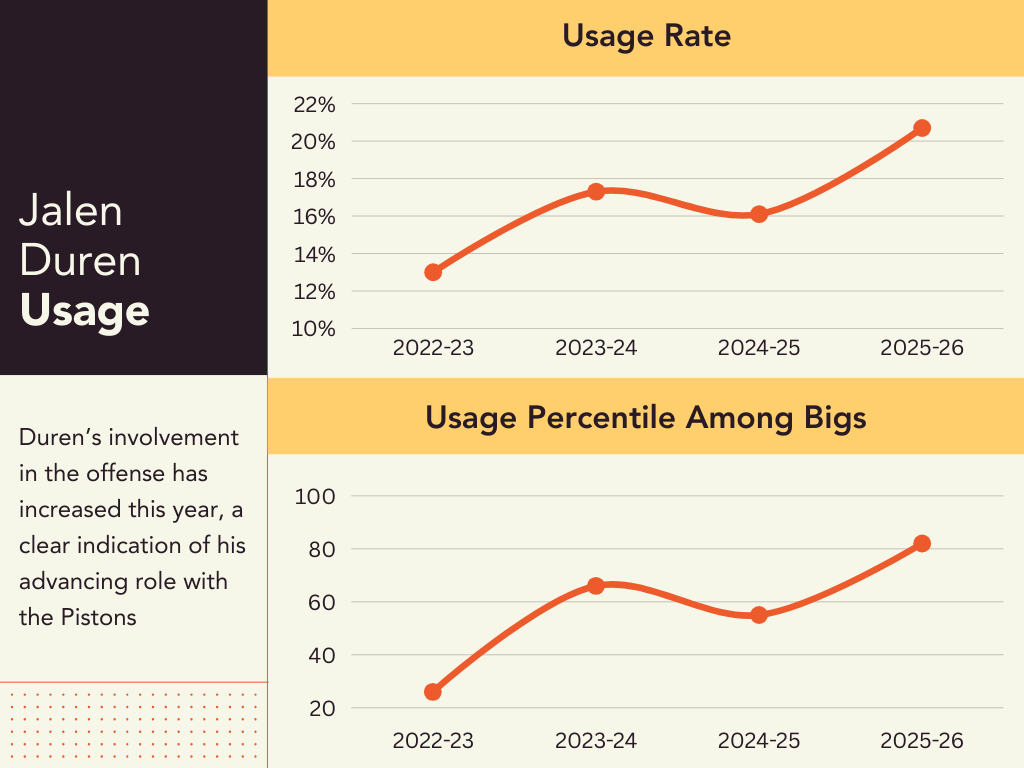
With a 20.7% usage rate, Duren ranks in the 82nd percentile among bigs in the league, the highest of his career. His raw shooting efficiency is largely the same year to year—71% at the rim this year vs 73% last year and 49% from mid-range vs 55% last year. What has changed is his frequency.
Last year, 82% of Duren’s attempts were at the rim. That number is down to 66% this season. His midrange attempts have skyrocketed, accounting for 34% of his attempts this season versus 18% last year. He has nearly doubled his mid-range attempts and has kept his efficiency relatively level.
That progression in his game creates more problems for opposing defenses. Playing with a high usage point guard like Cade Cunningham means that the Pistons need variety in terms of shot threats from the other players around him. 30% of Cunningham’s attempts are at the rim, meaning that when he drives, Duren needs to be a threat on the catch from midrange to optimize spacing for the Pistons to get the best look possible.
By showing an ability to hit those shots with good efficiency, Duren adds a layer to the Pistons offense that will be crucial come the postseason. With this enhanced role offensively, it would be logical to assume that it would come at the expense of his defensive play.
But it hasn’t. Duren’s blocking numbers have been consistent year over year, and he has an uptick in his steals per game, going from 0.7 last year to 0.9 this year. His rebounding rate has remained constant as well, hovering around the same average as his previous two seasons. Remarkably, Duren has leveled up offensively without much if any drop-off defensively. That consistency is especially impressive considering that he is taking four more shot attempts per game and has gone from averaging 11.8 points per game to 17.8 points per game this season.
There are some deficiencies to be addressed, however. An increase in usage has predictably led to more turnovers (up by 0.5 from last year) and Duren is not a three-point threat at all. His next level of evolution will be adding the corner three to his arsenal, much as Bam Adebayo has done in the last two seasons. The trajectory is nevertheless impressive for a player that is just now entering his basketball prime, and for that reason is positioning himself as the perfect complement to Cade Cunningham.
Complementing Cade Cunningham
The issue that the Pistons ran into last year in the playoffs and one that is present this year is around the team’s second scoring option. Last year it was a combination of Jaden Ivey, Malik Beasley, and Tobias Harris. Ivey was supposed to be that secondary initiator, but injuries have held him back. Beasley is no longer with the team as a result of his involvement in a prop betting scandal.
This year, the team still has some issues with determining who that secondary scorer is. Ausar Thompson and Ron Holland are incredible athletes but don’t have the needed offensive polish yet. Duncan Robinson, Tobias Harris, and Caris LeVert are more suited as role players without outsized responsibility. The assumption has been that the secondary scorer needs to be a wing or a guard, but what if it is actually Jalen Duren?
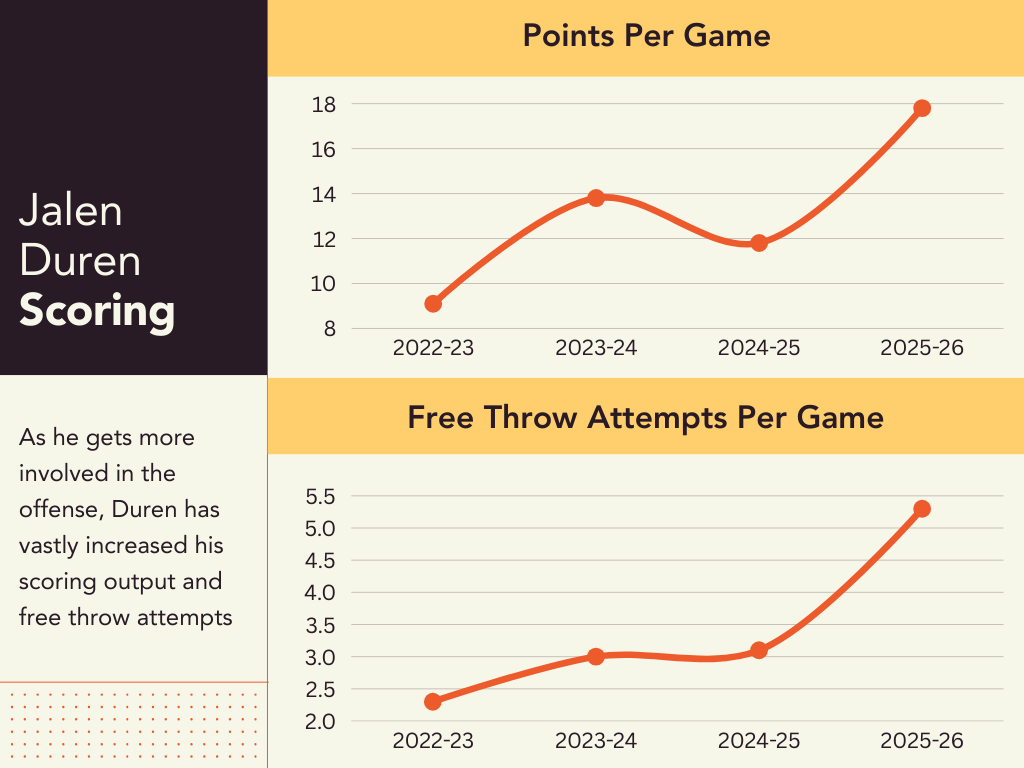
Duren’s shot volume has increased; he is not a liability from the free throw line (shooting 71.6% on 5.3 attempts per game) and is an efficient shooter from the midrange. His ability to pop out and hit open jumpers creates possibilities for this team that don’t have to end in a step back three or contested rim attempt from Cunningham.
Because of their standing in the conference today, many will clamor for the Pistons to make an “all-in” move for a complementary scorer. But the more measured approach should be to allow Duren to fit into more of an advanced offensive role.
If he is able to add the occasional corner three into his arsenal and become a more adept swing passer in rotations, the Pistons offense becomes that much more potent. What is often forgotten in the importance of building a championship contender is the importance of culture, and Jalen Duren is a culture driver for this franchise.
The Pistons have been at their best historically with a gifted point guard (Isiah Thomas, Chauncey Billups) and a physical big man (Bill Laimbeer, Ben Wallace). The duo of Cunningham and Duren fit that bill. In a sense, Duren could be the most advanced version of that physical archetype—adding touch and offensive skills that we may not expect from him.
The Pistons identity has always been rooted in a team concept with an emphasis on toughness and togetherness, being a sort of counter argument to the star player blueprint in the NBA. Jalen Duren, in that regard, is the prototypical vision of a Detroit Piston. As they continue to win games and contend for a spot in the Finals, it’s clear that Duren’s ascension is essential. He is the sort of player that this fan base will rally behind, and his continued growth and evolution as a player will show us just how far this team can go in today’s NBA landscape.
Thanks for reading Deep Cover! This post is public so feel free to share it.