Jana El Alfy: A Champion for Arabs
The Huskies’ center is providing Arab fans something many of us have never had: representation in the game of basketball
It’s a spring night in Amman, Jordan and I am huddled by a table talking with my cousins and uncles while Liverpool FC is playing on the TV. Soccer has always been a sport that my family loved, and in Jordan it is by far the most watched sport in the country. In the years leading up to this moment there was a fascination between Barcelona and Real Madrid, the Spanish powerhouses that dominated the landscape of the sport.
But with the arrival of Mohammed Salah to Liverpool, there was a new layer of pride and fandom that was unlocked. Because Salah, an Egyptian, gave my family some representation in a game that has been dominated by South Americans and Europeans for decades. It is a sort of representation that us Arabs are far too often denied.
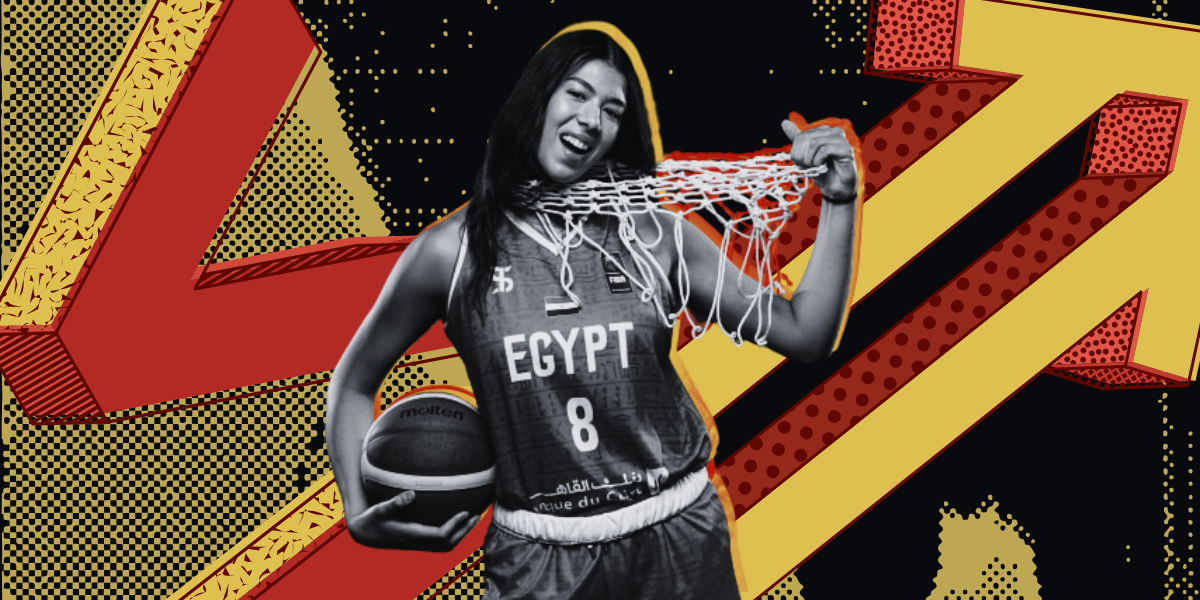
I was reminded of this moment when I saw University of Connecticut center Jana El Alfy record 6 points, 8 rebounds, and 4 steals against UCLA in the Women’s Final Four this year. El Alfy is also Egyptian, the daughter of the Egyptian Women’s National basketball head coach Ehab El Alfy. Jana provides Arabs like me something that is far too often missing when we watch sports: an exciting player that is proud of where she came from.
A Historic Lack of Representation

Throughout the history of professional basketball in the United States there have not been many Arabs represented on rosters. In recent years, the game has become more international with players from France, Germany, and Spain entering both the NBA and WNBA en masse.
There has been increased momentum in developing African talent by the NBA recently and this has paid dividends with a number of players entering the league from Cameroon or Nigeria. This is great for the development of basketball in Africa because younger players can look at Joel Embiid or Pascal Siakam as an aspirational figure.
The same cannot be said for Arab nations. There have only been a handful of NBA players like Rony Seikaly (Lebanon), Saleh Mejri (Tunisia), and Abdelrahman Nader (Egypt) that were born and raised in Arab countries before making it to the NBA. This doesn’t account for players that were naturalized citizens of Arab countries like Rondae Hollis-Jefferson for Jordan or Chantelle Anderson for Lebanon.
Nader was the last Arab to play in the NBA where he was a role player for the Phoenix Suns who barely saw the floor. The most successful of the small group was Seikaly who was named Most Improved Player in 1990 and averaged 14.7 points and 9.5 rebounds over an 11-year pro career. But he retired in 2000, and there has not been an identifiable Arab figure in pro basketball since then.
There is a slight exception, however. Denver Nuggets star Jamal Murray, who identifies as Canadian Jamaican, has a Syrian mother. Murray has often presented himself as a Canadian first, which makes the recognition of him as an Arab figure less concrete than others that have come before him.
In El Alfy, Arabs have someone that they can follow at a notable program that will be heavily featured on national broadcasts over the next couple of seasons. Her potential as a pro prospect is currently unknown as she is still a very raw talent. But what we as Arabs can cling on to is that she is unapologetically Arab, which is something that has been absent for us in American sports.
A True Representative

As an Arab American that has lived in the United States for most of my life, I can attest to the expectation of assimilation that is placed on us. When I lived in Detroit, strangers would assume that I spent a lot of my time in Dearborn (a predominantly Arab city) as a sort of stereotyped assumption. It became such a pervasive stereotype that I felt the need to avoid the city because I was made to feel that it was to spend money and time in a place that was representative of my culture and heritage.
Whenever I visit now, I often spend at least one full day in Dearborn because it allows me a moment of embracing my Arab culture. This microaggression from non-Arabs underscores the reality that many Arabs living in the US live with. Our culture has been so demonized over the years to the point that it is a negative trait to be Arab.
Over the last two decades, it has been normalized to accuse an Arab of being a terrorist or a domestic abuser. In movies and TV shows we are typically cast as cigarette smoking villains. If you asked an average American on the street how they feel about Arabs, it is relatively likely that they will say that they are uncomfortable with Arabs and that Sharia Law is the ultimate endgame of our people. This is of course racist and completely discounts the fact that not all Arabs are Muslims.
This is the reality for all Arabs in the United States. The stereotyped image has become the accepted reality, a never-ending hamster wheel that we are subjected to in our daily lives. The representation in films and TV has improved in recent years with the likes of actor Rami Malek and comedian Mo Amer. But the sports world remains largely untapped despite the increasing globalization of basketball.
Jana El Alfy presents a new way forward for us in the way of representation. Jana’s parents, Ehab El Alfy and Dina Gouda, look like families that I saw in my high school days living in Amman. When they came to watch Jana play in the Final Four, they travelled for 25 hours to see their daughter play and when Ehab spoke about how proud he was of her it felt like I was listening to one of my uncles speak about his own daughter. On Jana’s Instagram page her profile picture is in front of one of the pyramids at Giza and her time with the Egyptian national team is well documented. There is no mistake that she is proud of her heritage.
Perhaps even more important than the outward display of cultural identity is the way that she has been embraced by her teammates. During the holy month of Ramadan, El Alfy was encouraged by her Huskies teammates, with star guard Paige Bueckers (recently drafted number one overall by the Dallas Wings of the WNBA) offering to make her food to eat during Suhoor (the time before sunrise where food can be consumed before fasting begins).
This sort of acceptance sends a message that we as Arabs can be ourselves in front of our American contemporaries without fearing judgment or cruelty. While this sounds like a bare minimum baseline to expect, far too often in the last two decades it has not been a given. In my own life I have heard Arabic be called “terrorist language” and had my name alone be the cause for harassment at an airport.
With Jana El Alfy we have a modern player that is a great representation of Arabs that cuts through all the stereotypes that many in my generation have had to face. She is still only 19 years old and likely has three more years in Storrs ahead of her. It remains to be seen if she will develop into a WNBA prospect. There are concerns about her footwork and composure during the games.
While that future remains unknown, what is known is that Arabs have a new athlete to look towards that is one of us. It is a feeling of inclusion that many of us have not experienced while watching sports. I know that I, along with many other Arab Americans, will be watching the Huskies with added interest over the next few years. We have waited a lifetime for someone who looks like us to be on the big stage, and that moment has finally arrived.