
The WNBA’s Playoff Expansion Prism


The league has been no stranger to adding more games to its postseason in the past, it may be time to consider it again
Throughout the entirety of the WNBA season, it felt like a story was being written about the Minnesota Lynx. After an offseason of tremendous roster overhaul and a recovering Napheesa Collier, the team seemed destined for a step back. But they didn’t. Thanks to a sensational rookie campaign by Olivia Miles, the Lynx secured the number one seed and were penciled in to make a deep playoff run.
But two games into the postseason, their season is over, taken down by a New York Liberty team that has had an up-and-down season, to say the least. The league is as deep as it has ever been—evidenced by the fact that the Liberty, with all their star power, were an eight-seed and that the Dallas Wings were a seven-seed despite having one of the best guards in the league (Paige Bueckers).
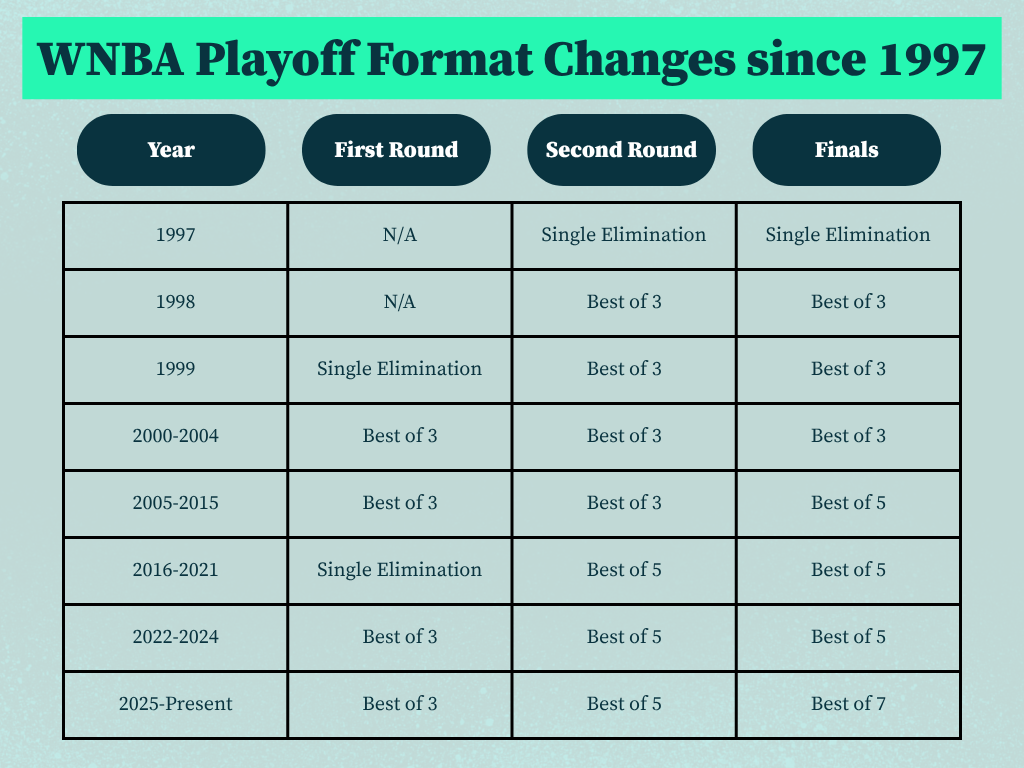
The WNBA has slowly been moving towards playoff series expansion. From 2016–2021, the league had a single-elimination format in the first two rounds before a best-of-five format in the semifinals and Finals, with the top two seeds receiving byes until the semifinals. In 2022, they adopted a best-of-three first round, and then best-of-five through the Finals. Last season, they expanded the Finals to a best-of-seven. This evolution has presented the league with a modern postseason dilemma: the thrill of volatile upsets versus the lure of more games.
Throughout the women’s basketball ecosystem, postseason play has often been defined by single elimination. NCAA women’s college basketball, EuroLeague Women, and Unrivaled all feature a single-elimination playoff bracket. The WNBA uses a series format, likely due to the deep integration between it and the NBA—which has employed playoff series for a number of decades.
As the WNBA grows and more teams are set to be added, a question arises: which way is the better way? Both have merit, but crucially, if the WNBA’s series approach is the better way, is there an inevitability and a need to expand to offer more of what makes that format special?

The benefits of a single-elimination tournament are clear: obvious stakes. One bad game instantly derails what had been a good season, thus adding magnitude to the game. This is the formula that makes single-elimination tournaments like college basketball’s March Madness and the NFL playoffs such captivating television. There are no second or third chances, and teams need to perform at their best to be rewarded.
The beauty of this format is that the unexpected can happen. A bad game from a star player on the favored team could lead to elimination. But the inverse of this is that if an underpowered team advances, it will likely face an even better team in the following round, which increases the potential for a blowout. In single elimination, it is often not the best team that wins but the one that survives.

If single elimination is a sprint, then playoff series are more of a marathon. They are a test of endurance. Currently, a team in the WNBA could play as many as 20 playoff games—which equates to 45% of the total games played in the regular season. There is more attrition to winning this way and more difficulty due to variables like injury and regression to the mean.
A playoff series helps to create mythmaking moments. The mythology of a player is often defined in what they do when faced with the adversity of a playoff series. There is something almost fairy tale-like about a team going down in a series by a game or two and then rallying back to emerge victorious.

Consider the 2018 WNBA semifinals between Seattle and Phoenix. The Storm were up 2–0 in the best-of-five series and needed one win to advance. When the series shifted to Phoenix, the tables turned and the Mercury evened the series at two games apiece. What was once a commanding lead became a precarious situation for the top-seeded Storm—the tenor of the series shifted in a way only prolonged familiarity can create.
The Storm would go on to win the decisive Game 5 in Seattle, then sweep the Washington Mystics in the WNBA Finals. It’s not a stretch to suggest that the adversity overcome in the previous round helped to propel Seattle to where they needed to be and prepared them to win that championship.
There have been incredible playoff moments created in the WNBA with its current format, but as the league continues to expand and add more games, the idea of expanding the playoff format has to be considered.
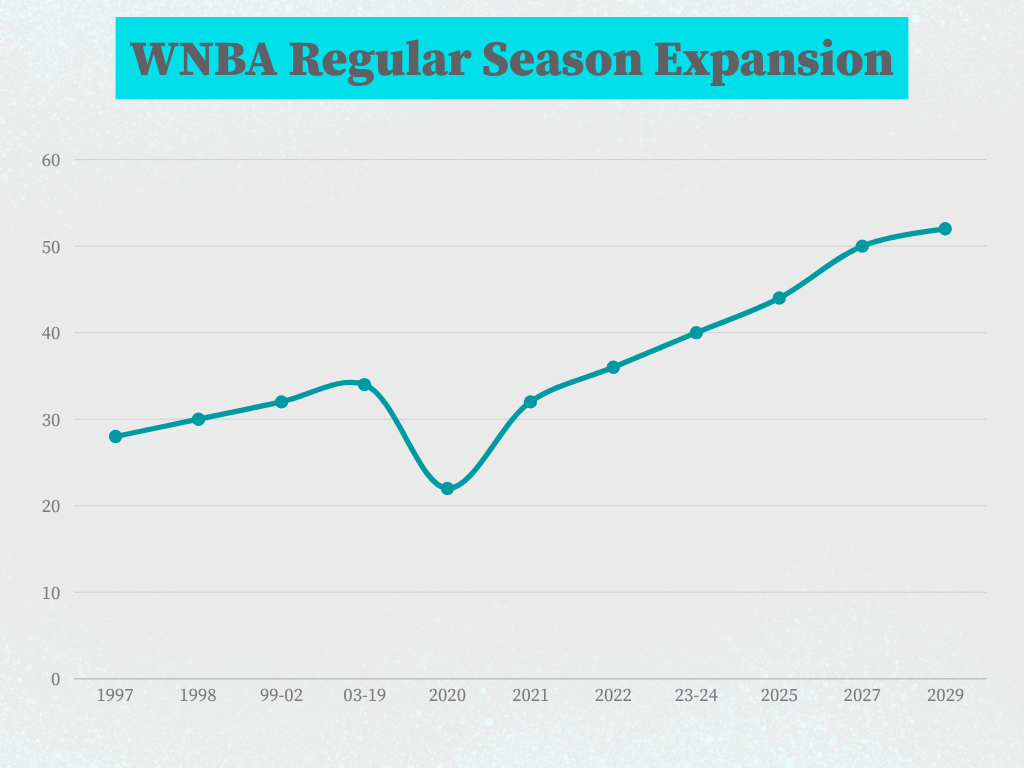
In 2027, the league will expand its regular season to 50 games—a six-game increase from the current system. By 2029, that number may rise to as many as 52 games as three new franchises plan to enter the fold by 2030. The WNBA, like every other sports league, has come to realize an undeniable truth: to continue increasing revenue, more game real estate needs to be made available to current and future media partners.
We have seen this in both the NBA and NFL as new mechanisms have been added to increase what media rights holders can bid on. For the NFL, it has been adding a 17th game to the regular season; for the NBA, it was the introduction of the In-Season Tournament and the Play-In Tournament. The WNBA is approaching this with more regular season games, but there is validity to applying it to the postseason as well, considering the abundance of talent currently in the league.
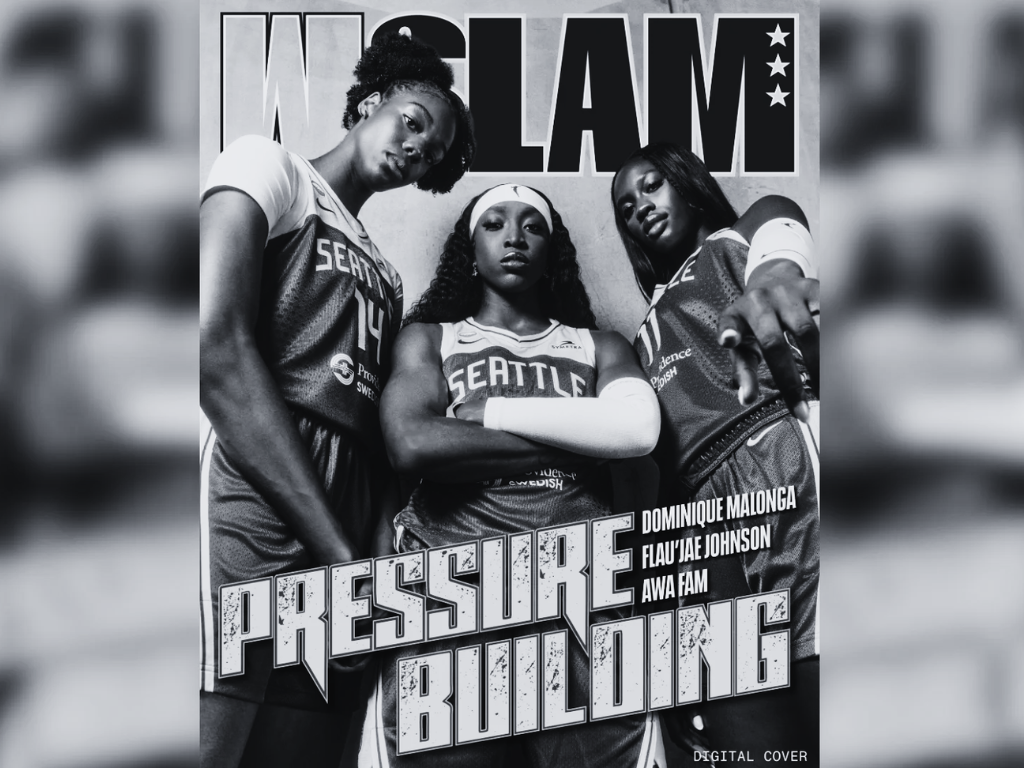
It seems that every team in the WNBA is filled with promising players and stars. Even the worst team in the WNBA this season, the Seattle Storm, have an incredibly promising young core of Dominique Malonga, Flau’jae Johnson, and Awa Fam that should make them a playoff team for years. The Chicago Sky and LA Sparks, two franchises often labeled as mismanaged, have interesting players like Kamilla Cardoso, Sydney Taylor, Rae Burrell, and Cameron Brink. The league is getting deeper and talent has been spread around.
It ultimately feels like a disservice that we only got three games of Dallas vs. Golden State or Las Vegas vs. Indiana. These were matchups that featured prolific figures in the current WNBA landscape, and seeing a longer series between them would have been basketball theater.
It seems that the WNBA is starting to see it this way with the expansion to a best-of-seven Finals. But it could go further: make the second round and semifinals best-of-seven as well and expand the first round to best-of-five, to maximize the matchups and increase the tension that makes playoff basketball great.

There is an argument to be made, however, that the current system presents a happy medium between the attrition of a longer series and the unpredictability of single elimination. Seeing the eight-seed Liberty sweep the top-seeded Lynx is proof of that. The dilemma the league faces is deciding what story it wants its postseason to tell.
Does it view itself as a league where the best team will rise to the top through attrition, or does it prefer the more unpredictable nature of shorter series? With the star power of the league, it would benefit from a longer series format. The players are becoming more visible as brands in their own right. What a longer series accomplishes is the creation of (on-court) animosity through familiarity—a chess match that becomes more fascinating the longer it goes on for.
Consider the second-round matchup between the Golden State Valkyries and Las Vegas Aces. The Aces’ A’ja Wilson is operating at the peak of her powers and faces a Golden State team that had the best defensive rating in the league this year. That sort of matchup deserves a seven-game series. Similarly, the matchup between the Dream and Liberty pits two of the league’s stars, Angel Reese and Sabrina Ionescu, against one another. That too deserves a longer series.

While the money will always dictate that more inventory of playoff games is a good thing, it must also be acknowledged that it helps to establish more lore. It creates pressurized moments, adversity that can swing dramatically over a slightly longer period of time.
That is what is sacrificed by staying committed to a shorter postseason. It removes the opportunity for mythmaking. Consider the Lynx losing to the Liberty. It’s reasonable to suggest that after losing convincingly in Game 1, the Lynx were still shell-shocked in Game 2 and had little in the way of answers against New York.
A decisive Game 3 in that scenario creates a number of wrinkles. The pressure on New York to close the series out and complete the upset. The ability for Lynx head coach Cheryl Reeve to scheme a new game plan. A chance for Olivia Miles to have an early signature playoff moment—even if it doesn’t decide the series.
Longer playoff series are not only a mechanism of revenue maximization to offer more inventory for broadcasters. They are also a way to allow this unique generation of players, some of the best the league has ever seen, to have more opportunities to build their legends, to create moments that we remember forever. Is foregoing all of that worth it to maintain upset potential and viability? I would argue that it’s not even close.