
The Anatomy of Sports Misery
When near-success can sting more than perpetual failure


The legendary Jim McKay once famously described sports as “the thrill of victory and the agony of defeat”. We often celebrate the former while ignoring the latter. The greatest sports stories usually revolve around the champions and winners—history is, after all, written by the victors. But how do we quantify the depths of despair for teams and fans that experience losses?
ESPN recently tried to answer this question with a tool they call the “Misery Index”. By measuring a person’s favorite teams, the Misery Index tool pools 25 years of data—including results, expectations, and postseason success to determine how poor of an experience a fan base has. It covers American professional leagues, so international soccer and college sports are excluded. For the most part, the “miserable” teams in this exercise simply have bad records. But it forces us to ask, what is true misery, and when losing turns into apathy, is it still misery?
Defining Utopia

Before exploring what true sports misery looks like, it’s important to understand what the opposite looks like. In the NFL rankings, ESPN places the Kansas City Chiefs, New England Patriots, and Philadelphia Eagles as the three least miserable teams. Since 2011, these teams have been represented in all but two Super Bowls—accounting for 81% of the appearances in that time. They are viewed as the gold standard of the league, frequently competing for titles and often winning those titles.
But winning alone isn’t the only metric of success. Well-run operations are also awarded even without as much title domination. The Seattle Seahawks, Tampa Bay Buccaneers, and Los Angeles Rams rank highly with far fewer Super Bowl appearances and wins, but they have consistently offered their fans playoff football, leading to a higher satisfaction rating from fans. The same is true in the NBA, where well-run organizations like the Heat, Warriors, Celtics, and Thunder rank the highest in fan satisfaction.
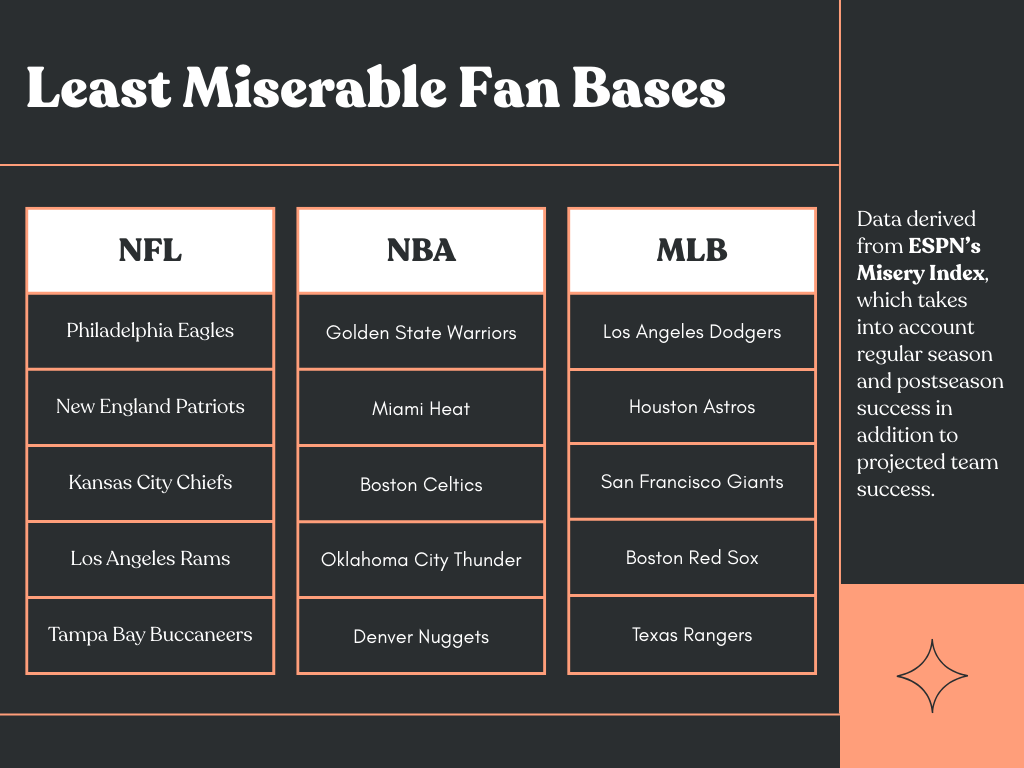
All of these teams have a common thread: winning consistently and organizational stability. They have strong coaches and general managers and have developed talent to remain competitive in an ever-changing landscape. And typically, that is enough to keep fans satisfied, because drama and turmoil can easily be glossed over when a team is having success.
These types of organizations are the ones that every pro team wants to be—successful, profitable, and with full fan buy-in. But every team cannot be that. With every champion, there are multiple losers in every season, in every sport. But what sort of losing is the one that leads to more misery: continued success without the championships to prove it, or is it pure ineptitude? There is an argument for both.
The Pit of Ineptitude
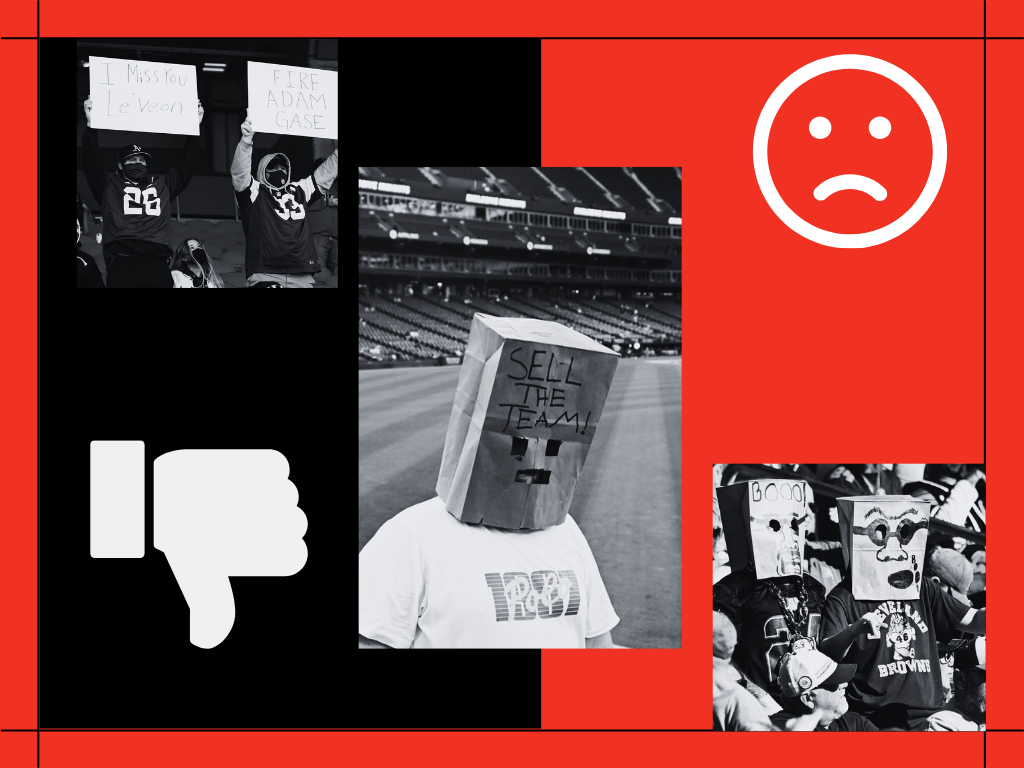
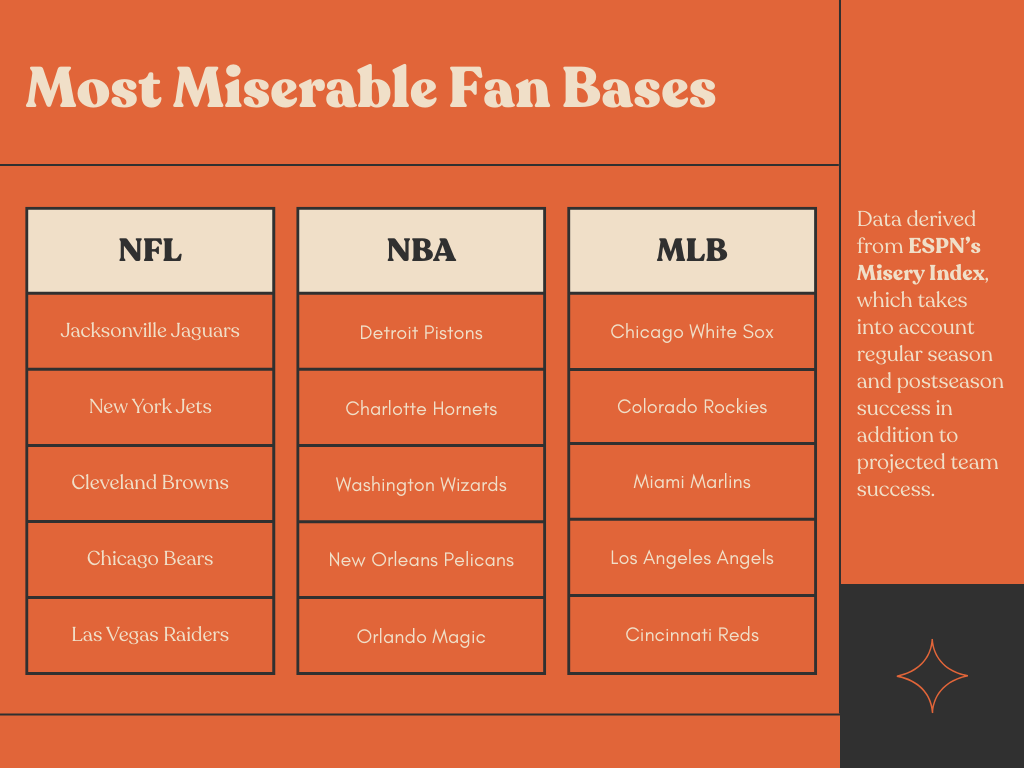
On ESPN’s ranking, teams that are associated with losing occupy the top of the list: the Colorado Rockies, Washington Wizards, and the Cleveland Browns, among others. The fans of these teams are undoubtedly tortured and have seen a lot of losing. The Browns, for example, have only made the playoffs three times since 1999, have had a winning record only four times, and finished last in their division 17 times. They are on their 12th coach since then and have had a revolving door at quarterback. It is, in short, a difficult existence when compared to teams like the Baltimore Ravens and Pittsburgh Steelers in their division.
Teams that have little to no hope of ever overcoming their own ineptitude leave a sense of emptiness with the team’s chances when they truly can’t compete. The NBA’s Charlotte Hornets fit this mold—they ranked as the NBA’s second most miserable fan experience according to ESPN. Since re-emerging as the Hornets after the Bobcats era in 2014, Charlotte has had one playoff appearance, with only two seasons finishing over 500. The Hornets, as currently constituted, feel like a team stuck on the mediocrity treadmill, hoping for Draft Lottery luck.
At what point do the fans of teams like the Browns and Hornets check out and support their team on autopilot? If the losing continues to persist, it’s reasonable to suggest that numbness will develop. Where fans will still follow the team, but lack true investment because the inevitable has already been determined before the game is even played.
It begs the question: Is this misery, or is it simply an unfortunate reality? When I lived in Detroit, the Lions were a poorly run operation for years. For many fans that I knew, they still watched the games, but the team and product on the field became a sort of background noise. Traditions to watch the team on Thanksgiving were upheld, but without the hope of winning—instead focusing on upholding tradition and connecting with friends of family. When the team started to improve then those fans were reawakened, but the years of mediocrity became an accepted norm as opposed to a gut punch.
There is something to be said about the depth of a fall. When your team is already at the bottom, losses are a baseline expectation. You hope that they will turn it around, but deep down, you don’t truly believe that they will win games. Any success is a pleasant surprise, and every loss elicits a “it was good while it lasted” response. I would argue that the more devastating existence is when you repeatedly get close to the mountaintop but continuously fail to reach the summit.
The Agony of Proximity

In the NFL, teams like the Vikings, Chargers, and Bills are considered to be legitimate operations. Since 2001, the Vikings have only had six seasons with six wins or fewer. This means that they were in the playoff mix nearly every year, with some level of hope for the bulk of a season. They made the playoffs nine times in that span, leading to a fan base that was hoping that their team could finally figure it out, despite the fact that they have not made it to a Super Bowl since 1976.
It’s been 15 seasons since the Bills won fewer than 5 games, and they have won 10+ games in six consecutive seasons. And yet they have not been able to make a Super Bowl. They have gotten to the AFC Conference Championship game twice, tasting the chance to finally win a title, but thwarted by their nemesis, Patrick Mahomes and the Kansas City Chiefs. The formula for the Bills has been there with an elite quarterback, skill players, and competent staff, but they have not put it together—meaning that their fall is steeper than teams that simply lose games repeatedly.
Winning a title is the great elixir to misery. Even appearing in a championship game or series can change the way a team is viewed. An example of this is the Miami Heat. They haven’t won a title in 13 years, but they have been largely viewed as an excellent organization. The reason for this is that they win enough games, make the playoffs, and have made the Finals twice in the last six seasons. Even without winning titles, their runs to the Finals and winning their conference make being a fan of the team an enjoyable one.
When a team is considered in the upper echelon but cannot reach the summit, they are building up a foundation of hope. Every passing week of the regular season, they will look more and more like a contender, while their perpetually losing counterparts are thinking about their Draft position before the season is halfway through. The building up of that belief, only to lead to an early exit in the playoffs, is decimating, because it requires extended investment.
In many ways, it is like a story of two brothers. One is generally put together and doing well, while the other is a mess. When the latter screws up, it’s almost expected, even if it is exasperating. But when the former makes a similar mistake, it’s viewed as a huge misstep because the expectations were different.
So which one is worse? On the one hand, perpetual losing vacates all sense of hope in a sports fan. On the other hand, losing when it matters after building up confidence is demoralizing. I would argue that the build-up only to then be disappointed is worse. Hope can be a dangerous thing, and in the context of sports, it creates added investment, which can make repeated failures sting more than the steady stream of disappointment from an incompetent franchise. It is ultimately the difference in being unable to accomplish a task versus being close to completion and repeatedly failing—the result is ultimately the same, but the feelings of failure are vastly different. Or, in other words, there are truly levels to the idea of “the agony of defeat”.
Thanks for reading Deep Cover! This post is public so feel free to share it.