
The Ascension of Cade Cunningham
The Pistons guard has continued to refine and improve, showing that he is on the cusp of greatness

Four weeks into the NBA season, the top of the Eastern Conference standings looks a little different than many assumed. In preseason podcasts and previews, two teams were mentioned as the class of the conference: Cleveland and New York. Both of those teams have started off well—the Cavs are 7-4, while the Knicks are 6-3. But they do not sit atop the Eastern Conference at the moment.
That distinction belongs to the Detroit Pistons. In the offseason, the Pistons (who lost in six games to the Knicks in the first round of last year’s playoffs) were cast aside in favor of Atlanta and Orlando who made splashy trade acquisitions. And yet here they are, with an 8-2 record, riding a six-game winning streak. The catalyst of this hot start is, unsurprisingly, the stellar play of point guard Cade Cunningham. Coming off a year of star ascension, Cunningham is ready to take the next leap into superstardom.
Promise Fulfilled
In the 2021 NBA Draft, the Pistons had a 14% chance of winning the Lottery. Pistons fans were understandably skeptical that they would get the top pick. They had never won the Lottery and had only moved up from their pre-Lottery position once in 12 previous tries. But this time the ping pong balls were favorable to them and won the Cade Cunningham sweepstakes.
Cunningham was highly heralded coming out of Oklahoma State with some scouts calling him “Luka Doncic lite” while others compared his physical tools to Jayson Tatum. When the Pistons picked Cunningham, they were looking for a savior. They were coming off of back-to-back 20-win seasons and the end of the Stan Van Gundy and Blake Griffin mediocrity experiment.
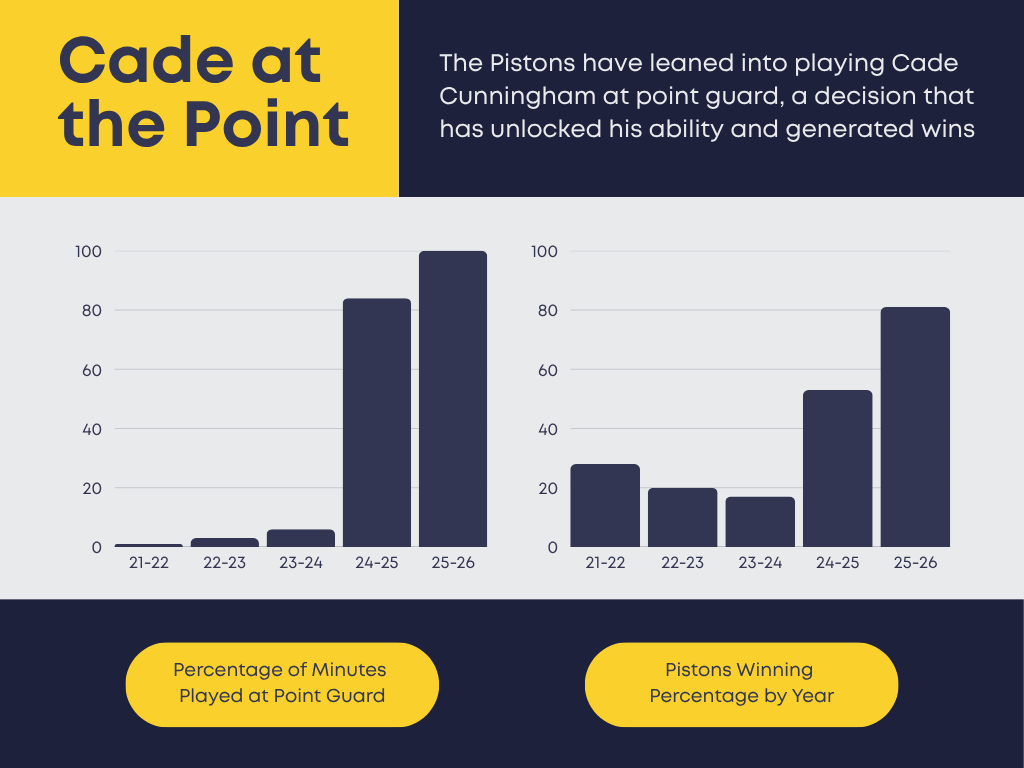
The issue that came with Cunningham’s entrance into the league is a positional curiosity. At 6’6”. he possesses the size of a modern wing but also has a point guard skillset. In his first three seasons, Cunningham played 3.4% of his minutes at the point guard position. The result: the Pistons had the worst record in the NBA and Cunningham missed most of his second season with an injury. Last season with the arrival of JB Bickerstaff as the team’s new head coach, the idea of Cade as a wing player was disposed of.
Under Bickerstaff, Cunningham played 84% of his minutes at the point—resulting in career highs in points per game and assists. More importantly, the team won 44 games—the most since 2016. Cunningham emerged as the engine of that offense, taking on a massive responsibility to facilitate the other pieces. The emergence of Cunningham was recognized with him being named to his first All-Star team and being named third team All-NBA.
Cunningham was drafted to turn around a once proud franchise and make its fans have something to believe in again. He did that last season without question. But other players have made fans believe again. The question that remained about him was if he could take another step into superstardom—to cross the threshold into dominance.
The Superstar Trajectory
Superstar players don’t ascend to their status in the NBA immediately—it typically takes a few years. But when they arrive, it is noticeable. When Kevin Garnett jumped from high school to the NBA, the talent was undeniable. He was an All-Star in his second season, averaging 17 points, 8 rebounds, and 2 blocks per game. But he truly became a superstar in his fifth season. That year he finished second in MVP voting, made All-NBA first team, and was selected to the All-Defense first team.
When Garnett made that leap, the Timberwolves won 50 games. For Dirk Nowitzki it happened in his sixth season, where he elevated his level of play and the Mavericks won 60 games. Cade Cunningham seems to be having that sort of a moment in his fifth season. It’s the moment where the consensus goes from “he’s a good player” to “he’s one of the best players in the sport”.
Like many young stars that were picked at the top of a draft, Cunningham has had to deal with the supplementary scoring dilemma. Because these players are usually drafted by bad teams, they are often one-man shows early in their careers. The Pistons tried to address this when they drafted Jaden Ivey, but his ongoing health issues have stunted the growth of that possibility. While Cunningham has gotten his numbers, the next step has always been centered around making the others around him better.
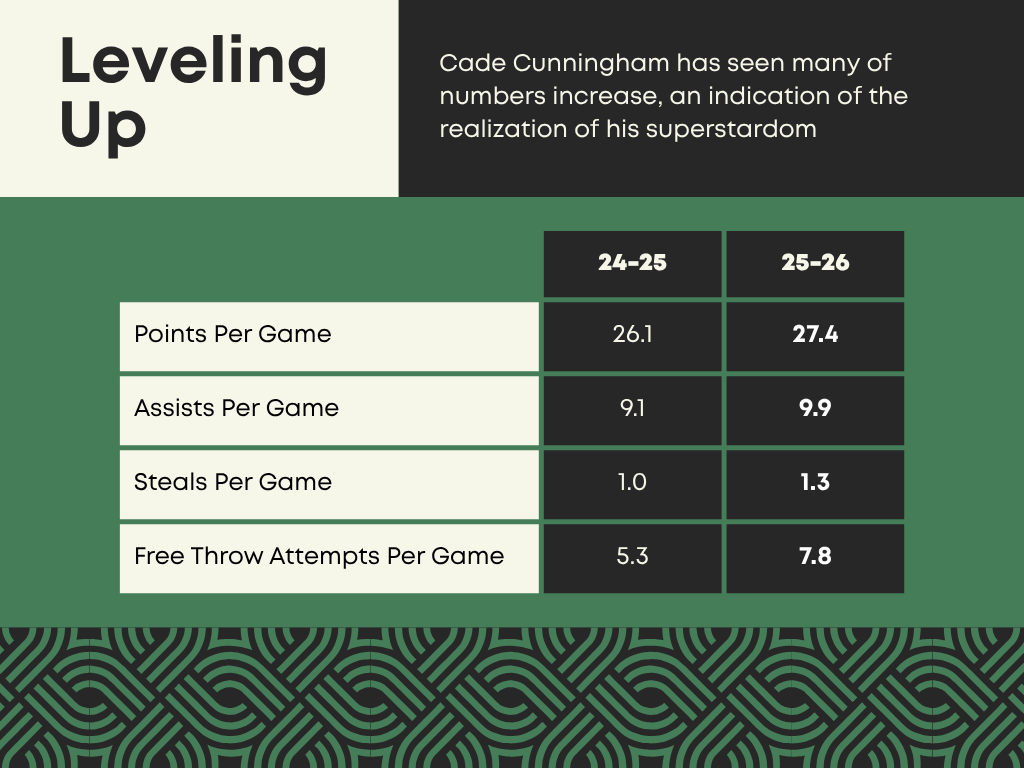
It’s the same dilemma that LeBron James faced during his first years in Cleveland. When he was able to harness his ability to set up chances for his supporting cast, those teams flourished and LeBron became a force. This season, Cunningham has increased his averages in points, assists, steals, and free throw attempts per game. He is doing this while decreasing his usage rate, telling us that he is more comfortable in the offense and not forcing the action as much.
Like many young perimeter players, his shot is still a work in progress. He is currently shooting 28% from three and 43% from the field. 57% of his shots have come inside the paint, which shows a commitment to getting inside and getting to the free throw line. While many fans don’t like to hear it, upping his free throw attempts per game is a winning trait that allows his team to stay in games.
His style is still very heliocentric, but he is developing more to his game with every passing game. He is utilizing his gravity on offense to develop a potent pick and roll game with big man Jalen Duren. He is learning to use his physicality to get to the basket.
We are witnessing the early days of a players mastering his craft. By the end of the season, it’s conceivable to think that Cunningham will be viewed as one of the best players in basketball. And his team, behind his efforts, will be a very real player in the Eastern Conference championship picture. We are witnessing the emergence of the heliocentric scorer of basketballs next generation.
Thanks for reading Deep Cover! This post is public so feel free to share it.