
The Flaw of the 40-20 Rule in the Modern NBA
In the modern NBA, only 40% of conference finalists meet Phil Jackson's famous threshold—down from 81% a decade ago. Championship contenders can no longer be identified by a single stat

What does it take to be a championship contender in the NBA? There’s a lot of ways to answer this question, and almost all of them would have some merit. Hall of Fame head coach Phil Jackson’s metric is a rather simple one. Known as the 40-20 rule, Jackson’s philosophy is that for a team to be seen as elite they must win 40 games in a season before they lose 20.
The rule is relatively sound mathematically, as it dictates that a team win two out of every three games consistently, which should measure out to a team that can win a championship. The thing is that for all the embracing of numbers and statistics, the 40-20 rule suggested that excellence could be measured systematically without accounting for the nuances of a season.
Jackson’s rule generally translates to teams that win the title—since 1999 only four teams didn’t meet the 40-20 threshold and still won a title. But if we consider conference finalists as “title contenders” then the reality shifts a bit, showing that trying to predictively measure what constitutes a contender is a flawed exercise to begin with.
Times are Changing
This decade has been one that is defined by parity, with seven straight seasons featuring a new champion. This level of distribution of glory hasn’t been seen since the 1970s. First, we must establish, what defines a title contender? A fair baseline would be the four teams every year that are playing in the Conference Finals, since they are the closest to actually winning a title.
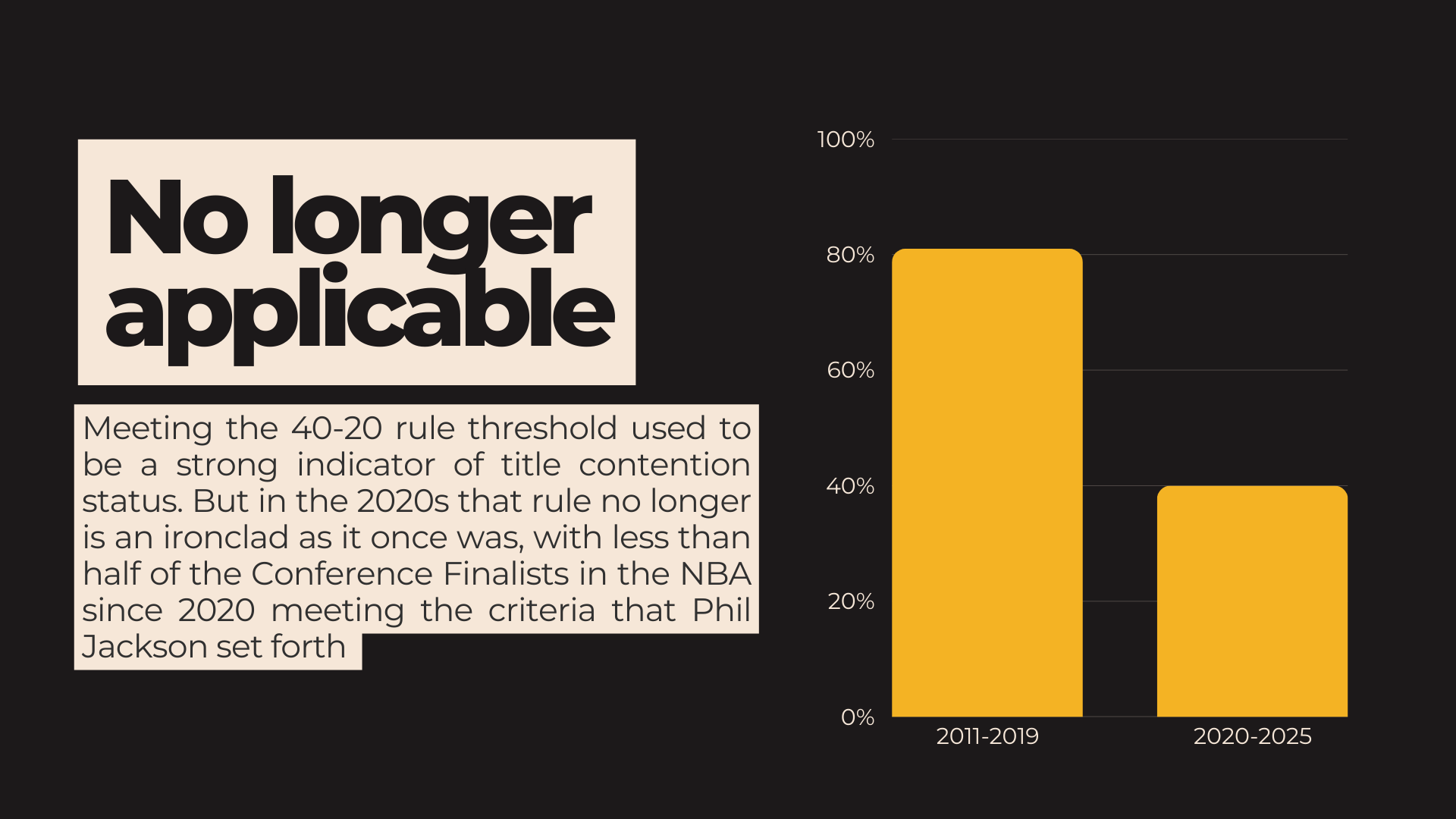
To understand how much different the NBA of today is, let’s compare the conference finalists from 2020-2025 and 2011-2019. 26 of the 32 conference finalists from 2011-2019 satisfied the 40-20 rule. Notably, two of LeBron James’ Cavaliers teams did not, which speaks to James’ noted reputation for ramping up once the playoffs arrive.
That is still an overwhelming number of teams that meet Jackson’s criteria—with 81% of teams that were the final four in the league matching the Hall of Famers standard. It’s also important to note that this timeframe was firmly in the superteam era. Multiple Golden State teams are represented in this timeframe, as are LeBron’s Miami teams, the Duncan Spurs, and the Harden Rockets.
Those numbers dip dramatically after 2020. Of the 20 conference finalists since then, only eight satisfy the 40-20 rule. In fact, last season three of the four finalists were not 40-20 teams. This was also the case in 2021-22. The convenience of the Phil Jackson rule is that it is deemed as gospel when the champion passes the benchmark. But the phrasing “elite” team should mean a team that has a chance to win a title.
The bigger truth of the matter of Jackson’s methodology is that with all of his championship teams, they met the criteria. So his correlation would then be that what worked for him must then be the standard. What that framing ignores, however, are some of the factors that helped enable his team during his era.
Era-specific Advantages

Phil Jackson was hired by the Bulls as an assistant coach in 1987. He would then go on to coach the Bulls and Lakers until 2011—with brief hiatuses in 1999 and 2005. When he entered the coaching ranks there were 23 teams in the NBA, after he left there were 30.
League expansion is ultimately a part of Jackson’s experience as a winning head coach in the NBA. When he won his first title in 1991, the Hornets, Heat, Magic, and Timberwolves were under three years old as franchises. Three of those teams were in the Eastern Conference, and they got to beat up on them pretty regularly.
In the 1991 season, the Bulls played 13 games against those young clubs and went 13-0 in those games, accounting for 15.8% of their games that season and 21% of the Bulls’ wins. None of those teams won over 31 games that season.
Prior to the second Bulls three-peat, the league added two more teams. That meant that 20% of the league during the Bulls legendary 1996 campaign where they finished 72-10 featured franchises that were less than ten years old.
Against those six teams in 1996, the Bulls went 15-4—once again taking advantage of some teams that were still figuring out the NBA (especially Toronto and Vancouver, the two newest teams). Those Bulls teams were all-time teams, and that cannot be disputed. However, it is fair to say that they did benefit from a slightly diluted talent pool due to expansion drafts.
Because of his experience, Jackson’s conclusion of the 40-20 rule is a natural one because his teams were in an excellent position to win a lot of games due to the nature of the league.
Even in his Laker years, there was only one new team added—the Charlotte Bobcats—but there was a sense that the league was in a strange transition in the wake of Michael Jordan’s retirement. Offenses were less efficient in that era, with field goal percentage dipping when compared to the 1990s and today’s era.
In essence, during Jackson’s the gap between good teams and mediocre ones was wide, with talented teams separating and being able to rack up wins. That is no longer the case in today’s NBA, making the merit of the 40-20 rule come into question.
Modern Forces
In 1996, nine of the fifteen players selected to the All-NBA teams played in 80 or more games. Last season, none of them did. As medical science has advanced and the regular season has been devalued, teams have become more cautious with their players, often resting them in a process that is called “load management”.
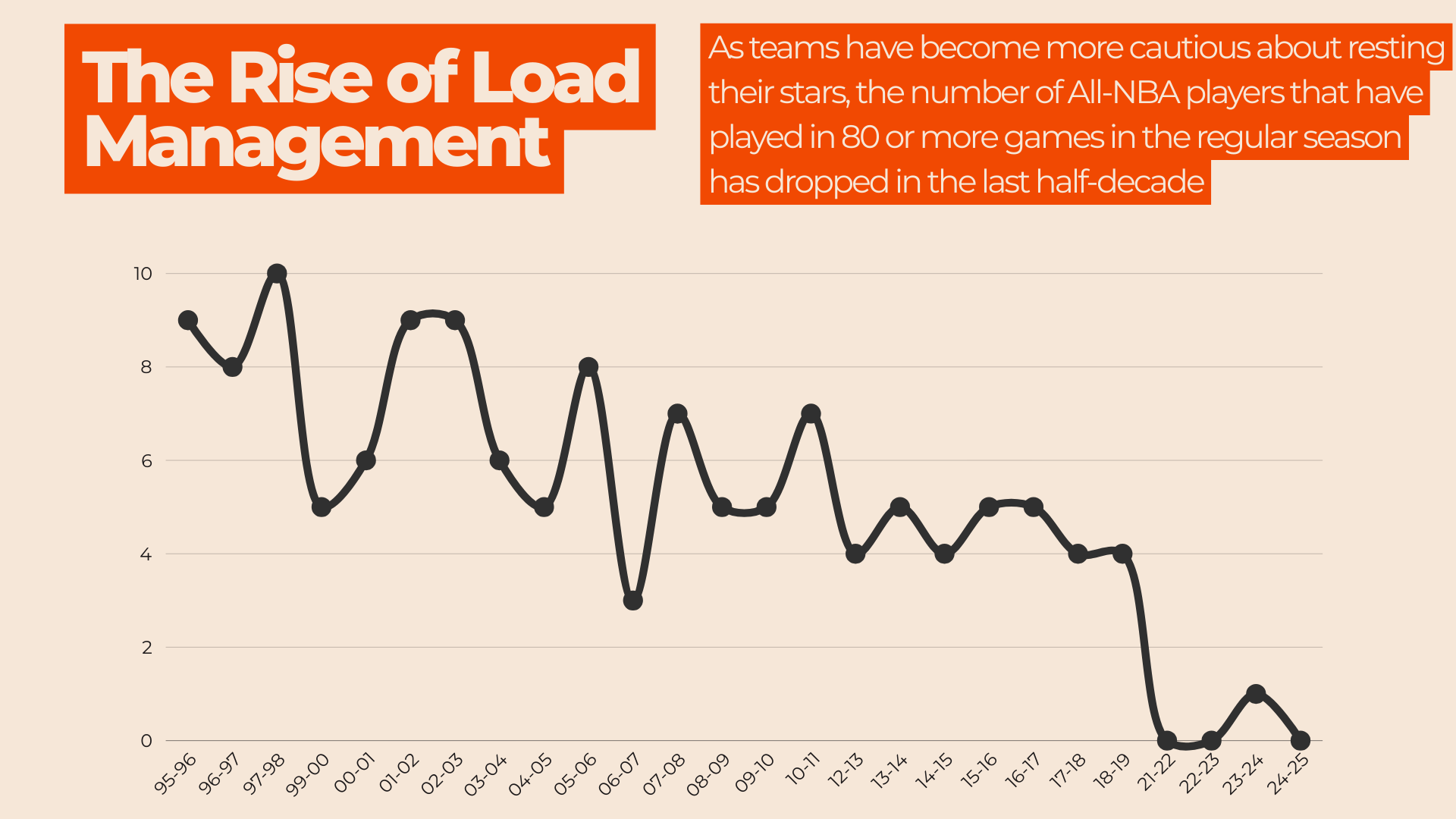
While Kawhi Leonard is the face of this practice in the eyes of many fans, the process has universal acceptance around the league. Players will often be rested when they suffer minor injuries in the hopes that they won’t face a more serious injury shortly after.
This resting of players is rooted in long-term vision of star players being closer to 100% come the postseason. This also has led to teams accepting “scheduled losses” where a number of players are rested on back to backs and other schedule quirks.
Interestingly, the advent of the NBA’s Play-In Tournament that opens up postseason play to more teams, has also had an impact in this regard. Teams that got off to a bad start 20 or 30 games into the season have hope to climb back—meaning that they have incentive to win games between Christmas Day and the traded deadline. This further complicates the efficacy of the 40-20 rule.
While load management ultimately leads to decreased win totals, the Play-In Tournament also gives teams a reason to not be as focused on win accumulation. The convergence of both elements often leads to most teams not valuing rapid regular season win accumulation. Situations where teams won a lot of games and flamed out in the playoffs like the Joe Johson-era Atlanta Hawks are a big motivator in this regard.
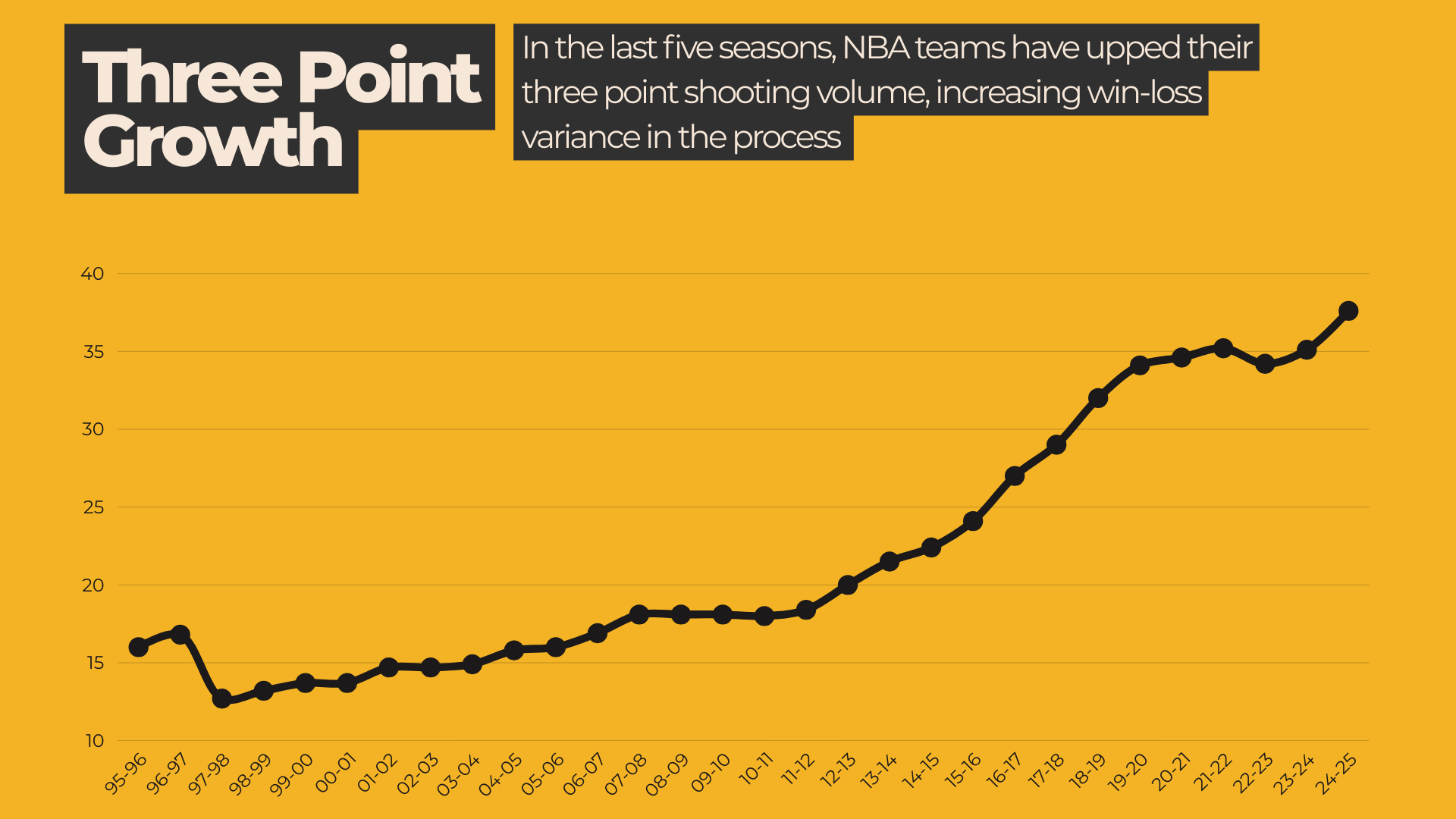
But perhaps the biggest driver of the rule no longer being an iron clad metric is the advent of the three-point shot. When Jackson coached, teams rarely shot more than 20 threes per game. In today’s game, teams regularly shoot over 40 per game. In fact, this season, 12 teams shoot 38 threes per game or more.
Because of the variance in efficiency with three-point shooting, the chances of a bad team catching fire from outside and beating a superior team is higher. A perfect example of this is the game between the Washington Wizards and Detroit Pistons on February 5, 2026.
The Pistons were the number one team in the Eastern Conference, and the Wizards were a cellar dweller that was tanking by playing their best players limited minutes. But none of that mattered, because the Wizards made 18 of their threes to the Pistons 9. The volume for both teams was high (33 for the Pistons vs 41 for the Wizards), but the efficiency was the story as the Wizards made 43.9% of their threes. The Wizards won the game by 9, a reflection of the way that the three-point shot has created random outcomes during the regular season.
Elite teams are inevitably prone to bad shooting nights, which is ultimately not an indictment of the quality of the team but rather a reflection of the uncertainty and risk associated with the three-point shot. These types of games will happen multiple times a year to all contending teams, but it doesn’t make them any less of a contender—even if it means they won’t qualify for Jackson’s 40-20 benchmark.
Embracing Randomness

The 40-20 rule is still a fair metric for predicting an eventual champion. In the last five seasons, four of the champions met the criteria (the only exception being Milwaukee in 2020-21 when they beat Phoenix in the Finals who was a 40-20 team). But even in that framing the use of the measure as the only way a team could contend feels limited.
Last season, the NBA Finals featured a 40-20 team (Oklahoma City) and a non-40-20 team (Indiana). According to the logic of the metric, Indiana was not to be considered a title contender or elite team. And yet they took the Thunder to a Game 7 and are a great unknown because of the devastating Tyrese Haliburton injury that occurred early in that game. An injury that, when considering Haliburton’s importance to the Pacers, may have cost the team a title. Not bad for a team that doesn’t meet the “title contender” benchmark.
But because the champion is usually a 40-20 team, it feels relatively bulletproof since they are the last team standing. But the verbiage of Jackson himself indicates contention not the final champion. In today’s NBA, the reality is that there is no ironclad metric that defines successful, contending basketball.
In the last four years, teams of different strengths have made the conference finals, and thus were contending for a title. Offense alone isn’t the answer, as Minnesota made the Conference Finals in 2023-24 ranking 16th in offensive rating. But defense alone isn’t that metric either, as the Mavericks and Pacers in that same year ranked 17th and 24th in defensive rating that same year.
Even three-point accuracy which should matter more than it ever has in a three-point shooting league has proven to be inexact as well. The Celtics made the Finals in 2021-22 ranking 14th in three-point efficiency for instance. Pace is another flawed indicator. Oklahoma City won the title last year while ranking 5th in pace, while when the Nuggets won in 2022-23 ranked 23rd in the category.
The reality of today’s NBA is that there are so many variables—injuries, load management, shooting luck, matchup favorability—that define who is a contender and who isn’t. The league is more competitive than it has been in decades and the result of that is a bit of randomness. In most facets we have accepted that unpredictability is a feature rather than a bug of the NBA with elevated championship parity and competitive Play-In races. Yet we have held on to the idea of the 40-20 rule, mainly because of the stature of who said it. The reality is that championship DNA characteristics changes fast in today’s NBA, and no single statistic can hold for decades to quantify that.