
The Knicks, Celtics, & the Illusion of a Rivalry
Boston and New York are supposed to hate each other. In every sport but one, they do. The numbers reveal why Celtics-Knicks is rivalry theater, not basketball reality


It was supposed to be a down year for the Boston Celtics after Jayson Tatum suffered a torn Achilles in the second round of the playoffs last season. Boston traded away veteran pieces like Kristaps Porzingis and Jrue Holiday, while allowing Al Horford to leave in free agency. What went from a potential disaster has transformed into a feel-good story as the Celtics have surged to a top three place in the Eastern Conference a third of the way into the season.
For a brief moment, the Celtics were in second place in the standings—overtaking a Knicks team that has championship aspirations this year in the wake of the injury to Tatum. When this happened, Celtics fans took to social media with vitriol for Knicks fans. It was a response to Knick fans in the summer claiming dominion over the Eastern Conference in the wake of Boston’s roster upheaval. In the moment, this felt like typical banter between two rival fanbases that hate one another.
The thing is, how deep does the rivalry between the Knicks and Celtics actually run? We assume its depths are endless because of the geographical animosity in other sports. But when you look through the data and playoff history of both clubs, a much different story is told—the Knicks and Celtics have a rivalry in theory, but not in practice.
Two Classes of Organizations
When you think of gold standard organizations in the NBA historically, there are probably three teams that come to mind: the Los Angeles Lakers, San Antonio Spurs, and Boston Celtics. The Golden State Warriors may also come to mind, and Chicago is in the discussion by default because of the championships of the Jordan era.
The NBA has been crowning champions for eight decades, and the Lakers, Spurs, and Celtics account for half of the championships in the history of the league. The Knicks have only won the title twice, with the most recent win coming in 1973. As a Knicks fan that will be 40 next year, I have never seen the Knicks win a title and have seen them make the Finals twice (most recently in 1999, when I was 12 years old). A Celtics fan of the same age has seen their team make the Finals five times and win it twice. A Celtics fan in their late 40s has seen the team make the finals nine times and win five championships. The two franchises operate on two very different planes.
This pedigree matters when considering the stakes and merits of a rivalry. A great rivalry is only truly relevant because there is a back and forth between the teams. Ohio State and Michigan in college football works because the teams are both consistently in the national conversation for championship contention for example.
The Celtics true rival has always been the Lakers. The teams have played each other 12 times in the Finals and specifically went back and forth in dominance during the 1980s, the most pronounced era of their rivalry. The animosity between them still exists because of the cultural tensions that were fostered between them all those years ago and the connective DNA of players that links the teams.
The Bulls and Pistons were excellent rivals in the 80s into the 90s because they traded dominance and had iconic and consequential playoff matchups as a result. But when that stopped happening due to both teams coming upon hard times, the significance of their rivalry diminished.
In a historical sense, the Knicks are inferior to the Celtics by any measurable you can think of. The Celtics have more titles (18 versus 2), more Hall of Fame players (49 versus 29), more iconic moments. From a geographical point of view, the Knicks could be considered the Celtics’ “little brother” from the lens of team and franchise accomplishment.
From the Knicks perspective, being accepted as the Celtics rival is a point of validation. To be considered as meaningful enough to be on the radar of a team that has been so prominent historically. But geographics alone do not make a rivalry, and the idea of this rivalry between the teams feels even more far-fetched upon inspection of playoff context.
The Knicks Perspective
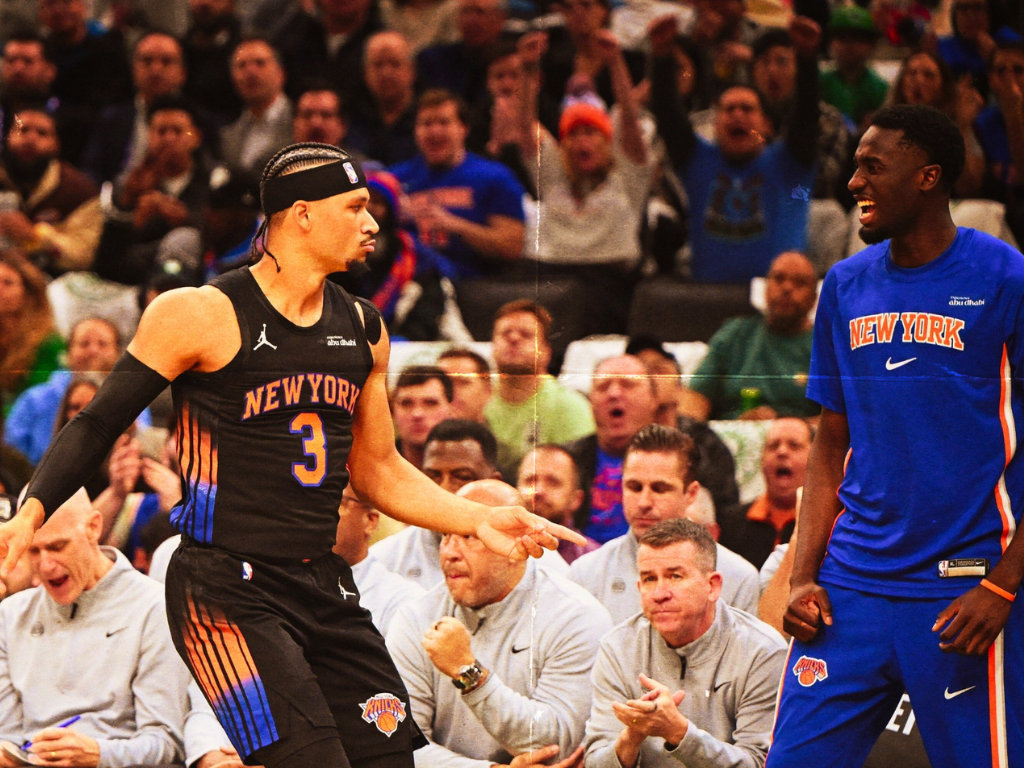
Since 1980, the Knicks have been a rollercoaster. The 80s were defined by tumult in the waning years of the glory years of the 70s leading into the rise of Patrick Ewing. The 90s became a golden era defined by Ewing, John Starks, and Pat Riley. Then since 2000, the team has been mostly bad with the exception of a few years with Carmelo Anthony in the early 2010s and the last few years with the rise of Jalen Brunson.
The Pacers have been in the way of the Knicks every time that they were a championship contender. The 90s with Reggie Miller, the early 2010s with Paul George, and currently with Tyrese Haliburton. If anything, the Pacers are the teams true rival, having played them 50% more of the time in the postseason than the Celtics and across multiple eras.
Since the 1980 season, the Knicks have played in 49 playoff series. In that time, their most frequent opponents were:
- Indiana Pacers: 9 times
- Chicago Bulls: 7 times
- Miami Heat: 6 times
- Boston Celtics: 6 times
- Detroit Pistons: 4 times
Even the matchups with the Heat have spanned eras. Late 90s matchups that pitted Ewing against Alonzo Mourning, 2011-12 against LeBron James after he spurned the Knicks in free agency, and in 2022-23 against Jimmy Butler. The persistent connective tissue of Pat Riley between the two franchises has kept the hatred between them alive, to the point that the teams haven’t transacted with one another in any sort of trade since Riley left the Knicks for South Beach.
Let’s then observe the six matchups between the Knicks and the Celtics. All but two (1983-84 and 2024-25) occurred in the first round. Those first round matchups were often mismatches between two teams, miles away in the standings.
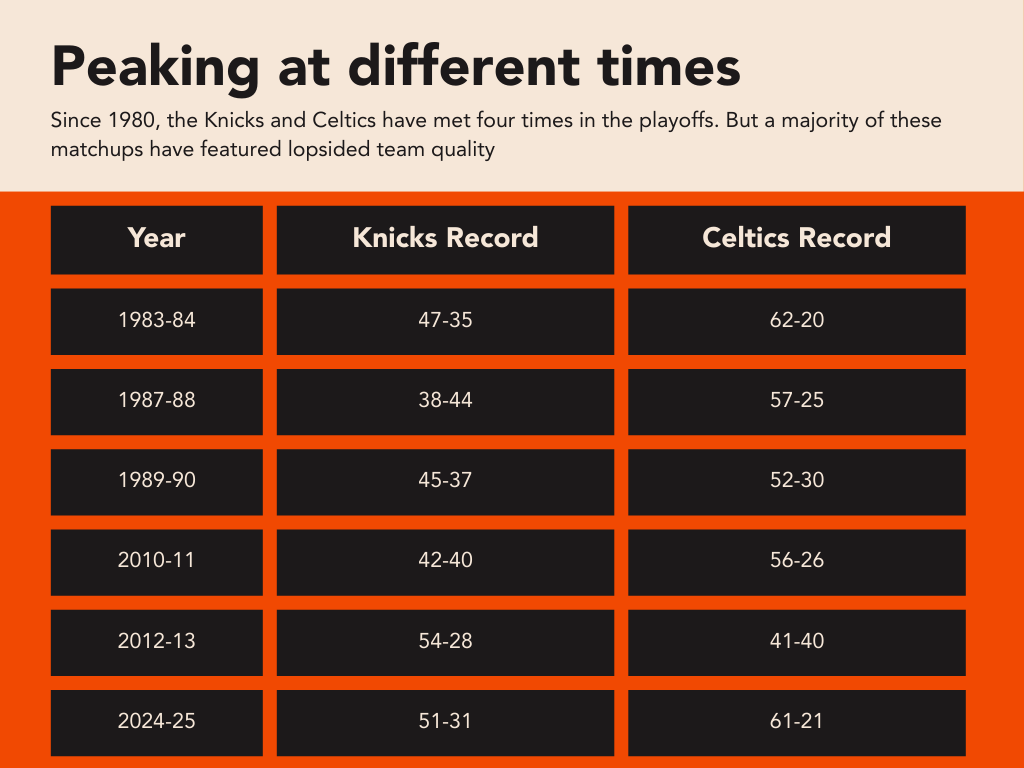
In three of those matchups, the Knicks won less than 50 games playing a Boston team that was a title contender. The one time that the Knicks had a good record and were considered contenders in 2012-13 when they went 54-28, the Celtics were a very pedestrian 41-40 (the Celtics had one game cancelled that season in the aftermath of the Boston Marathon bombing).
The two series of consequence between the two clubs was in 1983-84 and 2024-25. In 83-84, the Celtics had the best record in the NBA at 62-20. The Knicks were the 5th seed at 47-35. This was a year of brilliance for the Knicks Bernard King, who finished second in MVP voting to the Celtics’ Larry Bird—meaning that this matchup pitted the best two players in the sport at the time. The Celtics would go on to win the title that year, but it can be argued that no one tested them more that year in the Eastern Conference than Bernard King.
The teams wouldn’t meet again in the second round until 2024-25, when the Celtics were attempting to be repeat champions. Despite dominating the regular season series, Boston faltered in the first two games against New York and the unfortunate injury to Jayson Tatum in Game 5 extinguished whatever hopes they had of winning the series. Both teams were in the top three of the conference and had very real championship visions. The Knicks would go on to win the series but fall in six games to the Indiana Pacers in the conference finals.
There is an arguable 41-year gap in between playoff series matchups of true consequence between the Knicks and Celtics. From the Knicks point of view, matchups with Boston are more often than not footnotes as opposed to recurring instances when compared to the history with the Pacers and Heat. This is not a one-sided dynamic; the Celtics have even more reason not to view the Knicks as a true rival.
The Celtics Perspective
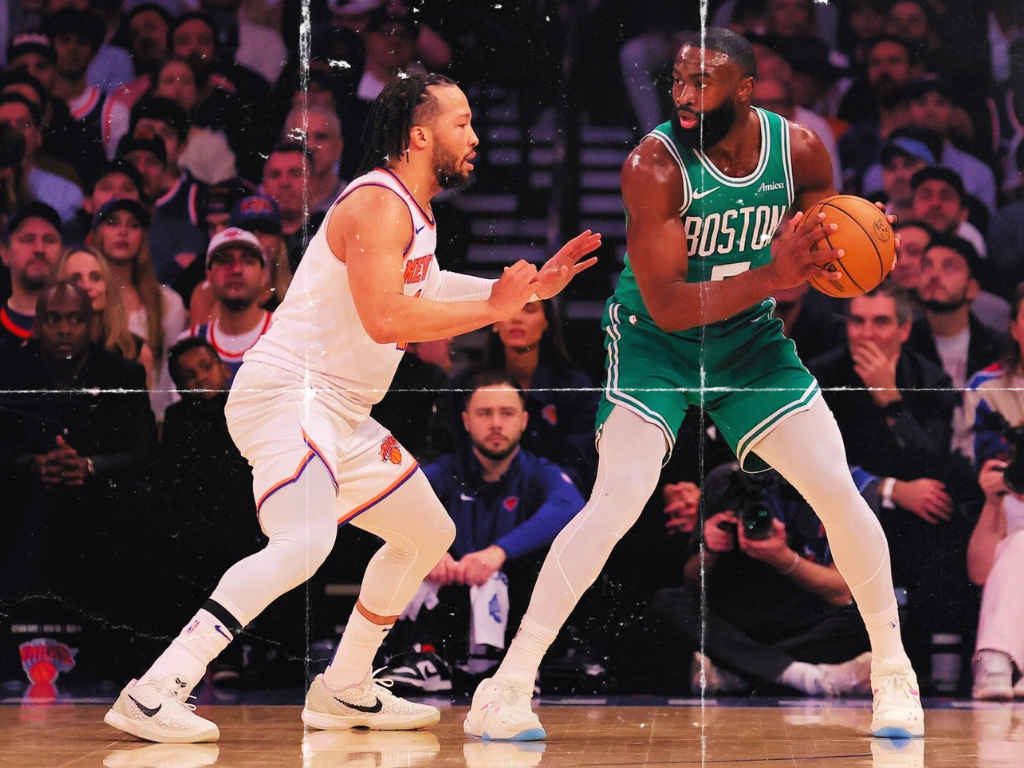
It’s important to note just how often Celtics find themselves in the postseason. Since 1980, they have made the playoffs 78% of the time. Outside of a lull period in the 90s (which can largely be attributed to the tragic deaths of Reggie Lewis and Len Bias), the Celtics are playing for titles constantly.
Rivalries in the NBA are built on high leverage playoff matchups. And when it comes to the teams they have seen in the playoffs, the Knicks are further down the list for the Celtics than many might imagine:
- Cleveland Cavaliers: 8 times
- Detroit Pistons: 7 times
- Philadelphia 76ers: 7 times
- Atlanta Hawks: 7 times
- Milwaukee Bucks: 7 times
- Miami Heat: 7 times
- New York Knicks: 6 times
- Brooklyn/New Jersey Nets:4 times
The Celtics true rival is the Lakers, who they have played five times in the Finals since 1980—which places the weight of each matchup at a much higher point of significance versus Eastern Conference playoff series.
Because of the stature of the Celtics, many of their matchups with Eastern Conference foes tend to feel like bumps in the road as opposed to true rivalry moments. The number that sticks out the most is the Cavaliers, which is more of a commentary on the rivalry between the teams in the LeBron James era, when they played each other four times. And because LeBron eventually ended up on the Lakers, that connective tissue is forged through animosity with the Lakers.
For the Celtics, the Knicks are like the annoying cousin that pops up once a decade during a holiday get-together. There is a large gap between matchups of relevance for the teams, meaning that there isn’t enough scar tissue between the two teams to form a true hatred. That is found instead between the Pacers and Knicks, or the Lakers and Celtics.
Defining a Rivalry

There is an expectation that the Knicks and Celtics should be fierce rivals because of their geographic proximity to one another. This is the assumption because of the reality in other sports. The most obvious example is in baseball where the Red Sox and Yankees have been blood rivals since the Babe Ruth trade. Since 1999, the teams have played each other six times and have often both been considered title contenders at the same time.
In the NFL, the Patriots played the Giants twice in the Super Bowl and are division rivals with the Jets, playing them twice a year. This matters in the NFL because of the elevated importance of every game in its shorter schedule. These dynamics helped to create a sense of animosity between the cities, which has been brewing for centuries.
During the colonial era, Boston and much of the Northeast was colonized by the British, while New York was colonized by the Dutch. As a result, there was a culture clash with Boston leaning more puritanical and New York being more mercantile.
This much shared animosity should presumably trickle over to the basketball court, leading to the assumption that the Knicks and Celtics must be rivals because that is simply what Boston and New York do. The issue becomes that many of the tenets of a fierce rivalry simply aren’t there between the two teams.
Iconic moments for each team are thought of against other teams, their true rivals. The two teams, despite both being inaugural members of the NBA have rarely been top-level teams at the same time. Since 1980, there have only been four seasons where both teams finished with over 50 wins—and two of those years have been in the last two seasons.
During the 80s, when the Celtics were the dominant team in the East, Boston averaged 58.3 wins per season. In the same decade, the Knicks averaged 38 wins per season. In the 90s when the Knicks were excellent and making deep playoff runs annually, they averaged 51.1 wins per season while the rebuilding Celtics averaged 38.2 wins per year.
In the brief three year prime of the Celtics Big Three era with Paul Pierce, Kevin Garnett, and Ray Allen, the Celtics were winning 59.3 games per season, while the dysfunctional Knicks averaged 28 wins per season. The overlap in competency has simply not been there, meaning that true seeds of rivalry were not allowed to form outside of geographic proximity.
The notion of the rivalry between the two teams persists for a number of reasons. Proximity is of course the first one, leading many to lean into Boston versus New York talking points to reaffirm the animosity between the two cities. It can be argued that the NBA wants to position the rivalry as bigger than it truly is to create a sense of urgency, especially when they meet in the regular season for the purpose of a ratings boost.
From the Knicks perspective, the rivalry idea versus the Celtics is more beneficial. It creates a legitimacy for their team, to highlight the longest standing matchup in the NBA between two original founding members. It creates legitimacy for a franchise that has gone long spells of time without it.
For Boston, it simply gives them more ammunition to hate New York. And in this parity era of NBA basketball, seeing the Lakers in the Finals is never guaranteed so the Celtics need a proper rival, and the Knicks fit that description pretty well.
Fast forwarding to today, there is an interesting wrinkle at play. Both teams are title contenders, and the seeds of a true rivalry may finally be planted.
A Change on the Horizon
In 2024, the Knicks identified the Celtics as the team they need to dethrone on their quest for a title. Much of the roster moves, such as acquiring Karl-Anthony Towns from Minnesota, were done with the explicit intent of beating the Celtics in a playoff series. Because the Celtics under Joe Mazzulla have fully embraced volume three-point shooting, the Knicks felt that the only way to compete was to add more shooting for themselves.
Their second round series in 2024-25 lived up to the hype a renewed intensity and desire for both teams to prove something to their fanbases. Really, for the first time in over 40 years, the matchup felt like it had real stakes with two teams that were built to compete for championships.
Could that series be the start of a long-standing back and forth in the postseason between both teams? Maybe. If the Brunson and Tatum eras lead to multiple playoff series this decade, then the reality would shift. But we’ve been there before. The series in 1984 seemed like the start of something, only to remain dormant for decades.
With that being said, the success of both teams is not a given. The Celtics are under new ownership, and it remains to be seen how they will handle paying the luxury tax. The return of Jayson Tatum after his injury is also a question mark in both the short and long-term prospects of the team. For the Knicks, their window of success may be shorter than many of us imagine—especially when we consider the shelf life of smaller guards like Brunson historically.
What works against both teams are that the current cap mechanics of the NBA in the apron era leads to the breakup of teams. It’s why the Celtics let go of so many pieces this offseason for instance. While it is no guarantee that they will continue to meet in the playoffs, it feels like both teams may finally be good at the same time for an extended period.
Despite that rosy future for the state of the rivalry, it is all hypothetical. The guts and core of the Celtics and Knicks “rivalry” is largely circumstantial. They play in cities that have a history of animosity politically, culturally, and in other sports. But it is not a given that the two teams actually have a rivalry. The reality is that they have the framework of a strong rivalry, a battle cry that fans could sell themselves on. This might change in the future, but for this Knicks fan the true rival will always be Indiana.
Thanks for reading Deep Cover! This post is public so feel free to share it.