
The NBA’s Structure & the Inevitability of Tanking
The league wants to end tanking, but its own structure makes it an impossible task


In a game against the Miami Heat on February 9th, the Utah Jazz did something unusual. Leading 85-82 after three quarters the Jazz benched their two best players, Lauri Markkanen and Jaren Jackson Jr. for the duration of the game. What the Jazz were attempting to do was a coordinated tanking strategy, intentionally trying to lose this matchup so that they would have a better chance at getting the number one pick in the Draft.
On this night, their efforts were in vain as the Jazz won game despite their best efforts. As punishment for their transgressions the NBA fined them $500,000 for what it called “conduct detrimental to the league”. Adam Silver would go on to say that the behavior exhibited by the Jazz “undermines the foundation of NBA competition” and that the league will “respond accordingly to any further actions that compromise the integrity of our games.”
This off-season the NBA intends to try to derail the practice of last-season tanking. Ideas ranging from eliminating the draft to no longer allowing protections on draft picks in trades have been suggested, and it seems that the league is seriously considering all potential solutions. What goes ignored in the case of Utah, Washington, and other tanking organizations is that success in the NBA and what is required to achieve it has often necessitated the idea of not being consistently competitive every year.
Superstar Scarcity
It’s often said that the NBA is a “superstar league”. Indeed, more than other sports, titles are usually won in the NBA when the team has a transcendent star that can shift the fortunes of an otherwise poorly run team. The only exceptions to this rule where a superstar was not present on a team that won a title was with the 1979 Seattle SuperSonics and the 2004 Detroit Pistons. Those teams featured a collection of good and some great players that were built well but did not have a player that anyone would consider a superstar.
This is not the case in other sports. In the NFL, the Seattle Seahawks just won a Super Bowl without a name brand player on the roster. Shohei Ohtani and Mike Trout played together on the Los Angeles Angels for six seasons and never made the playoffs once, while the Kansas City Royals without notable star power made the World Series two years in a row in the mid-2010s.
In the NBA, it’s a different animal. You need high-level talent to compete, and the way you get that talent is through the NBA Draft. Only 60 players are drafted every year, but generally speaking, the best players are acquired at the very top of the draft. We often hear about unheralded sixth or seventh round picks making a breakthrough in the NFL, especially at positions like wide receiver, running back, and safety. But in the NBA, these stories are few and far in between. The glaring exception to this is Nikola Jokic, who became the best player in the sport despite being selected with the 41st overall pick.
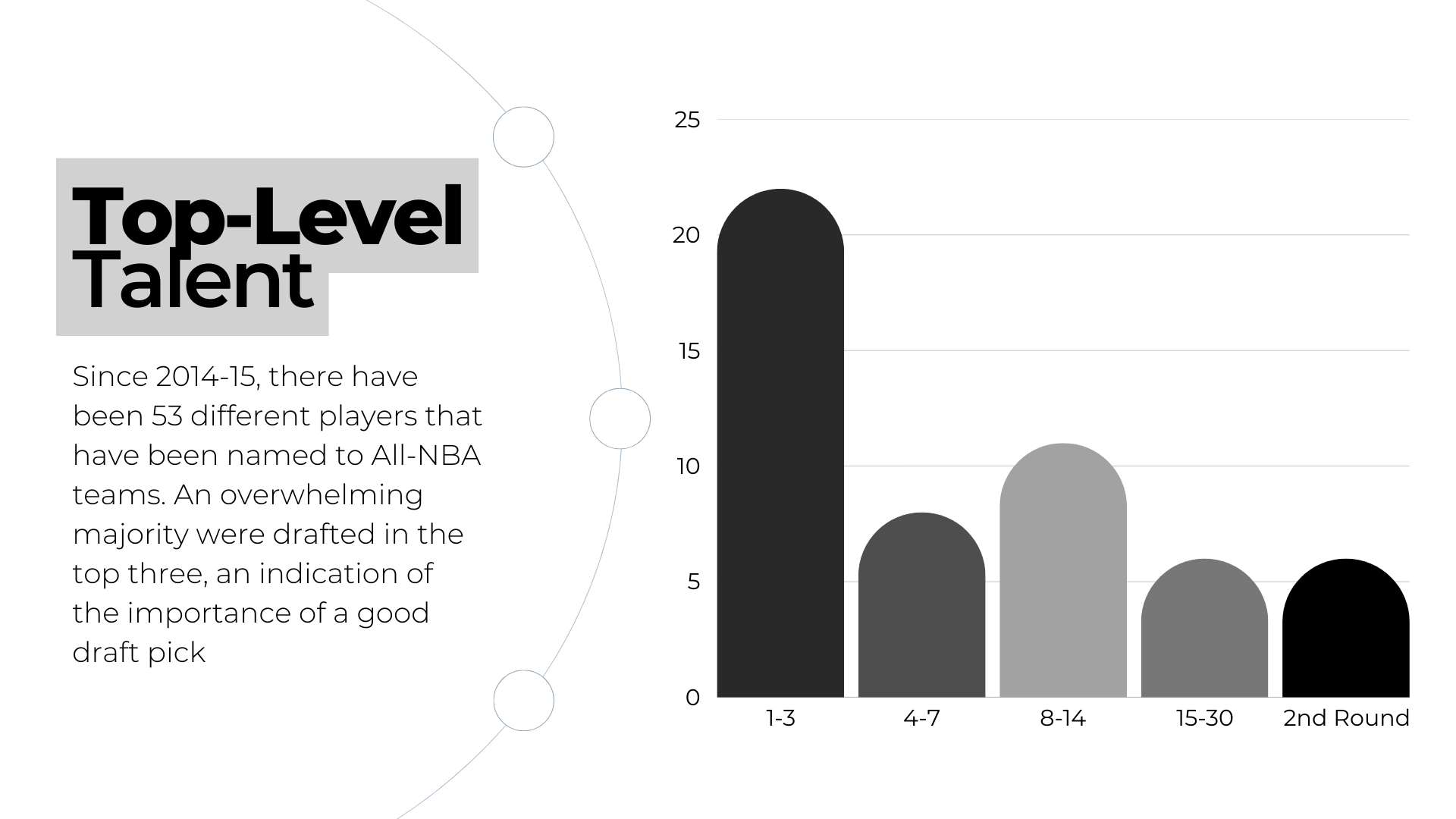
Over the last ten seasons, 53 players have been selected to All-NBA teams. These selections help to highlight the best players in the sport in any given year. 19% of those All-NBA players were selected with the first overall pick. 41% were selected in the top three. And a staggering 77% were selected in the Lottery (picks 1-14). While it is possible that a player like Jokic, Jimmy Butler (pick 30), or Jalen Brunson (pick 33) can be found in the late Lottery or the second round, the odds of that happening are extremely slim.
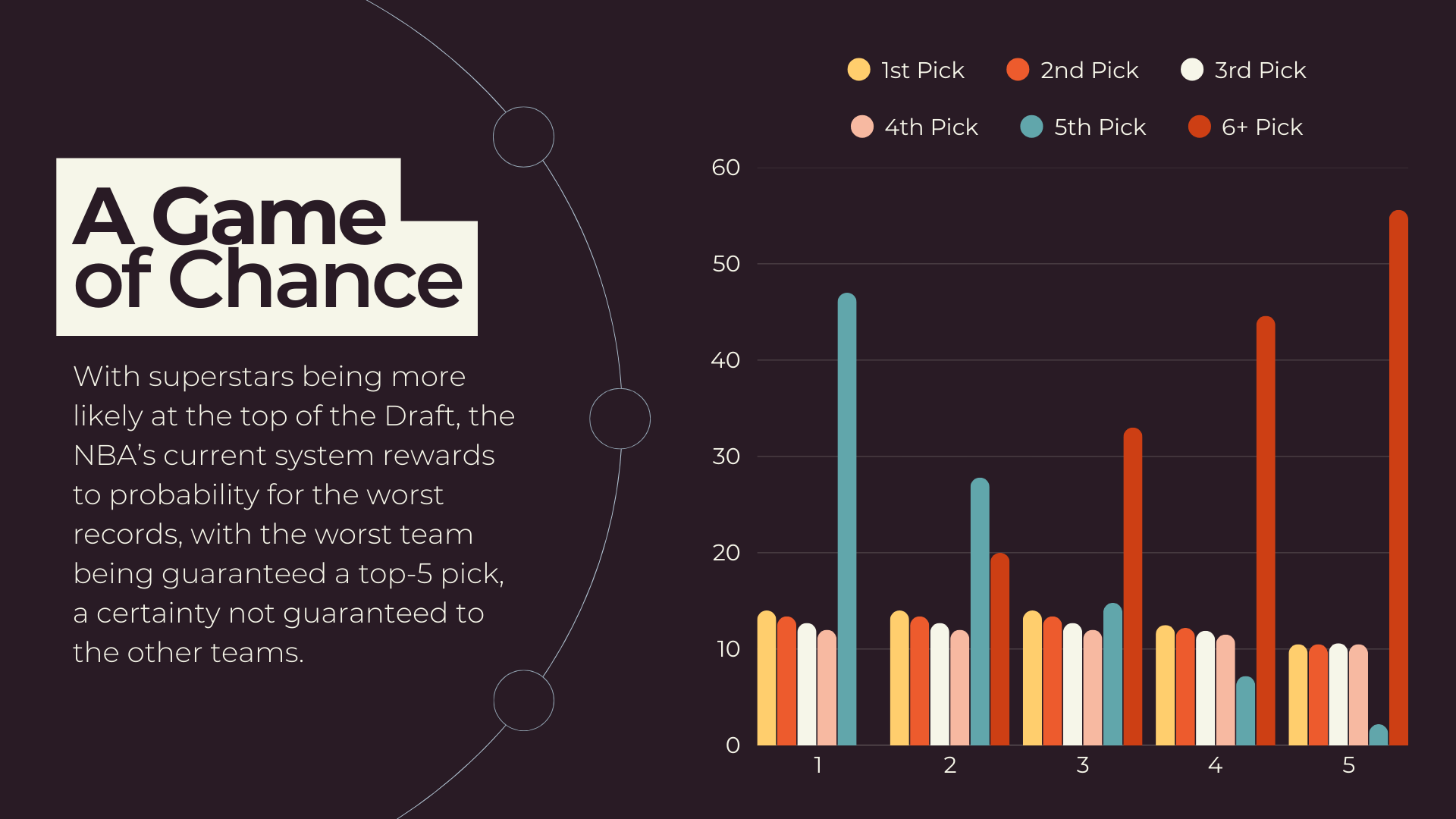
The better probability assumption is that a superstar will be found near the top of the draft, and that is the entire philosophy behind tanking. In a sport that covets high-end talent more than any other, putting your team in a position to acquire that sort of player is considered worth the risk. The worst team in the league only has a 14% chance of getting the number one pick due to flattened Lottery odds. But they are guaranteed a top five pick, with the overwhelming majority (47.9% chance) that they will end up with the fifth pick.
50% of the All-NBA players in the last decade were selected between picks 1-5, so a team can rationalize that losing today enables them to potentially get a franchise-altering superstar tomorrow. The calculus for many teams lately, however, is to hedge their bets by making big swings in the trade market in the hopes that they at least have some hope to sell for the next season while they perpetually lose to close out the current season.
The Front Office Optimization Era
One of the biggest bits of tension between sports fans and the teams that they watch is the rise of analytics and statistical probabilities in the games they love. Every sport has seen the impact of stats-driven strategy—more home runs and strikeouts in baseball, more fourth down attempts in football, and more three-point shots in basketball. Traditionalists argue that it dilutes the art form of a sport, while evangelists contend that it unlocks efficiencies that were not seen in the past.
In basketball specifically, the analytics calculation is relatively simple. Threes replaced midrange shots because they are worth 150% more in terms of points and have a negligible drop in efficiency. Consider that going 4/10 from three and 5/10 from mid-range means that a team scored more points when they shot threes. This is a more mathematically sound way to approach basketball, and it has been utilized with great success by most of the NBA.
But the critique has often been an aesthetic one, that games have become a three-point shooting contest. The concept of maximizing efficiencies has now entered the thinking of front offices as well when it comes to team building.
The Utah Jazz and Washington Wizards both made trades this year that on the surface are designed to make them more competitive. The Jazz traded for Jaren Jackson Jr.—a two-time block champion and three-time All-Defense selection. The Wizards traded for both Trae Young and Anthony Davis, who are both multi-time All-Stars and in the case of Davis a five-time All-NBA selection.
Looked at in a vacuum, these moves feel like ones of teams that are ready to compete for playoff spots, not teams that are tanking. But what both Utah and Washington have done is acquire players that will likely not play at all this season due to injury. What they have done is unlock a new realm of optimization.
Both the Jazz and Wizards see this upcoming draft as a potential goldmine for young superstar-level talent. With four elite prospects—AJ Dybantsa (BYU), Darryn Peterson (Kansas), Cam Boozer (Duke), and Caleb Wilson (North Carolina)—there is a lot of reason for a bad team to want to tank.
These front offices are giving themselves an opportunity to land a top-level prospect. But if they fail, they know that they have All-Star caliber players at their disposal for next season. In the case of these teams, they feel that they have to tank because you need a top-level star to win in the league. And if their consolation prize is a decent year or two of Trae Young or Anthony Davis, well things could be a lot worse than that. While it is wildly anticompetitive, teams view this as a necessary evil to reach a goal, which is an issue.
Trying to Fix a Systemic Design

The timing of Utah’s resting of Jackson Jr. and Markkanen is likely the most egregious one to the league—as it raises questions about the integrity of competition. Consider this about the NBA, for the bulk of its season, it’s competing with the NFL and college football for viewer eyeballs. Even its marquee day—Christmas Day—has been encroached upon by the NFL. The All-Star Break usually arrives right as the NFL ends its season and people gear up for the playoffs (with a little bit of March Madness mixed in).
So, when the football fan that is tuning into the NBA for the first time this season sees a professional team openly show that it has no interest in winning by benching its star players in a close game, that rubs people the wrong way. It falls into the accepted notion that the regular season doesn’t matter and that NBA players are entitled and don’t want to play. And that perception becoming a reality is NBA Commissioner Adam Silver’s nightmare.
As a result of the actions of the Jazz and other teams, tanking has become viewed as a crisis moment for the NBA. That rhetoric has ignored the reality that NBA teams have been tanking for draft picks for decades, as it was the tanking that netted the Rockets Hakeem Olajuwon that caused the Draft Lottery system to be implemented in the first place.
Some of the changes that Silver plans to present to the NBA owners include:
- Limitation on first-round pick protections in trades
- Teams not being allowed to pick in the top four a year after making the conference finals
- Teams being prohibited from selecting in the top four in consecutive years
- Teams being prohibited from selecting in the top four after consecutive bottom-three finishes
In a recent meeting with NBA executives, Adam Silver noted that tanking is “not who we are going to be as a league”. Silver wants teams to be competitive and not lose games by design. When the “Trust the Process“ Sixers teams lost a lot of games to get high-end picks that netted them Joel Embiid and Ben Simmons, the league adapted and flattened the Lottery odds. It seems that with this sort of “trade and stash” method of acquiring talent but not playing them right away, it will act again.
But can the NBA actually fix what has become an accepted strategy? If the goal is always to acquire superstar-level talent, the Draft will always be a primary way to get it. The other avenue is through trading, which has notably been an issue for smaller market teams in a league that gives players all the power to dictate their preferred destinations.
The NBA’s entire structure is centered around having a star player or two and building around them. The cap structure as it is currently implemented with 25% and 30% max contracts for stars predicates that a team must have a star player to compete.
With the focus being squarely on high-end talent acquisition, it feels relatively futile to suggest that teams will stop trying to maximize their chances at securing a top prospect. Furthermore, this blanket policing of losing teams loses the distinction between what the Wizards and Jazz are doing versus a team like Brooklyn that has a lot of rookies and is just playing them minutes to see what they are capable of.
The NBA wants to cure what it perceives as a disease. The problem is that tanking is more of a side effect than it is an ailment. The NBA saved itself in the 1980s because of star power, and that same star power has propelled it in the decades since then. Part of the trade-off of that emphasis is the way teams acquire stars. So, unless the NBA wants to change that entire core philosophy, teams will continue to lose games and find ways to strategically position themselves to land an elite prospect—because that was what the league has signaled as the only way to win in the end.