
The NCAA is Expanding March Madness for All the Wrong Reasons
The NCAA Tournament expansion isn't about discovering new contenders. It's about giving structural advantages to the conferences that already have them.


How much March Madness is too much March Madness? It seems that the NCAA thinks that we have yet to find that limit. The tournament currently has a field of 68 teams—60 teams that automatically qualify and eight teams playing for the last four spots in the 64-team field called “The First Four.” A new proposal is gaining momentum that would expand the field to 76 teams—effectively turning the “First Four” into the “First Twelve” with 24 teams playing for 12 at-large spots in the 64-team tournament field.
The decision to expand has been reported as an opportunity for teams from power conferences with middling records to have an opportunity to compete in postseason play. While money is said to not be the key motivating factor, it’s still a factor. Increasing the play-in portion of the tournament from four games to twelve games presents triple the opportunity for ad placement, and that cannot be ignored. Like other sports, the NCAA is looking to maximize viewership opportunity, and the way to do that is through more games. But we must wonder, does this come at the cost of cheapening a great tournament? And the ripple effects of doing so are merely just another ploy to widen the gap between the haves and have-nots.
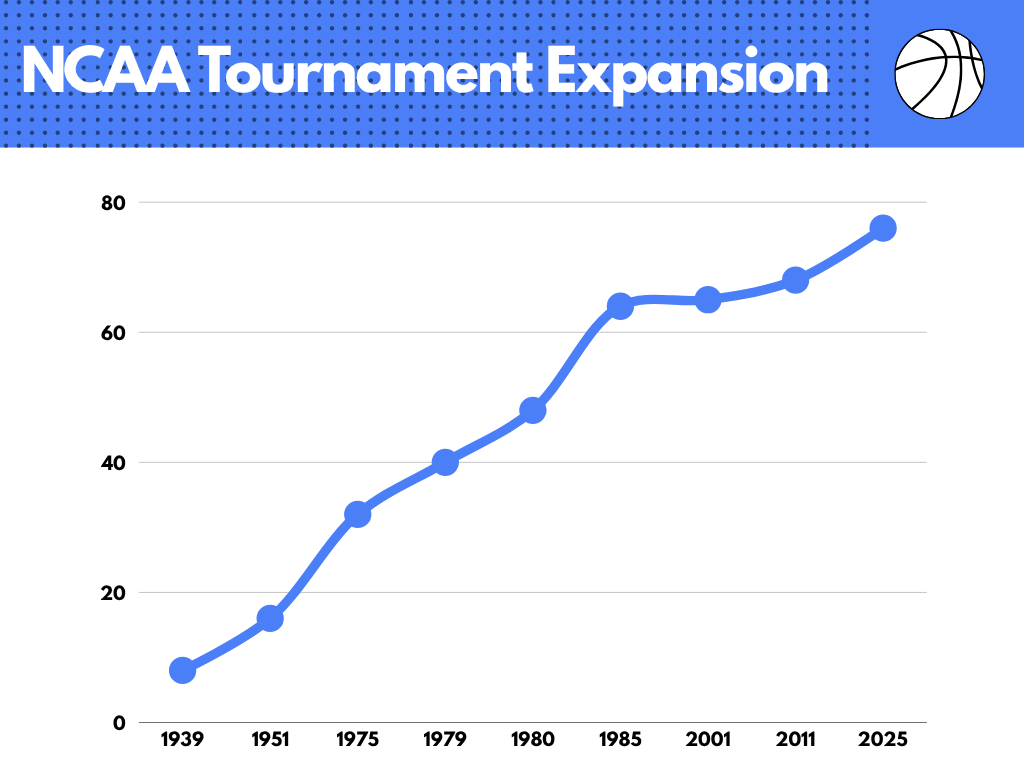
The NCAA tournament expanded from 64 teams to 68 in 2011. A lot about the way that we consume TV has changed since then. While cord cutting began gaining steam in 2008, it only recently became an expectation in 2023 when the number of households with streamers outnumbered the households with cable for the first time. 2011 was also before the arrival of mainstream live TV over internet providers such as Sling TV and YouTube TV were in existence.
As we have culturally moved on from cable packages, there has been an erosion of urgency for live TV. Shows are now on-demand, and while they are released on certain days of the week, we’re no longer locked into a specific time window to watch them. News has shifted heavily to social media, where reporters often update their X or Threads accounts with breaking stories, making the live news broadcast less important. The only things that remain essential to view live are sports and election results.
Sports leagues have identified this overwhelming demand for their product, and so have streaming apps. The latest media deals for the NBA, WNBA, and NFL are increasingly giving more games to streamers like Amazon Prime, Netflix, and Peacock. These apps are looking for any number of games to attract users to their services. By having a robust sports offering they ensure that subscribers don’t churn and continue using the service—which in turn leads them to watching other programming.

This is all good for the leagues and their partners, but games are a finite resource. There are only so many of them, but there is so much more money to be made off of them. The solution? Add more games. The NFL added an extra regular season game in 2021; the NBA added the In-Season Tournament and Play-In Tournament; and the WNBA has added ten more regular season games in the last five years as it has aggressively expanded. The NCAA’s March Madness media deal expires in 2032, but by adding more games, it creates a more appealing product when that deal is set to be re-negotiated. Those extra games becoming normalized then open up the door for more money from Apple, Amazon, and Netflix to maximize revenue for the rights to college basketball’s crown jewel.
The money of it all makes sense. College basketball has continued to devalue its regular season and, to a certain extent, has undermined its conference tournaments. It has become a one month sport to everyone but the diehards. The calculus for the NCAA becomes that adding more teams, means more engaged fan bases. It also means more eyeballs watching since anything that directly links to the tournament has stakes, and with that people will also bet on the games making it even more compelling.
But what teams are being included in this expansion? During the lead-up to Selection Sunday, there is a focus on the last four teams in and the first four out. The first four that just missed the cut this year in the men’s bracket were Oklahoma, San Diego State, Indiana, and Auburn. Oklahoma and Auburn both finished 7-11 in conference play and were the 11th and 12th ranked teams in the SEC. San Diego State finished second in the Mountain West, and Indiana finished with a losing conference record and was 10th in the Big Ten. Three of the four teams were simply mediocre teams from a big conference—those are the teams that will likely be selected in this expanded tournament field.

In the past, those schools would opt to play in the NIT instead, but that tournament has lost its luster to power conference schools, as they would rather spend their time recruiting players in the transfer portal. Many have started to view the NIT as a mid-major tournament with only four power conference schools playing in the tournament this year and last year—a steep drop from 15 participants in 2024. By expanding the tournament for the sake of better TV money, the NCAA is further diminishing a tournament that has been of decent value over the years, further cementing the sport’s status as a one-trick pony.
Under the proposed expansion these are the teams that would likely have been selected if there were 8 additional slots open, according to Pomeroy rankings:
- Auburn, SEC
- Oklahoma, SEC
- Cincinnati, Big 12
- Indiana, Big Ten
- New Mexico, Mountain West
- San Diego State, Mountain West
- Baylor, Big 12
- Seton Hall, Big East
Six of the theoretical additional teams would be from power conferences. This would exclude mid-major teams that had respectable seasons but didn’t win their conference, such as Dayton (25-12) in the Atlantic 10 or Belmont (26-6) in the Missouri Valley Conference. The expansion will likely favor the schools from the power conferences because of strength of schedule, even if they lost most of those games. By rewarding mediocre teams from brand-name conferences, the tournament starts to become a shell of itself.

If we zoom out a bit, let’s think about what makes the tournament so appealing. It’s the realm of the unknown. Every year, millions of people fill out a March Madness bracket and get into an office pool. It’s fun, requires little knowledge of the sport, and has the perk of bragging rights. The first weekend of the Tournament is often the one that gets the most headlines because people are tuned in, tracking their brackets, and on the lookout for a huge upset. But in the transfer portal and NIL world, the idea of what a Cinderella team has shifted.
It’s no longer the undersized Yale team that plays sound offense and gets hot from three. Those teams can no longer keep their players on their roster for a full four years. Instead, Cinderella is now a team from the SEC or Big Ten that underachieved in the regular season and got hot at the right time. We saw that this year as #9 seed Iowa and #11 seed Texas made the Sweet 16 in the men’s bracket and #10 seed Virginia made it in the women’s bracket. It is virtually impossible for a mid-major in this current climate to advance past the first weekend.
So when the NCAA talks about expansion of the tournament they don’t mean that we will see more of the unknown from a smaller conference have an opportunity to shock the Duke’s and Arizona’s of the world. What they mean is that they will give an opportunity to the teams that those same powerhouses handily defeated in the regular season to give them one more opportunity to show that they are not as mediocre as their record would indicate.
The NCAA is presiding over a situation in both college football and college basketball where the gulf between the haves and the have nots is widening by the day. The big conferences act more and more like professional leagues, and the NCAA implements strategies to assist them by giving those schools structural advantages.
As viewers, we have to wonder if this expansion is even worth our time. Do we need to see 9th place ACC and Big Ten teams play an extra game before the tournament truly starts? I would say that we don’t. More isn’t always better. And as with many things its seems that the NCAA is allowing greed dictate what is the best way to crown a champion in its sports.
Because who is to say when enough will be enough in terms of revenue and rights distribution. There is no limit to wanting to expand March Madness into Spring Madness and run through the end of April. Instead of trying to increase the viability of the regular season or bolstering the conference tournaments, the NCAA is opting for the band-aid solution. The NCAA is on a path of cheapening its premier basketball product through overexposure, and it’s a mistake they are willing to make because it makes financial sense. They are betting that more March Madness is better than good March Madness. History suggests they’re wrong. But by the time the numbers prove it, the deal will already be signed.