The New Orleans Saints & the Cost of Deprioritizing the Quarterback Position
Deferring development and a plan at the position has left New Orleans stuck in the middle and reminds us of the importance of quarterback talent in today’s NFL
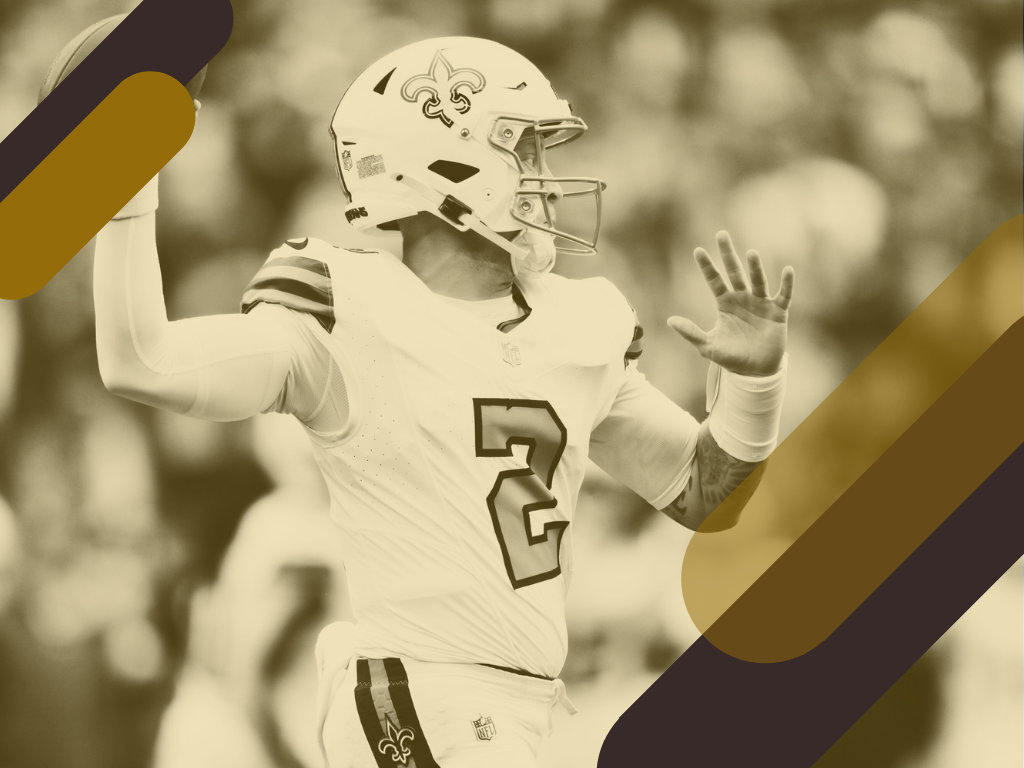
In Week 5, the New Orleans Saints earned their first win of the season against the New York Giants in a turnover-filled game that featured five New York giveaways. It marked the first career win for Saints starter Spencer Rattler, and the franchise’s first win led by a quarterback that they drafted in 27 years.
That’s very unusual. Most teams invest early draft capital in quarterbacks. But the Saints always approached it differently, prioritizing other positions and coveting system fit with veterans at the league’s most important position. Their unwillingness to invest in the position in the post-Drew Brees years explains the lack of success that they’ve experienced since he retired. It makes us wonder if a team can ever truly be successful without a proper quarterback development strategy.
A History of Acquisition
The top five passing leaders for NFL franchises is usually filled with players that were drafted by the team. Even a team like the Chicago Bears that has been considered a wasteland for quarterbacks features four of their draft picks at the top of their career passing leaders.
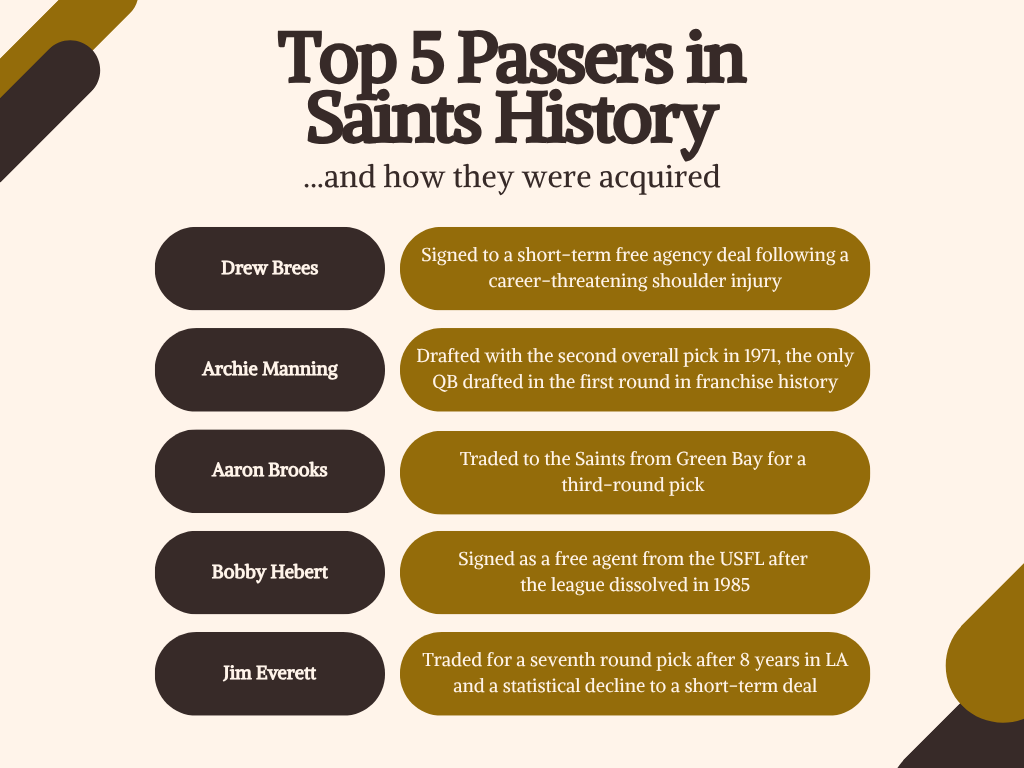
With the Saints, they have one such player: Archie Manning. Drew Brees was acquired as a free agent after being cut by the Chargers following a serious shoulder injury. Aaron Brooks was a fourth-round draft pick by the Packers who was traded to New Orleans. Bobby Hebert was signed as a free agent by the team after the USFL—where Hebert starred for the Michigan Panthers—folded. And Jim Everett was acquired in a trade from the Rams in exchange for a seventh-round pick. Even before Brees, it was not typically the Saints’ way to draft quarterbacks highly.
Those moves typically involved low-risk maneuvers by the franchise, addressing a need without compromising too many resources. Brees was signed on a short-term deal to prove that he was capable of rehabbing his injury and competing as a starter. Brooks was acquired as a backup to starter Jeff Blake (another veteran acquisition by the team) and was thrust into action after Blake suffered a broken foot. Hebert as a signing from the USFL was as low risk as it gets and Everett was another short-term deal on a value contract with minimal draft compensation needed to finalize the trade.
After Drew Brees retired in 2020 after a legendary revitalization in New Orleans, the Saints continued to rely on veterans instead of developing young quarterback talent. Since 2021 they have started the following players:
- Jameis Winston
- Trevor Siemian
- Andy Dalton
- Derek Carr
- Ian Book
- Jake Haener
- Spencer Rattler
With Winston, Carr, and Dalton specifically the Saints went back to the well of rehabilitating what were considered distressed assets and stringing together wins if the reclamation works. But it hasn’t gone according to plan, with the team missing the playoffs four years in a row and heading towards a fifth consecutive season out of the playoff picture. In the last four years, the Saints have gone 30-38—not good enough to make the playoffs but also not bad enough to get high enough draft picks to find a difference maker at QB.
The logic for many will be that they struck gold with the Drew Brees signing and that this success now dictates their methodology. The problem is that in the history of the franchise it hasn’t worked. Currently the Saints rank 23rd in the NFL all-time in winning percentage at 46.5%. If you took away the Drew Brees seasons, they would be at 40.6%—which would rank last.
It is undeniable that in today’s landscape that having an elite player at the quarterback is essential. The Saints success with Brees proved this, and their subsequent failures have reinforced it. It seems that the team may be coming around to this realization as they made Tyler Shough their highest drafted quarterback since Archie Manning in 1971. But if they think that another stopgap solution would lead to sustained success, then they are not paying attention to the trends of the modern NFL.
The Importance of the Position
There have been 40 players that have attempted at least 30 passes through five weeks this season. 31 of those players were selected in the first round of the NFL Draft. Of the nine that weren’t, only four—Dak Prescott, Geno Smith, Jalen Hurts, and Brock Purdy—are considered to be the answer at the position for their respective teams. Getting that position right has never been more crucial, and it can be argued that it is the most important to get right in all of sports.
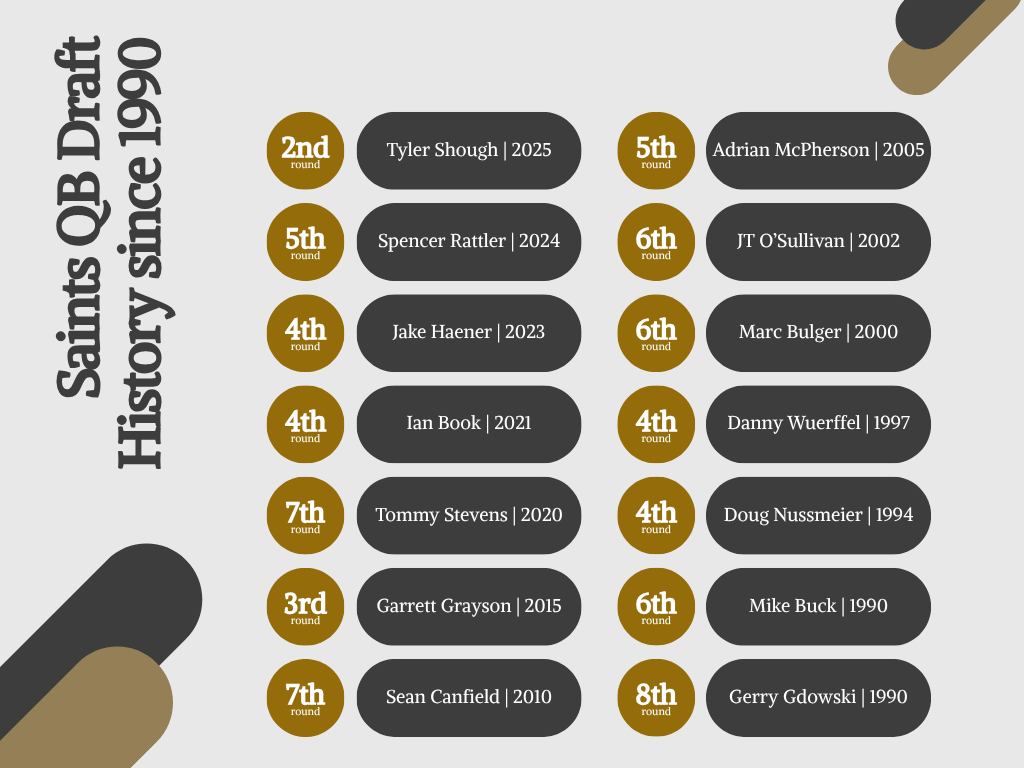
And to get it right, there has to be a significant investment in resources—whether through draft position or free agency. The Saints didn’t make that investment for Brees’ successor as it became clear in his final seasons that his arm strength was eroding. They didn’t invest in the position in the draft substantially in the last five drafts. And that is why they stand at 1-4 with a decent roster but not a lot of wins.
By being mired in the mediocrity loop that they have been in the last five seasons, they have missed out on opportunities to draft quarterbacks, and their salary cap situation prevented them from going after free agents. It is a perpetual state of being stuck for a fan base that grew accustomed to over a decade of competitive quarterback play.
This past draft, they could have had Jaxson Dart before the Giants traded back into the first round to get him. We don’t know how Dart’s career will unfold in New York, but he appears to have a higher ceiling than Shough, who was an older prospect at 26 years old and could not beat out Spencer Rattler for the starting job. It is once again an example of the Saints not prioritizing the most important position in the game.
From 1990-2024 the team never selected a quarterback higher than the third round. As the team heads towards another middling season and the Buccaneers seemed poised to win another division title, the outlook at the position seems bleak. The upcoming quarterback class was supposed to be worthwhile with players like Garrett Nussmeier, LaNorris Sellers, Cade Klubnik, and Arch Manning coming into the league. All of those players have disappointed so far this campaign, leading many scouts to believe that this year’s QB class may be weaker than expected.
Outlook and Options
Where does that leave New Orleans? If college prospects aren’t the answer, then they will continue to rely on Spencer Rattler or even give Tyler Shough a chance. The only other option is to go into free agency and lure someone like Mac Jones away from a backup role. Both options don’t seem appealing, especially in a division where Baker Mayfield is an MVP candidate, Michael Penix Jr. has shown flashes, and even Bryce Young has given Panther fans hope.
The Saints are something of a cautionary tale in today’s NFL. They are the consequences of not getting the position right and ignoring continuous investment in the quarterback position. A reminder that even when you have the right guy in place, it is crucial to continue developing and scouting a backup and succession plan. A team finding success in this way in the 2025 version of the NFL is simply untenable, and the Saints will continue to struggle until they prioritize the position the way other teams have.
Thanks for reading Deep Cover! This post is public so feel free to share it.