
The Penn State Illusion of Elite Status
The numbers say good but not great, and that gap defines the Nittany Lions


When I lived in Jordan, I became familiar with the Jordan Pro League—the country’s topflight soccer league. While I lived there, the league was dominated by two clubs: Al-Wehdat and Al-Faisaly. They dominated the league, winning 20 of the last 25 league cups. The fight for third place was always intriguing, but it was clear that those clubs weren’t on the same level as the top two.
I was reminded of the Jordanian league as I watched Penn State drifting from national championship contender to an afterthought in the discussion about the College Football Playoff in Weeks 5 & 6. This was supposed to be the year that the Nittany Lions figured it out, to make a run for a title behind their quarterback who was destined to be a first-round draft pick in the NFL.
Then they lost in double overtime to Oregon at home and followed that up by losing to a winless UCLA team fresh off a coaching change. The two games highlighted the glaring weaknesses of embattled head coach James Franklin: his inability to win a big game and his breakdown of leadership that led to such a massive letdown in Pasadena against UCLA. These critiques assume that Penn State is a perennial national title contender. But are they simply just a good football program masquerading as a great one?
Good But Not Great
An elite program often shows itself as such in the way it fares in its conference. Especially in the College Football Playoff era, the easiest way for schools to compete for a title is to win their conference. Penn State joined the Big Ten in 1993 after over a century as an Independent. Since it joined the conference, they have only had five losing seasons. But they have also won the conference just four times.
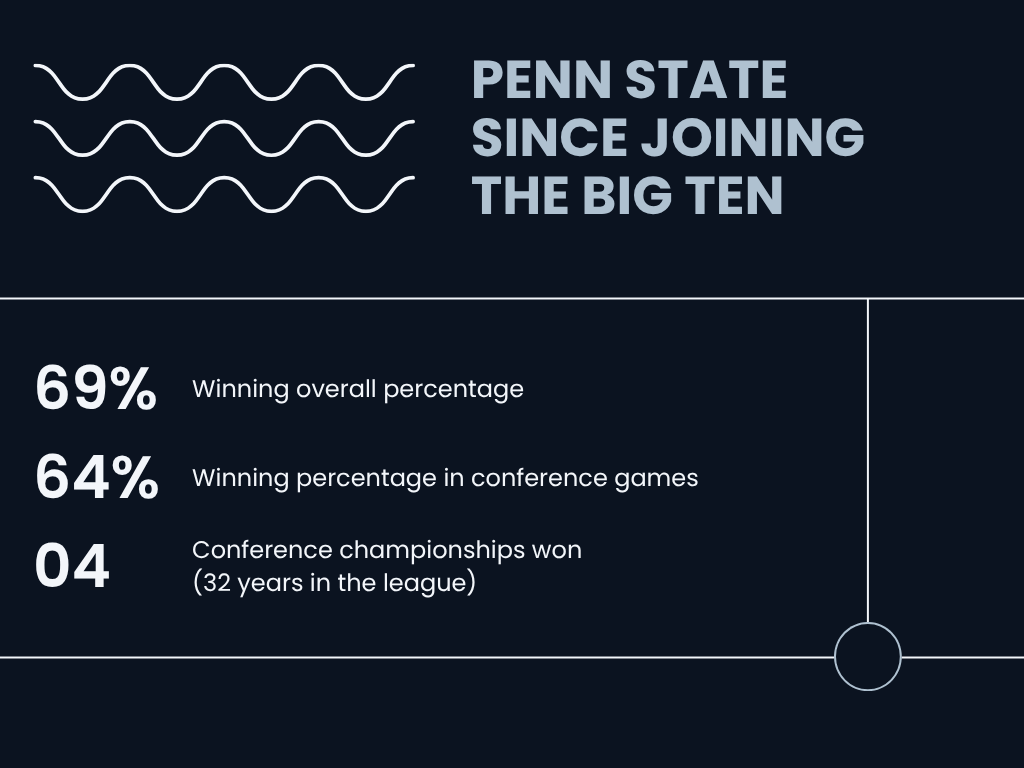
In that same span of time, here are the conference championship totals for other Big Ten schools:
- Ohio State: 14
- Michigan: 9
- Wisconsin: 6
- Iowa: 4
- Michigan State: 3
- Northwestern: 3
Penn State is often considered in the same class as Michigan, Ohio State, and (as of two years ago) Oregon. But the reality may be that they are simply more in line with schools like Iowa, Wisconsin, and Michigan State. There is a clear gap between the two classes of teams. One is constantly winning conference titles and, in a position, to compete for national titles, while the other is a consistent team that wins some games but rarely reaches the mountaintop.
Penn State’s last national championship was in 1986, in a college football landscape that is galaxies away from what the sport has become today.
Penn State’s predicament is reminiscent of Texas. Both teams have storied histories, with long rosters of NFL talent that came through the campuses. Both have done a fair share of winning, but it has resulted in limited national and conference success. Both have won four conference championships since the 90s. And yet questions linger about when these teams will break through. Because with a name brand, a prolonged lack of success creates an expectation of more both within a fan base and nationally.
But why is it that we view Penn State as some sort of national power when it has been nearly 40 years since they won a title and they have yet to give us a reason to believe that that will change. There are a few factors: tradition, a history of competence, and the benefits of a nationally relevant program in a starved geographic area.
The Penn State Illusion
Penn State is the tenth oldest Power Four football program; they are steeped in a deep history of players and coaches that have helped to define college football. They have the seventh most wins in the history of college football and rank 16th in winning percentage. Their prominence was undoubtedly during the height of the Joe Paterno era in the 1980s during the rise of college football’s TV era.
It is also important to note that Penn State benefitted by having little in the way of regional competition during that era. The northeast—especially in the 80s—was defined by its basketball teams. Villanova, Georgetown, and St. John’s were household names in March but did not have viable football programs. The biggest competition for eyeballs in the region for Penn State at the time was Boston College, Pittsburgh, and Syracuse. These limited options allowed Penn State to gain traction as a national brand, particularly when they were winning national championships 40 years ago.
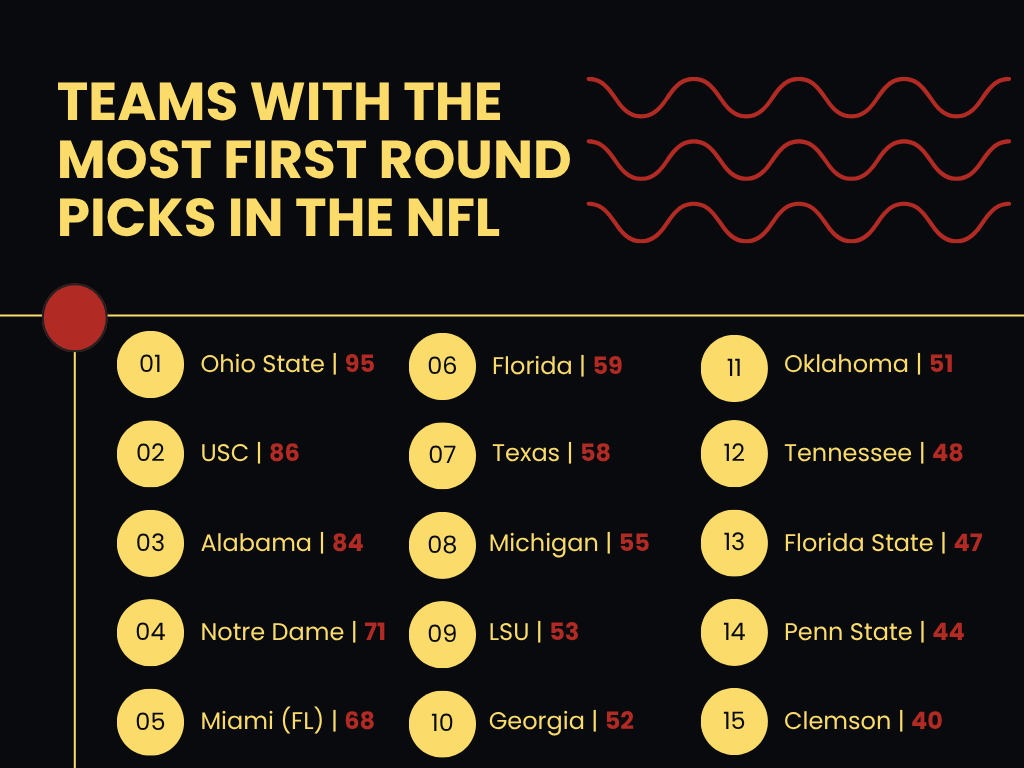
Penn State also became well known for producing NFL talent. They have had 44 players drafted in the first round of the NFL Draft—which is fourteenth best all-time. Some notable Penn State alumni include LaVar Arrington, Saquon Barkley, Micah Parsons, and Franco Harris. In fact, Penn State earned the moniker of “Linebacker U” for producing so many stars at the position over the years—a tradition that has continued with the likes of Micah Parsons and first-rounder Abdul Carter (who was drafted by the Giants this year).
All of that history tells a story that this is an elite program that has consistently been on the national stage. We think of them as a program that is always in the mix and that belongs in the conversation. But the final years of Joe Paterno were mired in disturbing scandal and mediocrity on the football field. From 2000-2011 they only made two major bowl appearances (2005 Orange Bowl and 2008 Rose Bowl), never truly contending for a national title.
The current regime with James Franklin has been defined by a team that wins a lot of games but loses when it matters versus the best opponents. Franklin is 4-21 against teams ranked in the top ten in his career as Nittany Lions head coach. Many of these have come against Ohio State and Michigan, which is somewhat expected considering that it is understood that those two programs are a level above Penn State.
Within the conference, Penn State has been miles behind Michigan and Ohio State—combining to go 23-43 against them. They have feasted on the lower-tier programs of the conference, going a combined 112-18-1 against Rutgers, Illinois, Indiana, Northwestern, and Purdue. The most back and forth they’ve experienced are against teams like Michigan State, Wisconsin, and Iowa—reaffirming their status as a consistently good program.
The immediate reaction by Penn State fans has been to fire Franklin because they expect more from this program. The problem with that sentiment is that they have no reason to expect more. This is a team that is good, but not great. The last time they were truly great, many current fans weren’t yet born. The true dilemma of Penn State lies in the overinflated expectations that we have for the program. The past two weeks clarified the truth that has long been evident: this is a good program, not a national title contender.
Thanks for reading Deep Cover! This post is public so feel free to share it.