
The Striking Similarities Between Arena Football and Basketball
Scoring, individual matchups, and the speed that make two sports that seem very different at first glance very similar to one another


The first time I attended an arena football game in person I didn’t know what to expect. I knew that the rules were slightly different and that the field was drastically smaller than outdoor football, but that was the extent of my knowledge on the subject. As the game unfolded, I realized that the pacing and flow of the game was faster, and at times a bit more chaotic.
Where outdoor football has a methodical structure that at times feels like a symphony orchestra, arena football felt more frenetic like a freestyle rapper or a jazz musician. In a weird way it felt more like basketball. I have thought about this casual association since then and it comes to mind whenever I watch an Arena Football One (AF1) game. This is a sport that is more like the one played on the hardwood, and with that understanding it can be more deeply appreciated.
The Art of the Rebound

Rebounding is a fundamental skill in basketball. Players like Dennis Rodman and Moses Malone made their careers off it. It's crucial in basketball from the perspective of enhancing a team’s opportunities to score and conversely taking that same opportunity away from the opponent.
Offensive rebounding in basketball allows a team to have a second chance at getting points from a possession. It maximizes their opportunity in a sport that values point accumulation. Defensive rebounding has the opposite effect, where it takes away that chance for an opponent to maximize their scoring potential. The incorporation of the net on either side of the goal posts in the arena game has a similar effect.
Unlike outdoor football, the arena game makes netting a playable part of the game. This makes an extra point or field goal attempt filled with possibilities. In basketball terms, it is a large backboard. Teams can utilize the net to get creative on an offensive play or as a chance to get points when a kick is missed, as a ball coming off the net is a live ball.
Conversely, defenders are also able to take points away when a ball off the net is in play, which is akin to the defensive rebound. Like in basketball, making a play on the ball coming off the net requires ball skills, awareness, positioning, and anticipation. They are similar skill sets that help to either maximize or neutralize point scoring depending on if your team is playing offense or defense.
Pace & Space
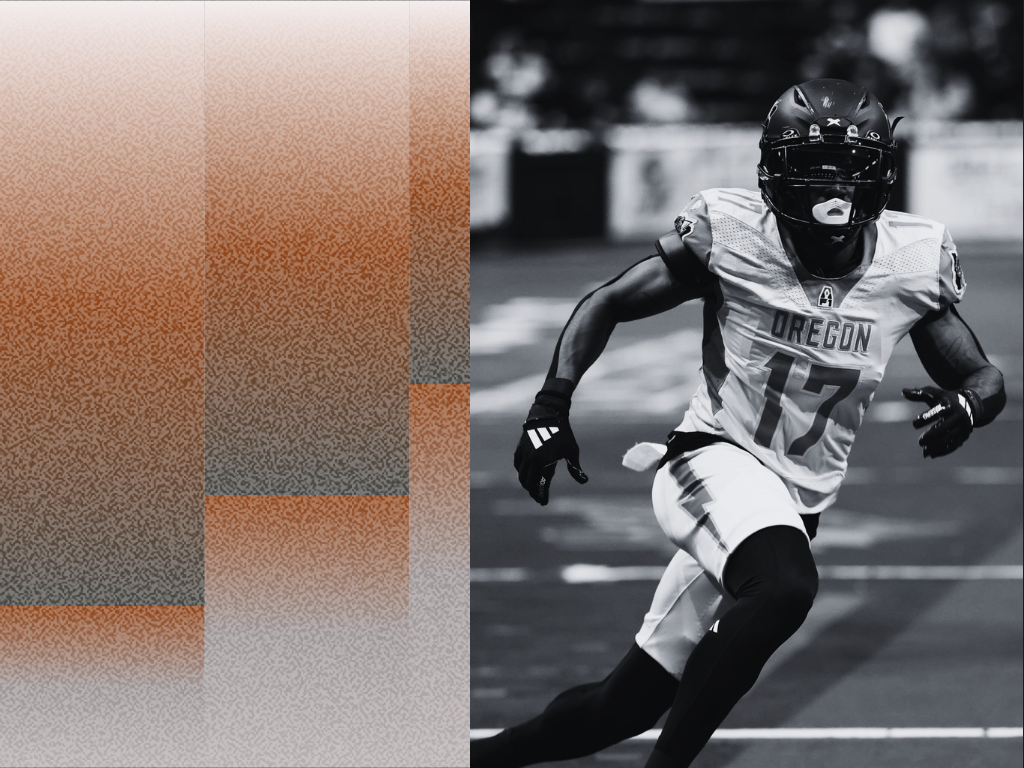
In the NFL, about 61% of plays are passing plays. This is a recent development, as for many years the run pass ratio was closer to 50/50. This year in AF1, 71.6% of the plays through Week 3 have been pass plays. But a deeper look at the running plays helps us realize that that number should be higher. 46% of running plays in AF1 this year have been executed by quarterbacks. This means that only about 15% of plays this season have been designed runs to the fullback.
The name of the game in AF1 is scoring quickly, and the best way to do that is chunk plays through the air. The higher volume receivers in the league (10+ receptions or more this season) have been averaging 12.76 yards per reception, covering 25.5% of the distance to a touchdown on every catch. This means that the probability of scoring quickly is elevated with a more competent passing game.
This probability calculation is not dissimilar from the rise of the three-point shot in basketball. Considering that there is a finite number of possessions, it is imperative that teams focus on their maximum number of points per possession. In basketball this means shooting a lot of threes and taking easy chances at the rim. In the arena game, that translates to taking shots down the field for instant points or leveraging medium length route patterns to amass chunks of yardage to minimize the number of plays needed to score points.
In outdoor football, mediocre offenses can win games due to the attrition that comes with the sport. In the arena game, those teams are incapable of winning games. Consider that the two teams that score the least (Salina 24.5 points per game, Nashville 30 points per game) have yet to win a game and the teams that are undefeated (Albany, Corpus Christi, and Billings) all average over 45 points per game.
This is incredibly like offensive performance in the NBA, where the teams that rank in the top 5 in offensive rating (Cleveland, Boston, Oklahoma City, Denver, New York) are all considered title contenders by most observers and fans of the sport. The arena game is similar, where maximizing possessions with points is the name of the game.
But What About Defense?

In the NFL, roughly 60% of defensive schemes feature zone coverage. This is not the case in the arena game. In outdoor football this makes sense as zones enable adaptability to cover the entire width of the field. Zone in essence covers up the potential breakdowns that can happen with man-to-man coverage.
The arena game, on the other hand, is operating with a much smaller playing area making zone defense a bit of a liability. This requires man-to-man to be the primary defense for defensive backs. Man-to-man creates moments where wide receivers need to win in isolated scenarios, which again sounds like the dynamics of defense in basketball.
In the NBA, zone defense is deployed only 2-4% of the time. In basketball it doesn’t make sense to do this with the increase in quick passes and shooting efficiency that modern offenses deploy. The solution is to be able to have defenders that have length and that can make instinctive plays at the point of attack.
In arena football, this is also the approach. Defenders need to win at the first move and deny air space from receivers running their routes. When this goes wrong, we see busted coverages that lead to big plays. But at the same time, we have often seen great one on one battles this season that have led to game tilting plays, much as a steal into a fast break would in basketball.
This season, 5% of passes in AF1 have been intercepted, which is double the average interception rate in the NFL. This trend translates to more big plays, more opportunity for defenders to make an impact, and overall increase the excitement of a game. This is more in line with the NBA, where teams average 8 steals per game and have between 80-100 defensive possessions per game. In short, more big plays which lead to more points.
The Arena Experience

In comparison to the size of an arena football field, the dimensions of outdoor football are mammoth. An NFL field is seven times as long and nearly twice as wide. The playing size in arena football is much more in line with basketball which has an area of 4,700 feet compared to the 4,250 feet of the arena game. The NFL, on the other hand, has a playing area of 57,600 feet. This means that space comes at a premium in both basketball and the arena game.
The playing field dynamics also share similarities. In the arena game, coaches are often on the field behind the play directing traffic and communicating with their players. This is like a basketball coach patrolling the sidelines and barking out plays and instructions as the action is unfolding.
Lastly, the fan experience is also analogous. Basketball fans that sit in the first couple of rows are posed with the possibility of a player jumping into the stands or a loose ball flying into their laps. The same risks exist in the arena game where balls often fly into the stands and players go over the side walls. It makes the fans more connected to the action, in a way that outdoor football does not offer.
The beauty of basketball is that it is a game that enables the artistry of amazing athletes. It is not as much about the scheme, but rather a celebration of their ability to make plays and accomplish the incredible. By design, the arena game is similar. Receivers routinely show tremendous route running and high pointing ability, quarterbacks often can fit throws into tight windows, and defensive players can show their tremendous ball skills and closing speed.
In many ways AF1 and the arena game is basketball on turf. It is fast paced, filled with action, and features a lot of scoring. While it may seem like a stretch of a comparison at first, it makes sense to me as someone who loved basketball before he loved football. This realization helps us to realize the potential of this sport and this league, where highlight plays are waiting to happen, and the action is relentless.