
Victor Wembanyama & Challenging the Familiarity Tax
The Spurs superstar has captured the NBA zeitgeist, but history indicates that fascination fades quickly—will he be the exception?

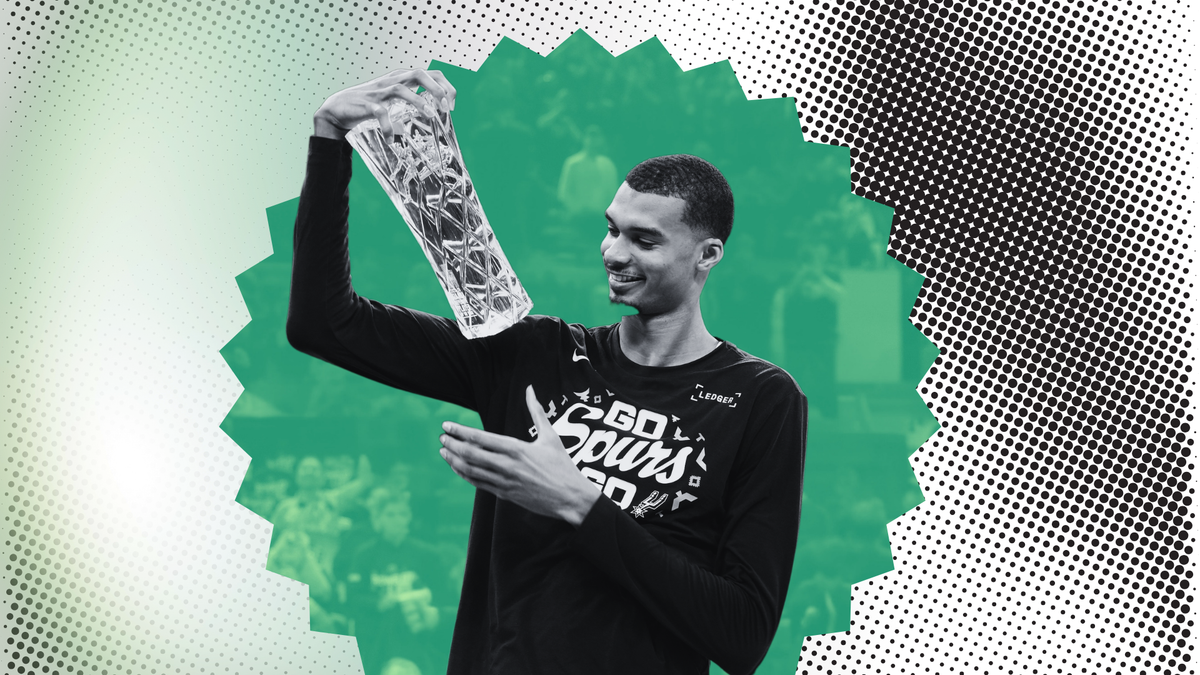
When Victor Wembanyama was named the 2025-26 NBA Defensive Player of the Year, it was the least surprising NBA award decision in decades. Wembanyama was the anchor of the Spurs defense, a one-man defensive scheme, and he became the first-ever unanimous winner of the DPOY award.
His unanimous selection was impressive considering some of the previous winners: Hakeem Olajuwon, Dennis Rodman, Dikembe Mutombo, and Kawhi Leonard, to name a few. In the wake of the award announcement, there has been a growing sentiment that far extends this season. Given Wembanyama’s age (22) and his defensive profile, there is an assumption that he will win this award, which heavily skews towards shot blockers, every year for the next decade. What this assumption ignores is the very real element of voter fatigue. It forces us to wonder: will a player as unique as Wembanyama be enough to consistently amaze us so that we do not grow bored of his greatness?
It’s safe to say that this year has been one that is characterized by the elevation of Wembanyama and the Spurs into the NBA limelight. The team improved by 28 wins and emerged as a championship contender in Wembanyama’s third season. As he has emerged there have been talking points of the way he has reoriented the way opposing offenses play against the Spurs. He feels inevitable and impossible at the same time. Countless times this season he has gone from covering the rim to contesting a corner three in one stride, a level of floor coverage that we have never seen before.
Wembanyama has amazed, astonished, and left us awestruck. But he is not the first person to amaze us on the basketball court. With every generation, there are players that enter the league that force us to reimagine what is possible. Before Magic Johnson we never thought that a 6’9” player could be an elite point guard. Before Michael Jordan it was considered ridiculous to think that a guard could be the fulcrum of an offense. And before Steph Curry, having a small guard shooting deep threes as a focal offensive point was considered unsustainable. What was once amazing quickly becomes routine.
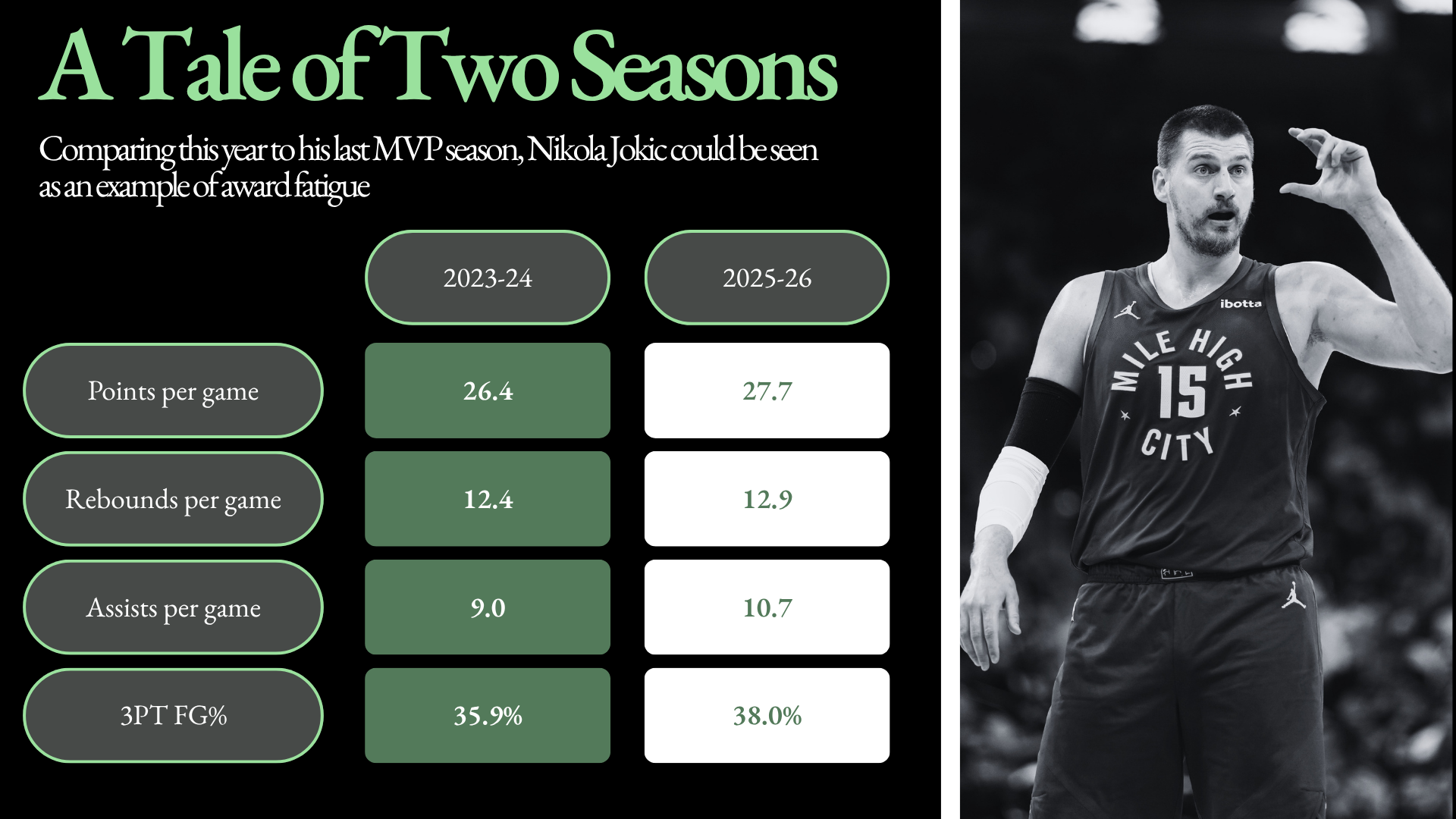
Consider Nikola Jokic as an example of this. Jokic last won MVP in 2023-24. This season, one where he is expected to lose out on the honor to the Thunder’s Shai Gilgeous-Alexander, has been one where he has surpassed that season’s output. Jokic has averaged more points, rebounds, and assists with higher efficiency than his last MVP season. Jokic has established a baseline of greatness that we often take him for granted as a result. We simply expect him to flirt with a triple double every night while shooting efficiently from the field in the process.
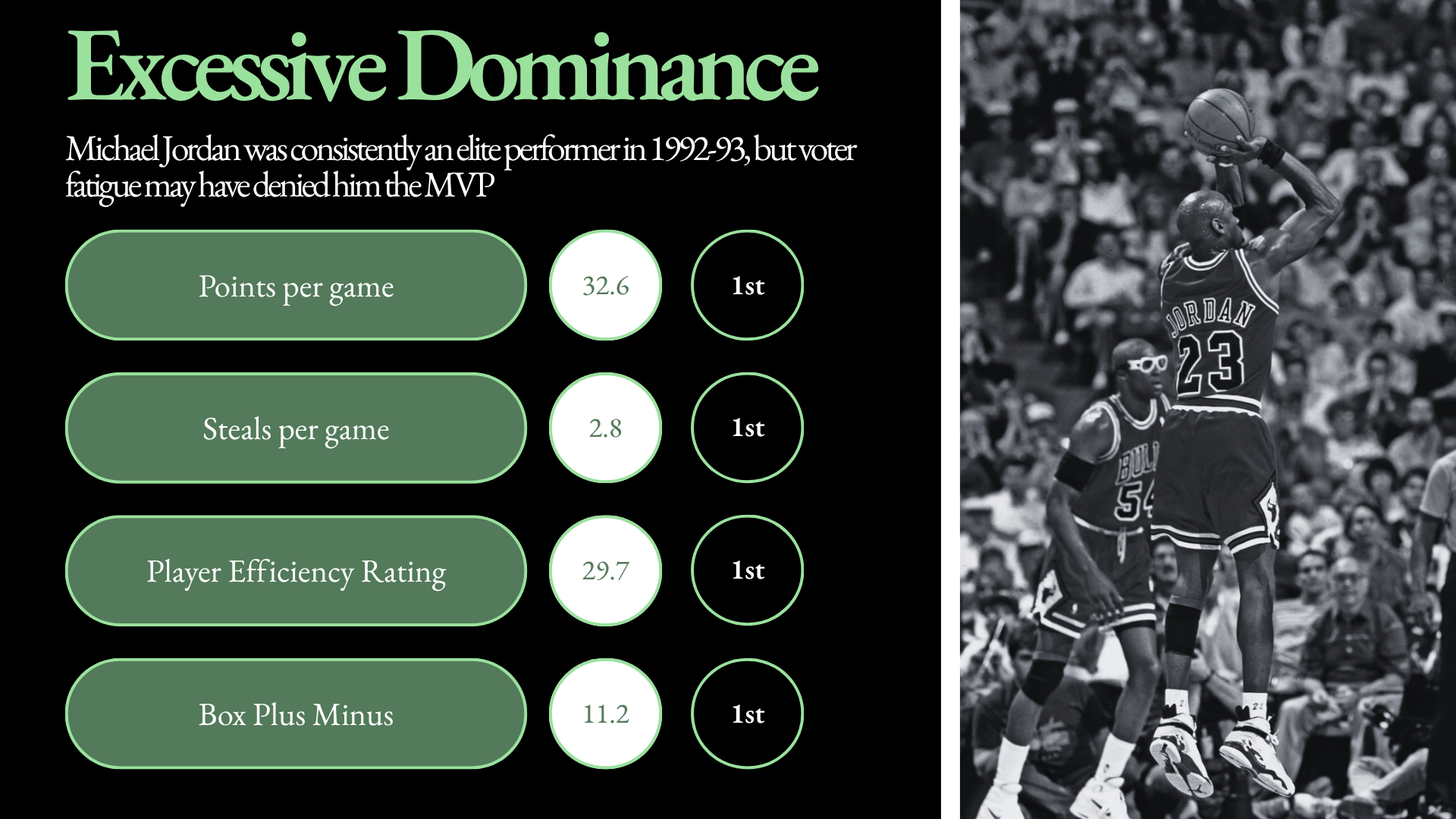
In the 1990s a similar thing happened to Michael Jordan. During the first Bulls threepeat it was widely accepted that Jordan was the best player in the sport, and he won the MVP in the 1990-91 and 1991-92 seasons. In the 92-93 season, however, he placed in third behind Hakeem Olajuwon and Charles Barkley (who won the award). That season, Jordan was a more complete scorer and defensive player, leading the league in both points and steals per game. Barkley had an excellent year on a very good Phoenix team, but Jordan was still the best player in basketball.
The reason for this: voter fatigue. As much as awards voters are reluctant to admit it, there is some storytelling and narrative building when it comes to awards. That ‘93 season for the Phoenix Suns was Barkley’s first with the franchise after eight years in Philadelphia. Up until that season, he had finished in the top six in MVP voting six times—finishing as high as second in the 1989-90 season. There was a sense that he deserved some benefit of the doubt for elevating the Suns from a 53-win team to a 62-win team, even if Jordan was the superior player.
That different spin is a product of greatness becoming ordinary. Most would concede that for the bulk of his career, LeBron James was the best player in basketball. He won four MVPs in five years, and after that finished in the top four in five straight seasons. He was still widely considered the best player on the planet, but the idea of his greatness had grown stale, human nature kicked in and awards voters wanted the next big thing. There was a real argument to be made that LeBron was superior to the winner of each of those seasons, but the fatigue caused by his greatness caused others to win the award. If that happened to one of the best players to ever pick up a basketball, it stands to reason that it will happen to everyone. Wembanyama presents the counter to that logic.
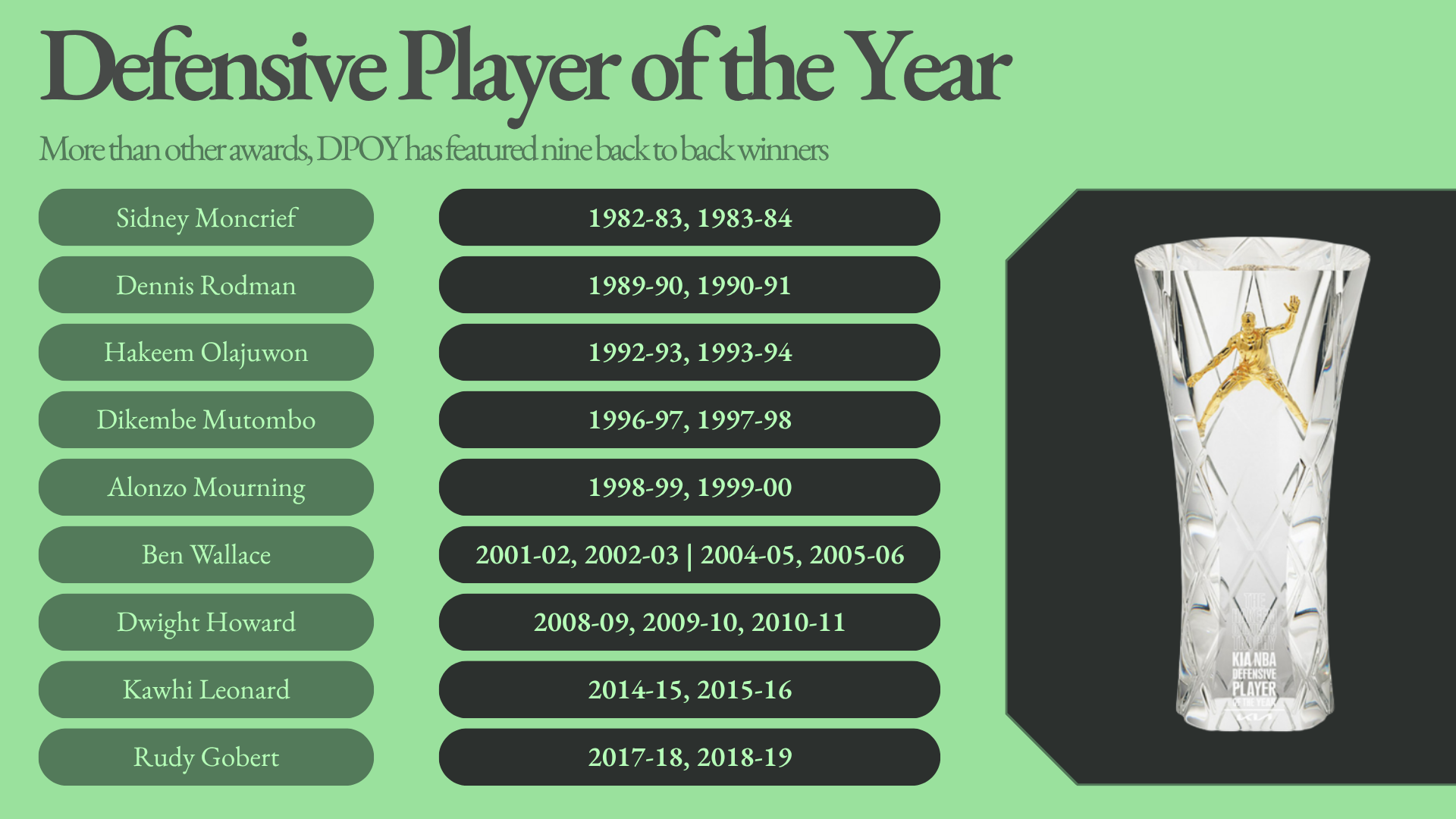
The same pattern shows up even in an award that’s historically been kinder to repeat winners: Defensive Player of the Year. The award has had back-to-back winner ten times, with the most recent example being Rudy Gobert in 2018 and 2019. But even this award is not immune to voter fatigue. Gobert in particular is an example of this, as his four DPOY awards are often scrutinized, partially because of an exhaustion with his name always being in the mix for the award.
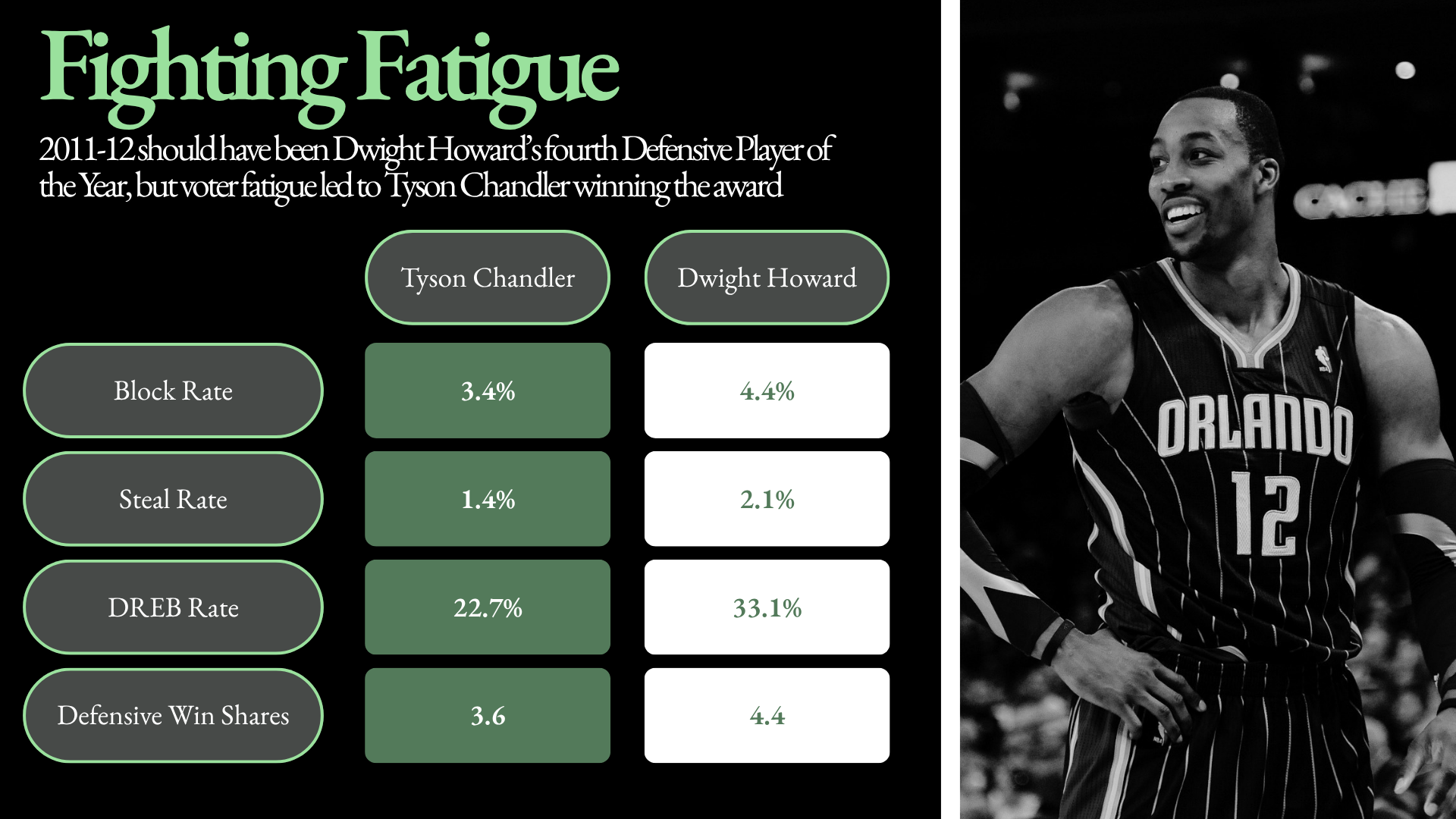
Dwight Howard won the award three consecutive seasons from 2009 through 2011. He came in third in 2012 to Tyson Chandler. That 2012 season, Howard had a better block rate, steal rate, defensive rebounding rate, and defensive win shares than Chandler. But there was a hesitation about giving him the award for a fourth straight season. Victor Wembanyama will be susceptible to this reality if history is to be believed.
Wembanyama presents a defensive archetype that we have not seen in the NBA in the past. Typically, centers that are elite rim protectors like Howard, Gobert, and Mutombo, are sole protectors of the rim, often lacking the lateral quickness to cover players on the perimeter. Wembanyama offers us a player with guard skills on both ends of the floor, which means that he is unlike any defender that we have ever seen before.
We have already seen the way that teams have shifted their strategy against the Spurs when he is on the floor. Rim attempts are altered by his mere presence, and he is able to close out on corner three attempts thanks to his absurd stride length. We are, however, still very early in the process of his career. And inevitably, what we now see as fantastical will eventually drift into the lane of the expected in his context.
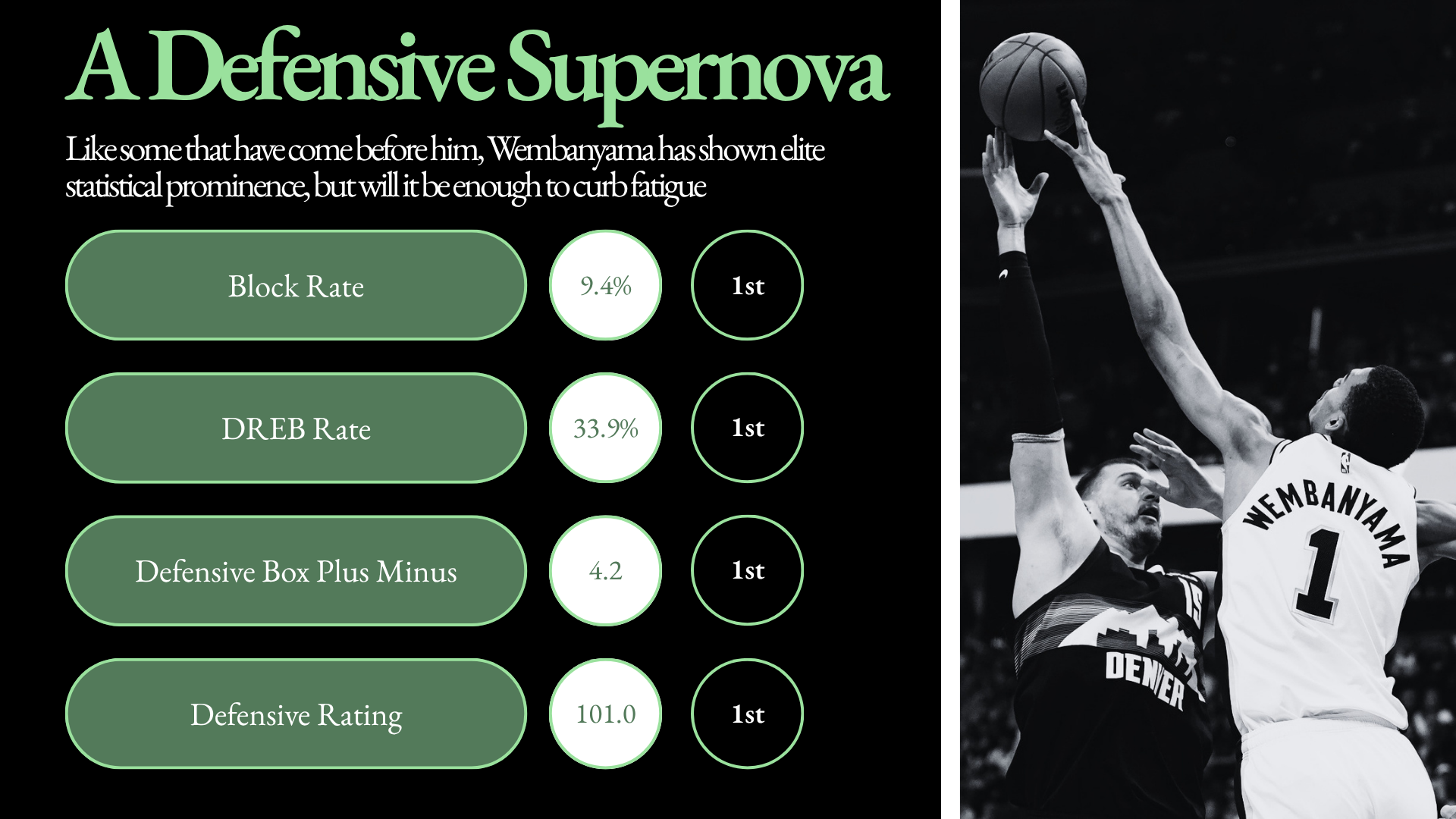
Three key metrics that have a good encapsulation of a player’s defensive impact are block rate, steal rate, and defensive rebounding rate. Wembanyama is in the 100th percentile among bigs in block and defensive rebounding rate, while also being in the 71st percentile of steal rate. He is at the pinnacle of two of the three most important defensive stats and is well above average in the third. Of players that played at least 1,000 minutes this season, Wembanyama is the only player to average above a 1.5% steal rate and over a 3% block rate, an indication of just how special a defensive talent he really is.
The question that arises is if his defensive skills are so extraordinary that we will never get bored of them. It’s an impossible thing to ask of anyone, but it is the fickle nature with the way we view players and seasons on a year-by-year basis. It is inevitable that if Wembanyama were to win the next two Defensive Player of the Year Awards that the following year many voters may think twice about setting the precedent to give it to him again. Not because of what he did or didn’t do on the court, but rather because it became so normal.
In Wembanyama we have a new litmus test for the way we view basketball awards. When the limits of human biology are extended in the way they are for him, is that enough to prevent us from falling into the trap of being bored of excellence? This is the failing of sustained excellence in the NBA. Eventually the consistent greatness is overlooked because we crave the new thing, an insatiable desire for what is next. That is what Wembanyama is up against, and the way we react to his sustained excellence will be incredibly telling of the limits of our appreciation of greatness.
Thanks for reading Deep Cover! This post is public so feel free to share it.