
Why NFL Coaches Still Get Conservative When It Matters Most
The cost of playing it safe when the game is on the line

Every major sport has seen its version of analytics over the last couple of decades. In the NBA, it was the three-point shot. In baseball, it was prioritizing power and accepting more strikeouts. In the NFL, it has meant being more aggressive on fourth downs. That trend in the NFL should yield a more exciting product. After all, more teams going for it on fourth down rather than playing the field position battle is more exciting.
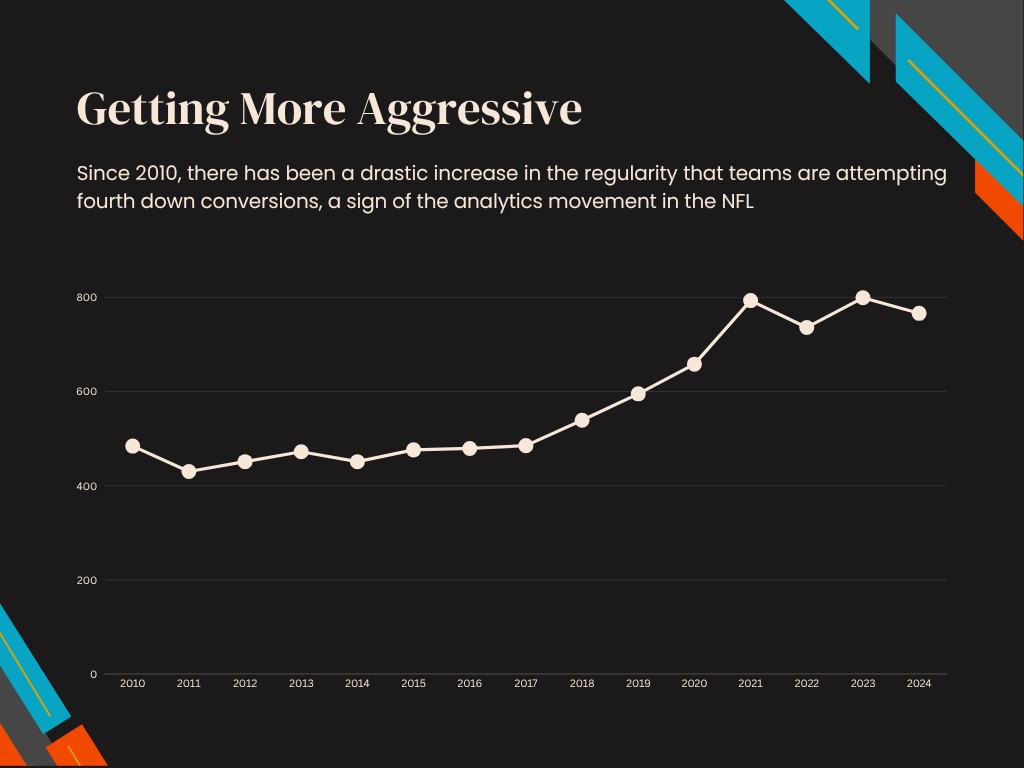
In 2005, there were 465 fourth down conversion attempts in the NFL. Last season, that number ballooned to 766 attempts. In 2005, the Titans were by far the most active fourth down team with 31 attempts. Last season, that total would have tied the Miami Dolphins for eighth in the league. This year, through just four games the Carolina Panthers have already attempted 11 fourth-down conversions.
This stat should tell us that teams are being more aggressive in their play calling. That they are willing to sacrifice the tenets of conventional wisdom to sustain drives and maximize their outcomes. And yet, all too often, that seems to not be the case in late game situations. Because the margins of victory are so thin in the NFL, conservative decisions seem to be the preferred choice of NFL coaches even in an analytically driven era.
Settling for a Bad Situation
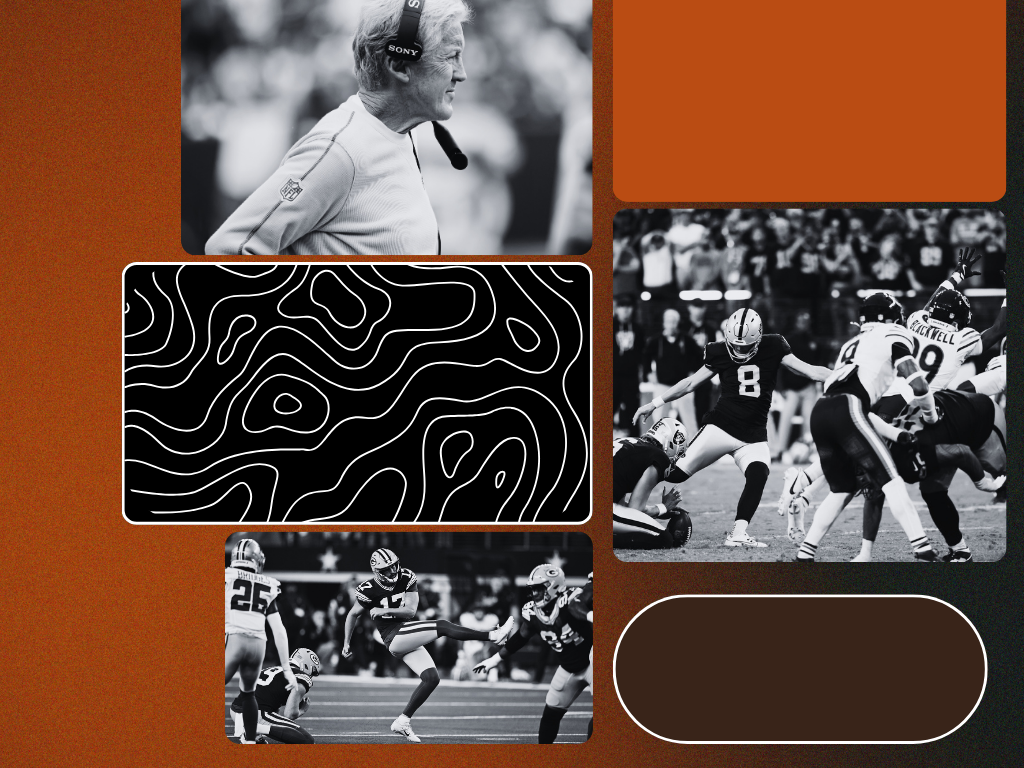
I was reminded of this conservatism during the Raiders’ final drive against the Bears in Week 4. The Raiders were receiving a kickoff with 1:34 left in the fourth, and were down by one point. They simply needed to get into field goal range for a chance to win it. They start at their own 42-yard line after a good kick return.
Then despite a poor showing from quarterback Geno Smith during this game, they move the ball efficiently. They call three consecutive short passes that are completed, and the receivers are able to get out of bounds. They move 20 yards down the field quickly employing this strategy with a timeout in their back pocket in case a player is tackled in bounds. Then they move away from those play calls for two relatively unsuccessful Ashton Jeanty runs that net three yards to set up a 54-yard field goal for Daniel Carlson. That kick is eventually blocked by Chicago, and the Raiders lose the game.
Yet they had 48 seconds on the clock and still had their timeout when they got conservative. Carlson is an accurate long-range kicker, but once kicks go beyond 50 yards, probabilities start to drop. Smith and the offense could have likely gained another 10-15 yards while further depleting the clock. 15 yards would have set up Carlson for a 39-yard attempt. In his career Carlson has made 72% of his kicks from 50 yards or more. But from 30-39 yards he has an accuracy of 95%. Even in the 40–49-yard range he has a slightly improved accuracy of 78%.
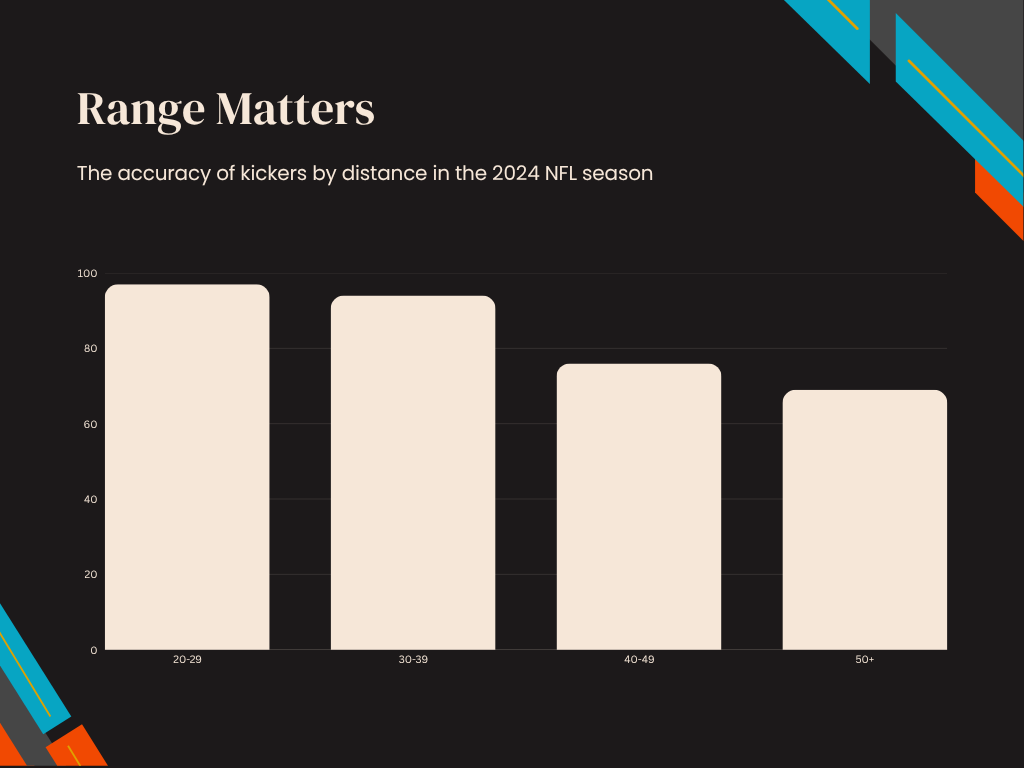
What is vexing about the decision of Pete Carroll and his coaching staff is that they had three consecutive plays where they were incredibly efficient with the clock and then just stopped because they had reached the outer limits of Carlson’s range. Two more completions would have increased the probability of success for a more routine kick that may not have been blocked.
The irony of the situation is that football coaches often preach aggression and playing until the whistle. And yet in deciding moments, they default to what the fundamentals of the game are supposed to be and ignore what is working and overlook the risk-reward analysis that could lead to a better outcome. This tendency speaks to what is deemed smart football tactics and how the pressure to win is so great that coaches will often overthink what should be done.
The Pressure to Win
For years, announcers and analysts would always bemoan offensive aggression in football—prioritizing taking the points and doing just enough to win. It’s a pedestrian approach, and there is a reason for that.
Unlike in other sports, the NFL has a very limited number of games that they play in a season. Every game means a little bit more, and there is an added sense of urgency to win at all costs. A team in the NBA can have a 10-game losing streak and still recover from it come playoff time. In the NFL, a five-game losing streak can mean that a season has gone off the rails and it’s time to think about your next job as a head coach.
Tightness that comes with coaching football as a result. Every play, every penalty, and every point is magnified with elevated importance. Coaches internalize certain metrics and, in focusing on first downs and clock management, often overlook what may be working in the pursuit of what they’re supposed to do.
Old conventional wisdom taught Pete Carroll that as soon as you enter your kicker’s range, you set up for the kick because who knows what disaster awaits if you gamble. That logic ignores that the Bears defense was having trouble covering short out routes and that his players were getting out of bounds with ease on three consecutive plays. It also ignores that those pass plays will get your kicker in an increased probability to being able to kick a successful game-winning kick.
The conservatism in late-game situations can often lead to not winning the game. We also saw it during Sunday Night Football in Week 4 in overtime between the Packers and Cowboys. On the final drive, the Packers could either win with a touchdown or settle for a tie with a field goal. On that drive the Packers offense lacked urgency, and it seemed that head coach Matt LaFleur was content leaving with a tie as opposed to playing for a win.
In today’s NFL, more often than not the aggressive teams win. That is true on the field and in the front office. The Rams built a top-level organization by taking big swings on players and sacrificing draft capital to do it. It got them a Super Bowl. The Detroit Lions were the laughingstock of the league until Dan Campbell got there and played with purpose and turned the fortunes of that franchise around. During the Patrick Mahomes era, Chiefs defensive coordinator Steve Spagnuolo relied on blitz-heavy schemes in high leverage moments to force mistakes. Aggression wins in today’s NFL.
Yet coaches like LaFleur and Carroll still tend to fall back on the tendencies of the past. The rules of today favor the bold with offensive biases and the desire to see more exciting offensive football. Teams that play too conservatively often define mediocrity in today’s league. Conventional wisdom simply is not the catch-all that it used to be. In today’s NFL, fortune favors the bold, and the Raiders deserved to lose because they went away from what was working in the moment because that’s what “you’re supposed to do”. The rules of the game have changed, and Carroll should know that better than most.
Thanks for reading Deep Cover! This post is public so feel free to share it.